
An F1 constructors points calculator is useful because team title odds are easy to misread. Fans often focus on the fastest driver, but the constructors championship is not a single-driver contest. It is the combined output of two cars across Grands Prix, sprints, reliability, upgrades and operational execution.
That is why constructors markets can disagree with drivers markets. A team may have the drivers championship favourite but still trail in constructors probability if the second car is not scoring enough. Another team may lack the single fastest driver but have two reliable points scorers, which gives it a higher weekly floor.
This guide explains the calculator logic behind constructors odds. Use it alongside the constructors championship tracker, the constructors odds guide, and the broader F1 points calculator.
Key takeaways
- Constructors points are the sum of both cars, so teammate contribution is central.
- The comeback target should be expressed as average points gained per remaining weekend.
- Sprint weekends increase the remaining points pool and create extra two-car scoring chances.
- Odds should move when reliability, upgrades or second-car performance changes the team floor.
How Constructors Points Work
In the constructors championship, each team receives the points scored by both drivers. If one driver finishes first and the teammate finishes fifth, the team collects both results. If one car retires, the team loses half of its scoring opportunity for that race. That two-car structure is the main difference between constructors and drivers markets.
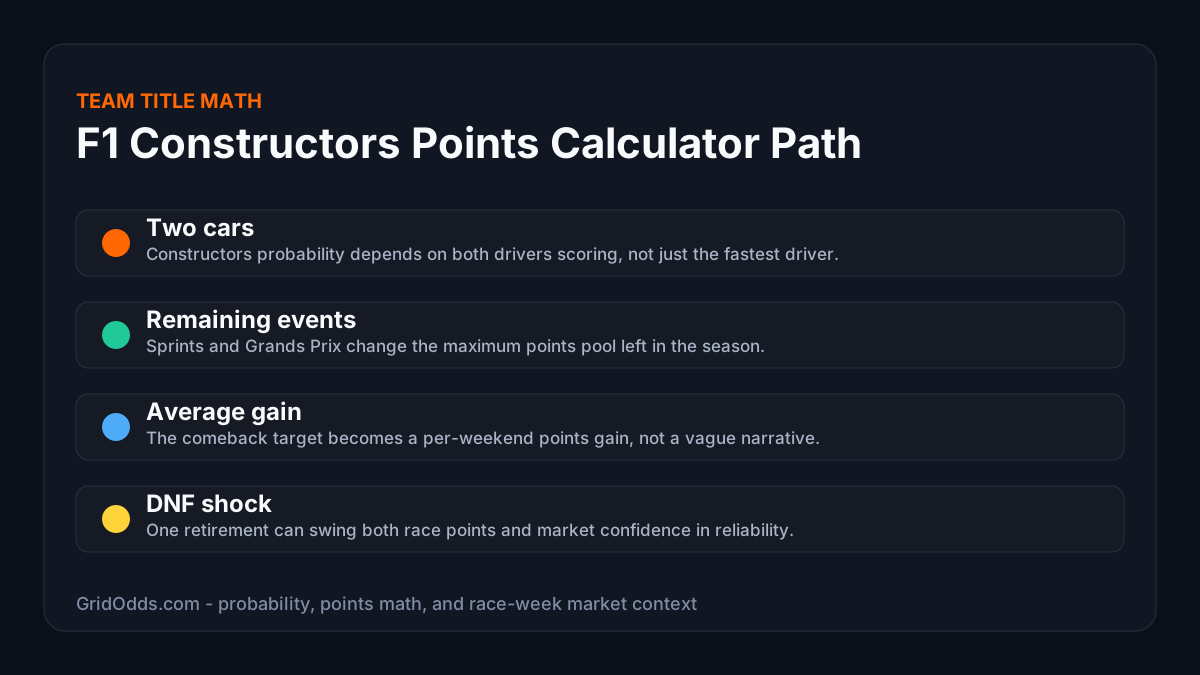
A calculator starts with three inputs: current team points, remaining events and expected points per car. From there, the question becomes simple: how many points does the chasing team need to gain per weekend to catch the leader? Once you see the required average, vague comeback claims become easier to judge.
The Comeback Formula
The basic comeback formula is current gap divided by remaining scoring weekends. If a team is 80 points behind with 20 weekends left, it needs to gain four points per weekend on average. If the same gap exists with five weekends left, it needs sixteen points per weekend. The market should treat those situations very differently.
Sprint weekends change the calculation because they add extra points. They also add more variance because both cars can score or lose points before the Grand Prix. A team with two strong sprint performers can chip away at a gap faster than the Sunday-only math suggests.
Why the Second Car Changes Everything
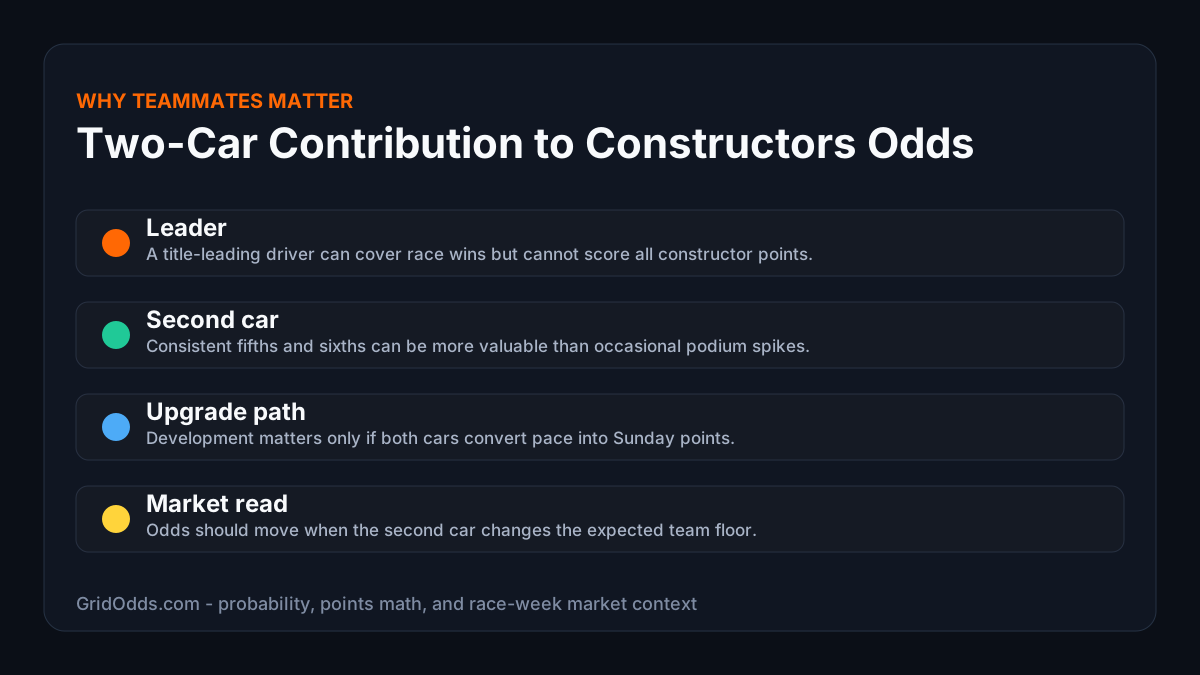
The most common constructors mistake is focusing only on the lead driver. A lead driver can win races, but they cannot score every available point. The second car sets the team floor. A teammate consistently finishing fifth, sixth or seventh may be more valuable to constructors probability than casual fans notice.
This is also where upgrades matter. If an upgrade helps only one driver or works only in a narrow setup window, the constructors market may be cautious. If it raises both cars across different circuit types, the team title probability should respond more strongly.
How to Use Calculator Logic With Odds
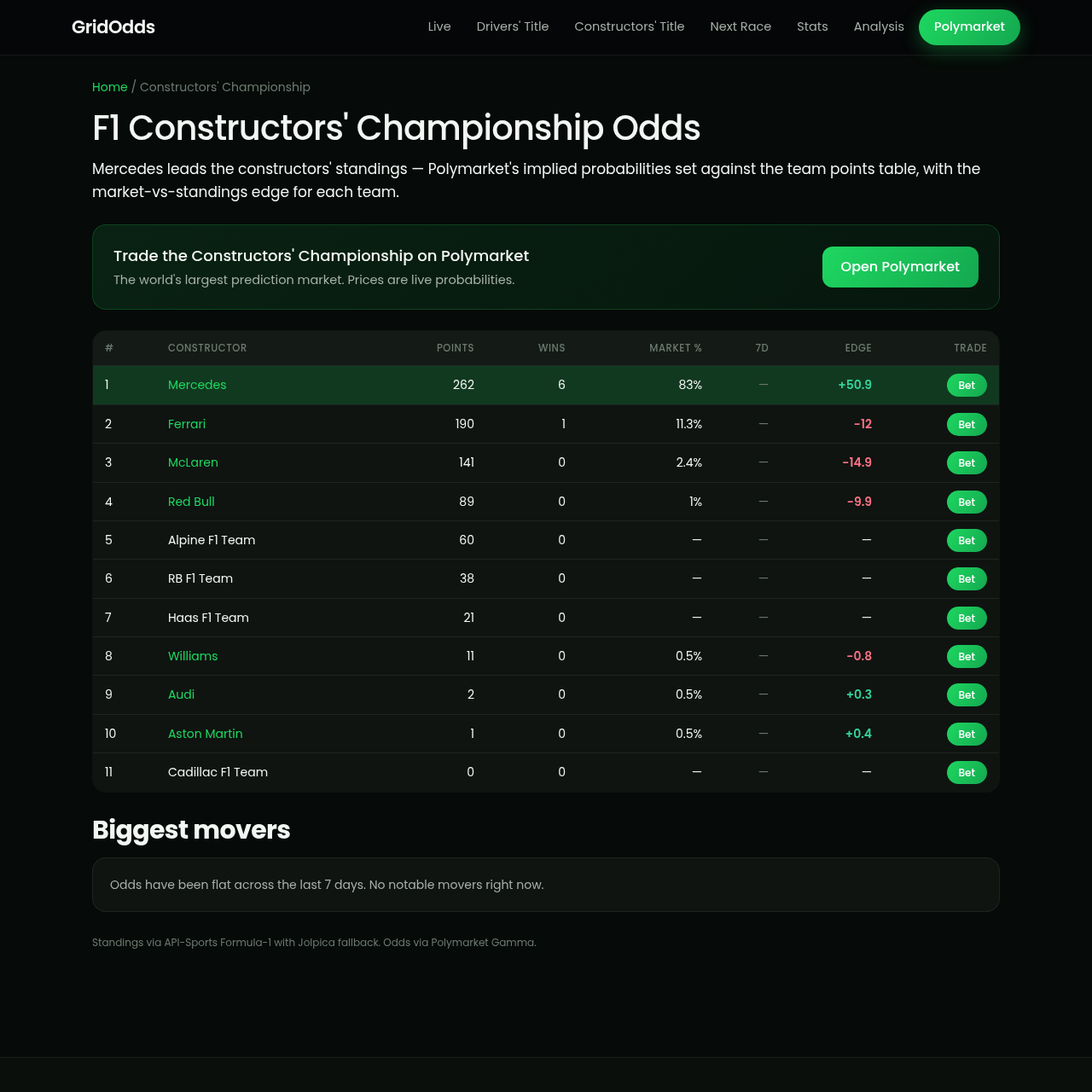
Start with the standings gap, then estimate the remaining points pool. Next, translate the gap into a required average gain. Then compare that required average with recent race results. If a team needs to gain ten points every weekend but has averaged only three, the market needs a strong reason to believe something has changed.
Those reasons can include a major upgrade, a reliability fix, a circuit run that suits the car, or a rival losing performance. Without a reason, a comeback price may be more narrative than probability. The GridOdds stats page helps by showing whether probability has moved gradually or spiked after one event.
Reliability and Operational Risk
Constructors points calculators should include reliability in the interpretation even if the arithmetic is simple. A fast team with repeated DNFs has a lower scoring floor than raw pace suggests. A team with clean execution, strong pit stops and few penalties may outperform the pure speed model over a long season.
Operational risk also includes strategy calls. A team that regularly splits strategies well can protect points with one car while attacking with the other. A team that repeatedly loses positions in the pits or misses safety-car calls has more downside than a points table alone shows.
Where Constructors Markets Can Be Wrong
Constructors markets can be slow to reprice second-car improvement. If a team's weaker car suddenly starts qualifying higher and scoring consistently, the weekly points floor changes. Markets can also overreact to one double podium if the circuit flattered the package. The calculator helps because it asks whether the new scoring rate is enough to change the season path.
Another common misread is ignoring sprint density. If several sprint weekends remain, the comeback path may be more open than a simple race-count model suggests. Conversely, if the remaining calendar has few high-variance races, a large gap may be harder to close than fans expect.
SEO Angle: Why This Page Should Exist
Calculator pages are useful even when the exact long-tail keyword has low reported volume. They satisfy a real need that broad odds pages cannot fully answer. Someone reading constructors odds wants to know whether the price matches the points math. A calculator-style article can answer that without cannibalizing the main constructors odds page.
The best internal linking structure is clear. The live constructors page shows the market. The constructors odds guide explains the market. This calculator page explains the arithmetic. Team prediction articles can link here whenever they discuss comeback paths or second-car scoring.
Bottom Line
Constructors odds are team odds. They depend on two cars, remaining points, sprint opportunities, reliability and development depth. A constructors points calculator makes the market easier to read because it turns title narratives into weekly scoring requirements. If the required gain is realistic, the comeback is live. If it is not, the price needs a very strong explanation.
Inputs a Constructors Calculator Should Use
A serious constructors calculator needs more than the current standings. It needs remaining Grands Prix, remaining sprints, maximum points available, recent points per team, reliability trend and teammate scoring split. The arithmetic is simple, but the interpretation improves when the inputs reflect how F1 teams actually score.
The teammate split is especially important. If one driver accounts for most of a team's points, the team's ceiling may look strong but the floor is fragile. If both drivers score regularly, the team can survive a bad weekend from one car. That is why constructors probability often rewards balance more than headline race wins.
Example: Turning a Gap Into a Weekly Target
Imagine a team trails by 72 points with 12 scoring weekends left. The simple target is six points gained per weekend. That may be realistic if the chasing team has recently been scoring with both cars and the leader has reliability issues. It may be unrealistic if the leader still has the fastest package and both cars regularly finish in the top five.
Now imagine the same 72-point gap with four weekends left. The required gain becomes 18 points per weekend. That requires not only superior pace but also mistakes, DNFs or sprint swings from the leader. The market should price that path much lower unless there is a clear reason the leader's scoring rate is about to collapse.
How Sprint Weekends Change the Team Title Map
Sprint weekends add scoring chances for both cars, which means they can accelerate a comeback or protect a lead. A team with strong short-run pace and two drivers starting near the front can gain points before the Grand Prix. A team with one vulnerable car can lose points before Sunday even begins.
For calculators, this means remaining weekends should not all be treated equally. A sprint weekend has a different points ceiling from a standard weekend. It also has higher damage and setup risk. The better calculator logic separates standard weekends from sprint weekends before estimating the average gain needed.
Common Constructors Odds Mistakes
The first mistake is importing drivers championship logic into constructors markets. The fastest driver matters, but the second car and reliability often decide the team title. The second mistake is ignoring operational performance. Pit stops, strategy and penalties can cost both cars points across the season.
The third mistake is using current points without remaining-points context. A 40-point gap can be small in March and massive late in the season. A calculator prevents that mistake because it always asks how much time is left to repair the gap.
Example: Two Teams With the Same Gap
Consider two teams that both trail by 50 points. Team A has one driver regularly finishing on the podium and a teammate outside the top ten. Team B has both drivers finishing fourth to seventh almost every weekend. The same 50-point gap means different things for each team. Team A has a higher ceiling if the lead driver wins races, but Team B may have the stronger constructors profile because both cars keep scoring.
A calculator should make that visible. The average points target is only the first layer. The second layer is how that average can realistically be achieved. A team that needs both cars to score but only one car is reliable has a fragile comeback path. A team with a lower peak but two steady cars may have a more believable path across a long calendar.
How to Connect Calculator Logic to Live GridOdds Pages
The calculator article should send readers to the live constructors page when they want the current market number. It should send them to the points calculator when they want remaining-points arithmetic. It should send them to team prediction articles when they want qualitative context about upgrades, driver pairing and reliability. Each page has a different job.
That internal-link structure is important for SEO because it shows a complete topic cluster. GridOdds is not publishing one isolated constructors article. It has standings, odds, prediction, calculator and team-context pages that answer related questions without repeating the same article.
What GridOdds Should Track for Team Title Math
The best team-title dashboard should show current gap, remaining maximum points, sprint weekends left, recent two-car scoring average and the required average gain. That turns constructors probability into a readable path instead of a single isolated percentage.
For readers, the practical habit is to translate every constructors headline into weekly points. If a team says upgrades are coming, ask how many points per weekend those upgrades need to create. If the answer is unrealistic, the market may already be pricing more hope than math.
The simplest reader test is this: if you cannot explain the comeback in points per weekend, you do not yet understand the constructors price. GridOdds should make that calculation visible before asking readers to interpret the market percentage. That keeps the page useful during every stage of the season, including sprint-heavy closing stretches, late reliability swings and sudden upgrade gaps. The math stays readable.
Frequently Asked Questions
- How do you calculate F1 constructors points?
Add the points scored by both drivers for each team in every Grand Prix and sprint. Constructors standings are based on total team points, not the highest-scoring driver alone.
- Why do constructors odds differ from drivers odds?
Constructors odds depend on two cars, reliability, upgrade depth and teammate consistency. A team can have the drivers favourite and still be vulnerable if the second car scores poorly.
- Can a team make up a large constructors gap?
Yes, if enough races and sprint points remain, but the required average gain per weekend must be realistic. A calculator turns comeback talk into actual points math.
- Do sprint races matter for constructors points?
Yes. Sprint points are smaller, but both cars can score and tight constructors battles can swing on those extra opportunities.