Search for Max Verstappen retirement odds today and the top results will tell you the market is somewhere between 5% and 25%. Every one of those numbers is stale. The best-ranked article quoting an actual probability stops at 25 June, and the question was effectively settled eight weeks later.
So I pulled the full daily price history out of Polymarket's order book rather than trusting anyone's summary, and lined it up against the news calendar day by day.
Here is what that shows. The market prices a 2026 Verstappen retirement at 1.4%, it got there in a 48-hour collapse on 20–21 August, and the wording of the resolution rules matters more than any of the speculation that is still being written about him. All prices below are from the Polymarket Gamma and CLOB APIs on 23 September 2026.
Key takeaways
- Polymarket prices a 2026 Verstappen retirement at 1.4% as I write this on 23 September, on $29,950 of lifetime volume. The peak was 25.0% on 9 April.
- The price did not drift down, it fell off a cliff. It sat at 10.3% on 19 August and 1.4% on 21 August — an 8.9-point repricing in two days, triggered by the Red Bull contract extension to the end of 2030 announced on 20 August.
- Every page currently ranking for this question quotes a price from June or earlier. The newest number I found on a competing article was 25 June, five weeks before the event that settled the market.
- The resolution rules are narrower than the headlines. Only an official announcement, from Verstappen or his representatives, of a retirement taking effect immediately or before the 2027 season, before 31 December, pays out. A sabbatical is not obviously covered by that wording.
- The rest of his board is bleaker than the retirement market: 0.30% for the drivers' title, 0.05% for Red Bull in the constructors', and 71 career wins, none of them in 2026.
Where the Verstappen Retirement Odds Sit Today
There is one live Polymarket market on the question: Will Max Verstappen retire from F1 in 2026? It opened on 1 April 2026 and closes on 31 December. Yes trades at 1.4%, on $29,950 of lifetime volume and about $1,659 of resting liquidity.
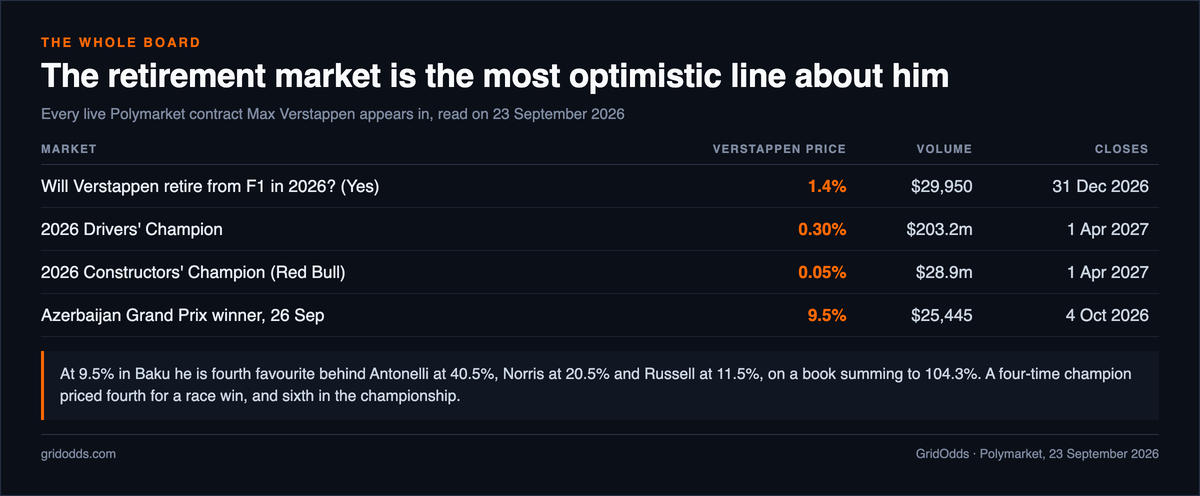
That number lands differently once you put it next to the other three markets Verstappen appears in. The season has gone badly enough that the retirement market is the most optimistic line on the board about him.
| Market | Verstappen price | Market volume | Closes |
|---|---|---|---|
| Will Verstappen retire from F1 in 2026? (Yes) | 1.4% | $29,950 | 31 Dec 2026 |
| 2026 Drivers' Champion | 0.30% | $203.2m | 1 Apr 2027 |
| 2026 Constructors' Champion (Red Bull Racing) | 0.05% | $28.9m | 1 Apr 2027 |
| Azerbaijan Grand Prix winner, 26 Sep | 9.5% | $25,445 | 4 Oct 2026 |
Baku is the only one of those with any life in it. At 9.5% he is the fourth favourite behind Kimi Antonelli at 40.5%, Lando Norris at 20.5% and George Russell at 11.5%, on a book summing to 104.3%. A four-time champion priced fourth for a race win, and sixth in the championship, is the entire backdrop to the retirement story.
The question is why the retirement number is low rather than high, when the sporting numbers are this bad. The answer is a piece of paper signed in August.
The Two Days in August That Ended the Question
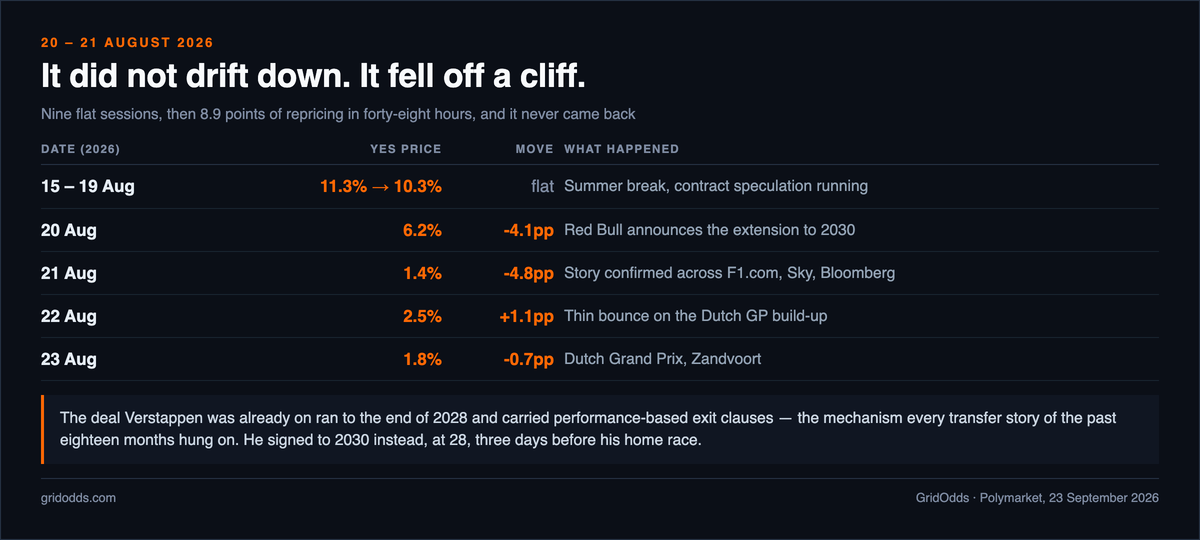
Prediction markets usually reprice in a slide. This one did not. It held at 10.3% for nine straight sessions, then lost almost nine points in two days and never came back.
| Date (2026) | Yes price | Move | What happened |
|---|---|---|---|
| 15–19 Aug | 11.3% → 10.3% | flat | Summer break, contract speculation running |
| 20 Aug | 6.2% | -4.1pp | Red Bull announces the extension to 2030 |
| 21 Aug | 1.4% | -4.8pp | Story confirmed across F1.com, Sky, Bloomberg |
| 22 Aug | 2.5% | +1.1pp | Thin bounce on the Dutch GP build-up |
| 23 Aug | 1.8% | -0.7pp | Dutch Grand Prix, Zandvoort |
On 20 August, ahead of his home race at Zandvoort, Verstappen signed a contract extension with Red Bull to the end of 2030. The deal he was already on ran to the end of 2028 and carried performance-based exit clauses — the mechanism every "Verstappen to Mercedes" story of the past eighteen months hung on. Sky's report and the rest of the wire coverage landed the same day.
What traders did with that is worth reading carefully. They did not price the contract as a promise to keep racing — contracts get bought out. They priced it as evidence about intent, three days before the race where a retirement announcement would have had maximum effect. He signed for four more years instead, at 28, in a car that has not won all season.
That is why the number is 1.4% and not 8%. Bridging from there: the two-day collapse only looks dramatic against what came before it.
The Full Arc: 25% in April to 1.4% in September
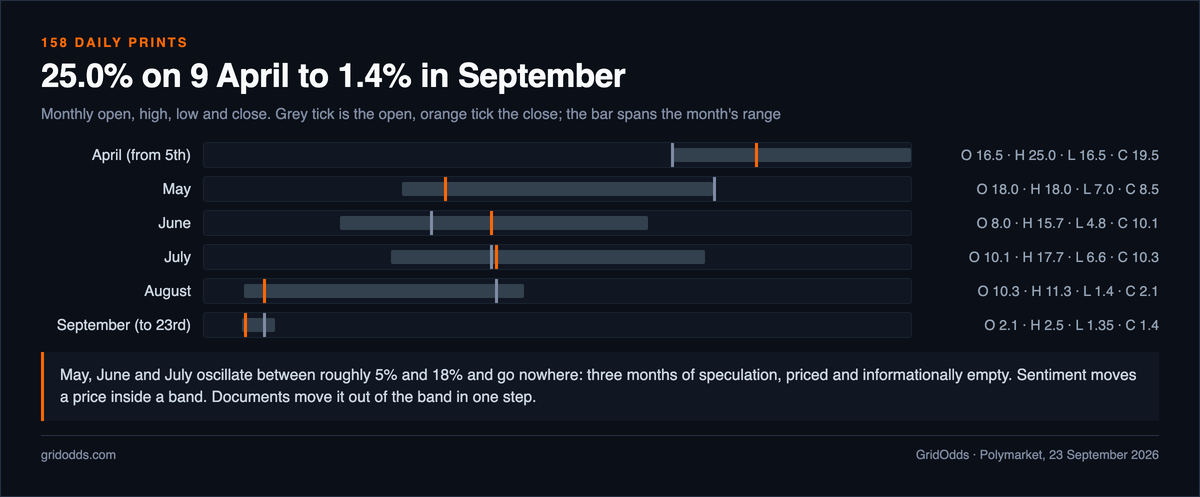
The market has 158 daily prints. Rounded to monthly open, high, low and close, the whole 2026 argument about Verstappen's future fits in six rows.
| Month (2026) | Open | High | Low | Close |
|---|---|---|---|---|
| April (from 5th) | 16.5% | 25.0% | 16.5% | 19.5% |
| May | 18.0% | 18.0% | 7.0% | 8.5% |
| June | 8.0% | 15.7% | 4.8% | 10.1% |
| July | 10.1% | 17.7% | 6.6% | 10.3% |
| August | 10.3% | 11.3% | 1.4% | 2.1% |
| September (to 23rd) | 2.1% | 2.5% | 1.35% | 1.4% |
The 9 April peak of 25.0% is the high-water mark of the whole story. It came days after Verstappen said he was considering walking away at the end of 2026 and admitted he was not enjoying the sport. One in four is a serious probability for a four-time champion quitting mid-contract, and the market got there in four days.
Then look at May through July. Three months of headlines, three months of the price oscillating between roughly 5% and 18% and going nowhere. That range is what speculation looks like when priced: noisy, mean-reverting, and informationally empty. Every one of those swings was a quote being re-interpreted, not a fact arriving.
The contrast is the point I would take from this chart into any other market. Sentiment moves a price around inside a band. Documents move it out of the band, in one step, and it stays moved. We have covered the same pattern on the title markets in our Antonelli title clinch analysis, where results rather than opinions did the repricing.
What the Market Actually Needs to Resolve Yes
This is the part no ranking page covers, and it is the part that decides whether a headline is worth anything. Polymarket's rules for this market are specific, and they are narrower than "Verstappen leaves F1".
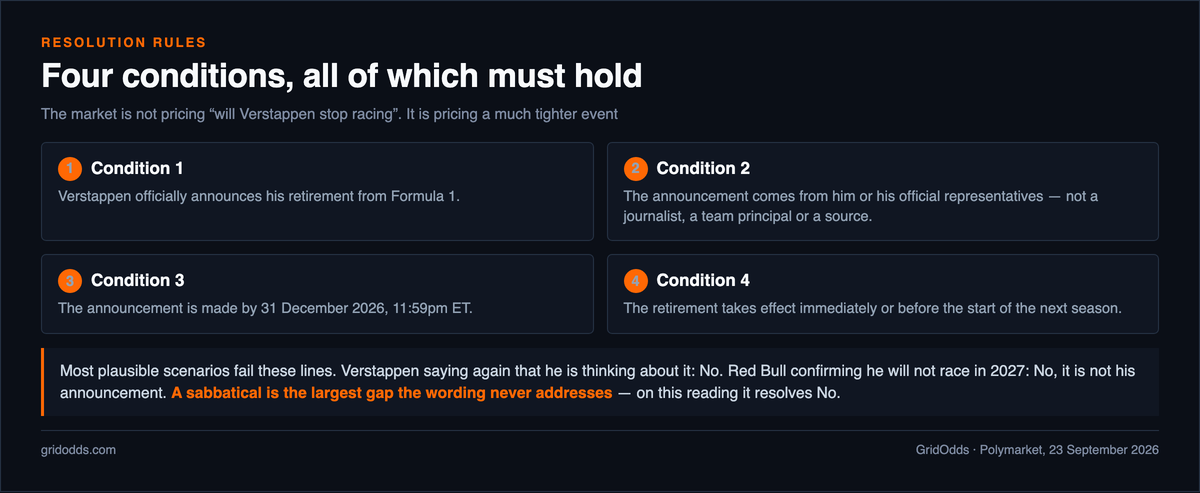
The four conditions, all of which must hold
- Verstappen officially announces his retirement from Formula 1.
- The announcement comes from him or his official representatives — not from a journalist, a team principal, or a source.
- The announcement is made by 31 December 2026, 11:59pm ET.
- The retirement takes effect immediately or before the start of the next season.
Run the plausible scenarios through those four lines and most of them fail. Verstappen saying again that he is thinking about it: No. Red Bull confirming he will not race in 2027: No, because it is not his announcement. Credible reporting that he has decided to stop, without a statement: the rules do allow "a consensus of credible reporting" as a secondary source, so this is the one genuinely contestable case.
The largest gap is the one the wording never addresses: a sabbatical. Several of the reports arguing he might step back frame it as a year out rather than a retirement, and an announcement of a sabbatical does not clearly state that he is retiring from Formula 1. On my reading it would resolve No, and I would not want to be holding Yes on that interpretation with real money.
That is not a technicality. It means the market is not pricing "will Verstappen stop racing", which is the question most readers think they are looking up. It is pricing a much tighter event, which is one more reason the number is as low as it is. If you want to check the wording yourself before the fact rather than after it, the market page carries the full rules. We go through this habit in more detail in our guide to reading F1 markets on Polymarket.
Why Verstappen Wanted Out: The 2026 Regulations
None of this makes sense without the rule change. Formula 1 moved to a power unit split of roughly 50% internal combustion and 50% electrical for 2026, and the consequence has been drivers lifting off early to harvest battery, then running out of deployment on the straight.
Verstappen has been the loudest critic on the grid. His most quoted line, reported by GPFans, is blunt:
"Not fun at all. Playing Mario Kart. This is not racing. Boosting past, then you run out of battery, the next straight they boost past you again. For me, it's just a joke."
Two things follow from that, and they pull in opposite directions. The complaint is about the sport, not about Red Bull, so a change of team would not fix it — which is what made retirement a live possibility rather than a transfer story. But a complaint about a rule set is also the most fixable kind of complaint there is, because rule sets get changed.
That is exactly what happened next, and it is the half of the story the competing articles skip.
The 2027 Engine Rebalance Answers His Complaint
In May 2026 the FIA agreed in principle to move away from the 50:50 split, phased across 2027 and 2028, toward a target of roughly 60% combustion and 40% electrical. RaceFans covered the vote when it went through.
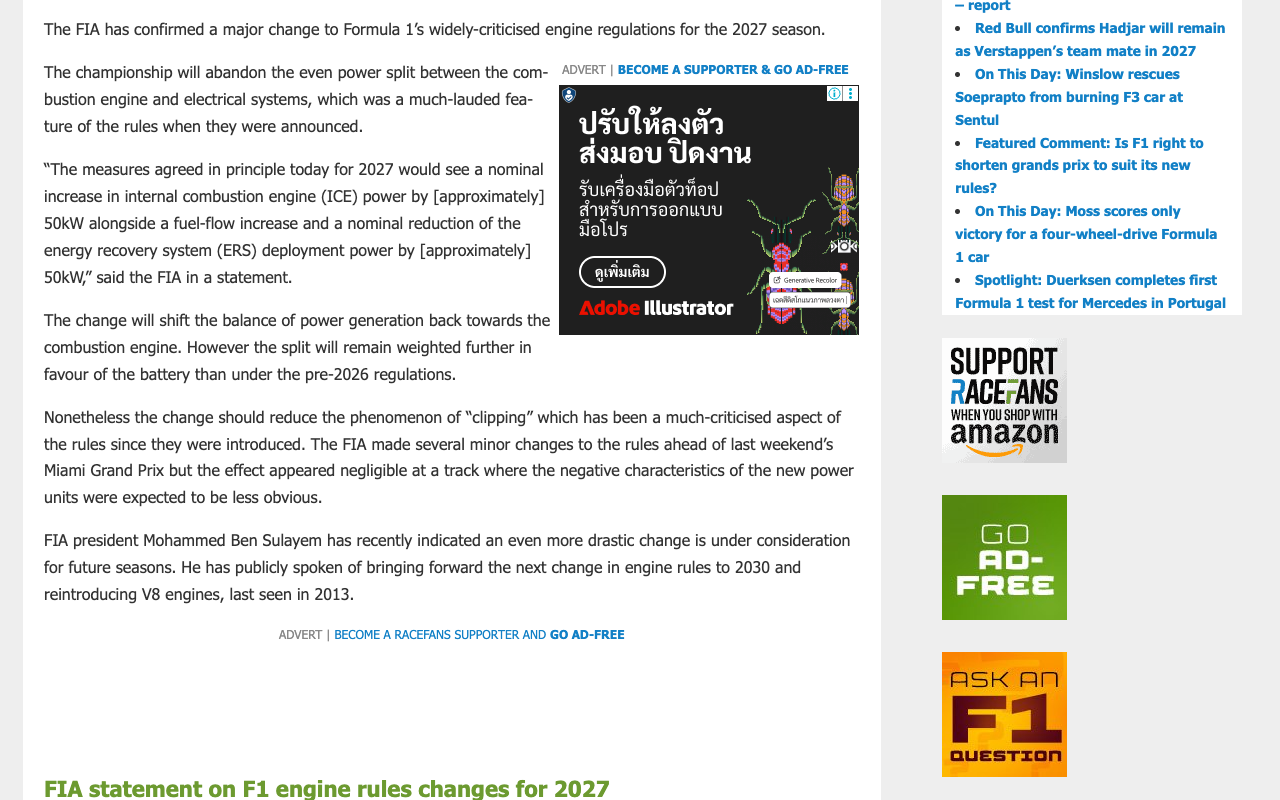
| Element | 2026 rules | 2027 direction | Effect on the driver |
|---|---|---|---|
| ICE / electrical split | ~50:50 | toward 60:40 | Less of the lap decided by battery state |
| Combustion power | Baseline | +~50kW | More power that does not need harvesting |
| ERS deployment | Baseline | -~50kW | Less clipping at the end of straights |
| Fuel flow | Baseline | Increased | Supports the extra combustion power |
Read that table next to the price history and the May slide from 18% to 8.5% stops looking random. The thing Verstappen said was ruining the sport acquired a published fix, with a date on it, inside the same month. It did not end the speculation, but it removed the strongest version of the argument for leaving: if the problem is the 2026 formula, the 2026 formula is being walked back.
Signing to 2030 three months later is consistent with a driver who decided to wait for the rebalance rather than quit over it.
A Winless Season Is Not the Same as a Finished One
The case for retirement was never only about regulations. It was also that a driver used to winning is now regularly beaten by cars he would have lapped two years ago. The numbers are genuinely bad.
| Metric | 2026 (14 of 23 rounds) | Context |
|---|---|---|
| Championship position | 6th | Champion in 2021, 2022, 2023 and 2024 |
| Points | 145 | 147 behind Antonelli's 292 |
| Race wins | 0 | 71 career wins, none this season |
| Podiums | 6 | Best results are three second places |
| Pole positions | 0 | None in 14 rounds; Norris took the latest, at Madrid |
| Red Bull, constructors' | 4th, 230 pts | 273 behind Mercedes on 503 |
He is also out-scoring his own team-mate Isack Hadjar by 145 to 71, which is the detail that argues against the driver being the problem. Red Bull have gone from fighting for a title in 2025 to fourth on the road, and the car has been the story all year — our 2026 teams analysis tracked that decline as the market priced it in.
One more thing worth knowing while you read the speculation: Verstappen turns 29 on 30 September, four days after Baku. Drivers do not usually retire at 29 from a seat that runs to 2030. The market has noticed that too.
How to Read a 1.4% Line Without Getting It Wrong
A number this small stops behaving like a probability and starts behaving like a floor, so two cautions are worth more than the headline.
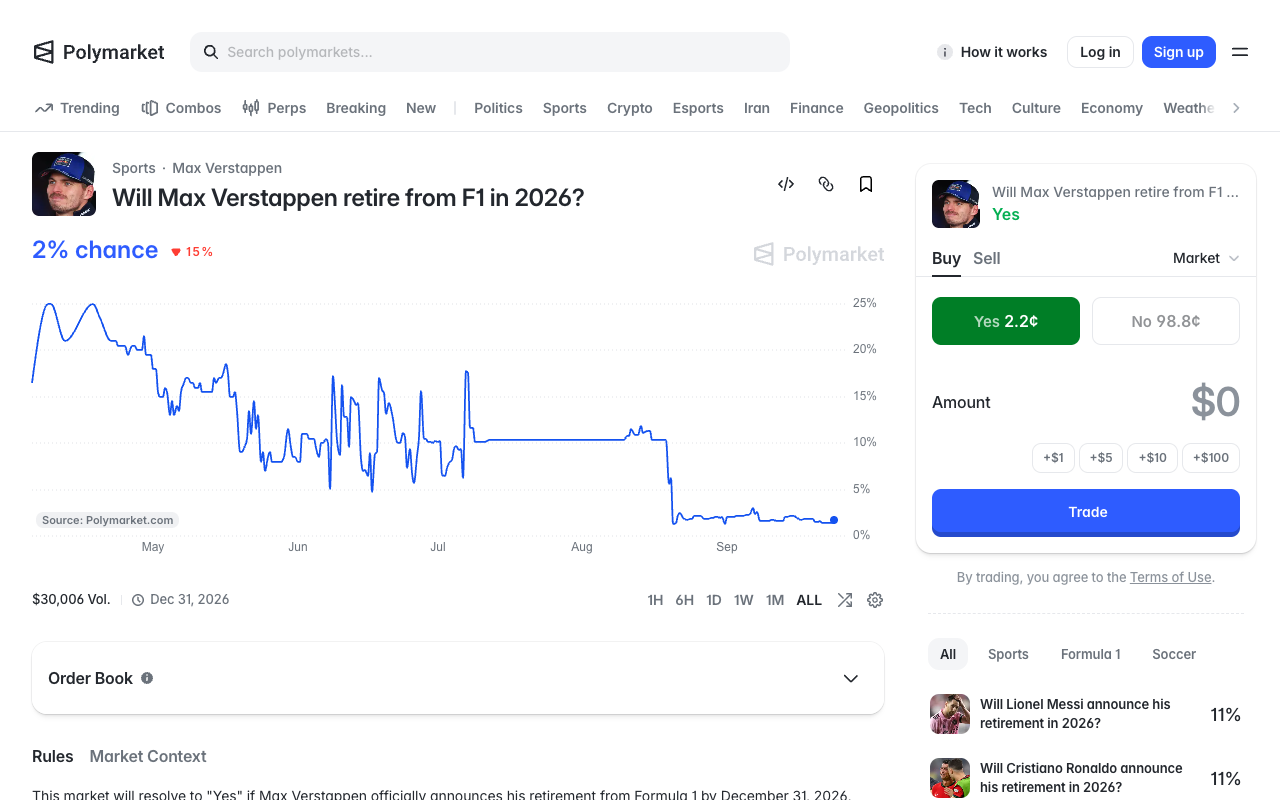
The first is liquidity. There is roughly $1,659 resting in this book against $203.2m in the drivers' championship market. Polymarket's minimum tick is one cent, so the entire distance between 1.4% and zero is a single tick. At this end of the range the spread is a large fraction of the price, and small differences — 1.4% against 2.1% a fortnight ago — are mostly noise rather than news.
The second is what the other side actually pays. Buying No at 98.6c to collect $1 on 31 December is 1.42% over 99 days, or about 5.3% annualised before fees, with your capital locked up and the whole downside being the one scenario you have decided is impossible. That is not free money; it is the market's price for underwriting a tail, and it is priced accordingly.
The reason to watch a market like this is not to trade it. It is that the price is a dated, falsifiable summary of what informed people believe, and on 21 August it told you the contract story was real several news cycles before the analysis caught up. That is the same argument we make in Polymarket versus the sportsbooks, where the overround usually decides which signal to trust.
What Would Actually Move It Before 31 December
Nine rounds remain and the market has 99 days to run. Three things would move this price, and the ordinary run of Verstappen headlines is not among them.
| Trigger | Likely effect on Yes | Why |
|---|---|---|
| A direct statement from Verstappen or his representatives | Large | The only route that satisfies the rules outright |
| Credible multi-source reporting of a decision to stop | Moderate | Qualifies as a secondary source, but contestable |
| A serious injury or personal circumstance | Moderate | The scenario the 1.4% is mostly paying for |
| Another "I'm thinking about it" quote | Minimal | Priced repeatedly between April and July, to no effect |
| A sabbatical announcement | Unclear | Probably resolves No on the published wording |
My read is that 1.4% is about right and possibly still a fraction rich. The contract removed the exit clauses, the 2027 rebalance removed the sporting grievance, and the remaining Yes paths are either accidents or a rules dispute over what a sabbatical is. If you only track one thing, track statements attributed to him directly — everything else has already failed to move this market five times this year.
The live board is on our drivers' championship page, and the next race page carries the Baku markets he is priced fourth in.
Prices quoted here were read from the Polymarket Gamma and CLOB APIs on 23 September 2026 and move continuously. GridOdds earns a referral commission if you open a Polymarket account through links on this site; it costs you nothing and does not change what we write.
Related Analysis
- Antonelli Title Clinch 2026: The Earliest Date Is Singapore — the championship Verstappen is 0.30% to win, and when it ends.
- F1 Drivers' Championship Odds 2026: Polymarket vs the Standings — the full board, points against prices.
- F1 Constructors' Championship Odds & Standings 2026 — where Red Bull's 0.05% comes from.
- Azerbaijan Grand Prix Odds 2026: Baku Runs on Saturday — the race he is fourth favourite for this weekend.
- F1 on Polymarket: How to Read and Trade the Championship Markets — resolution rules, tick sizes and book sums.
- 2026 F1 Teams Predictions: Market Signals — how the market priced Red Bull's fall.