Polymarket vs sportsbook F1 odds is not a question of which number is automatically right. It is a question of structure. A prediction market price and a sportsbook price can both describe the same race or championship, but they are built differently. If you compare them without adjusting for that structure, you can mistake noise for value.
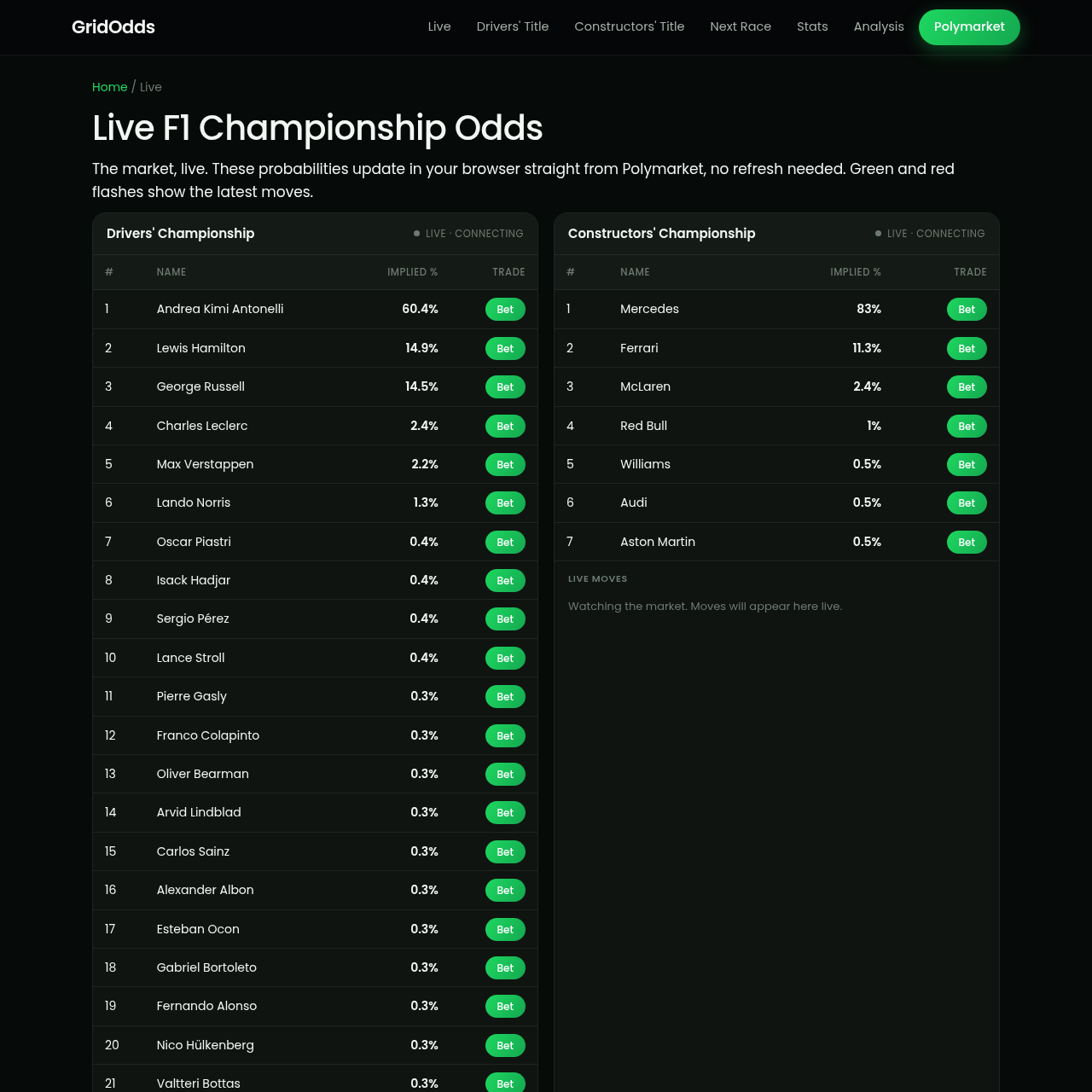
GridOdds focuses on prediction-market probability because it is easier to read as a live percentage. A Polymarket Yes price near $0.42 implies roughly 42%. A sportsbook decimal price must be converted and then interpreted with margin in mind. Both can be useful. Neither should be treated as advice.
This guide explains how to compare the signals. For the platform-specific primer, read F1 on Polymarket. For the value framework, use the F1 expected value guide. For broad price tracking, the F1 odds checker guide explains what to watch.
Key takeaways
- Prediction-market prices trade near probability, but liquidity and bid-ask spread matter.
- Sportsbook odds include margin, so raw implied probabilities can add up above 100%.
- Compare only markets that resolve to the same outcome.
- A price difference is not automatically value; it may reflect timing, limits, liquidity or jurisdiction.
The Structural Difference
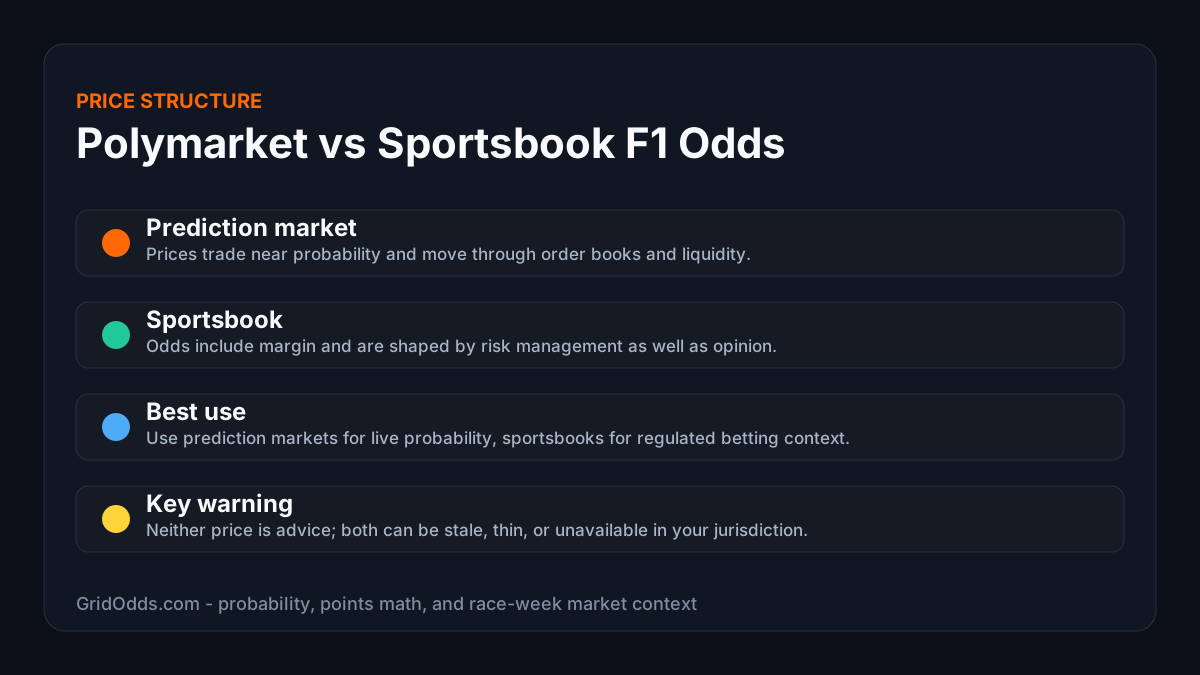
Polymarket-style prediction markets use contracts that resolve to a defined outcome. If a Yes contract trades at $0.37, the rough market-implied probability is 37%. That simplicity is why prediction markets are useful for readers who want a probability signal rather than a betting format.
Sportsbooks quote odds for betting markets. Those odds include margin and risk management. A sportsbook may shorten or lengthen a price because of liability, customer demand or trading policy, not only because its true probability estimate changed. That does not make sportsbook odds useless. It means they need adjustment before comparison.
How to Convert Both Prices to Probability
For a prediction market, the basic conversion is straightforward. A 62 cent Yes price implies roughly 62%. A 14 cent Yes price implies roughly 14%. In practice, you still need to care about spread and liquidity. A last trade at 62 cents is less reliable if the best bid is much lower and only a small amount traded.
For decimal sportsbook odds, divide 1 by the decimal price. Decimal 2.50 implies 40% before margin adjustment. American odds and fractional odds can also be converted, but the same warning applies: the book's market usually contains an overround. If every outcome's raw implied probability totals 106%, the individual numbers are not clean probabilities yet.
Why the Numbers Disagree
Polymarket and sportsbook prices can disagree for good reasons. One market may update faster after qualifying. Another may have more liquidity. One may be pricing a slightly different outcome, such as championship winner versus race winner, or driver head-to-head versus podium. A sportsbook may also restrict or reshape a market because of liability.
The first step is to confirm that the markets match. Do not compare a drivers championship contract with a race-winner price. Do not compare a yes/no contract with a three-way market without normalizing the outcome set. Most bad comparisons start with mismatched resolution rules.
Liquidity Matters More Than the Screenshot
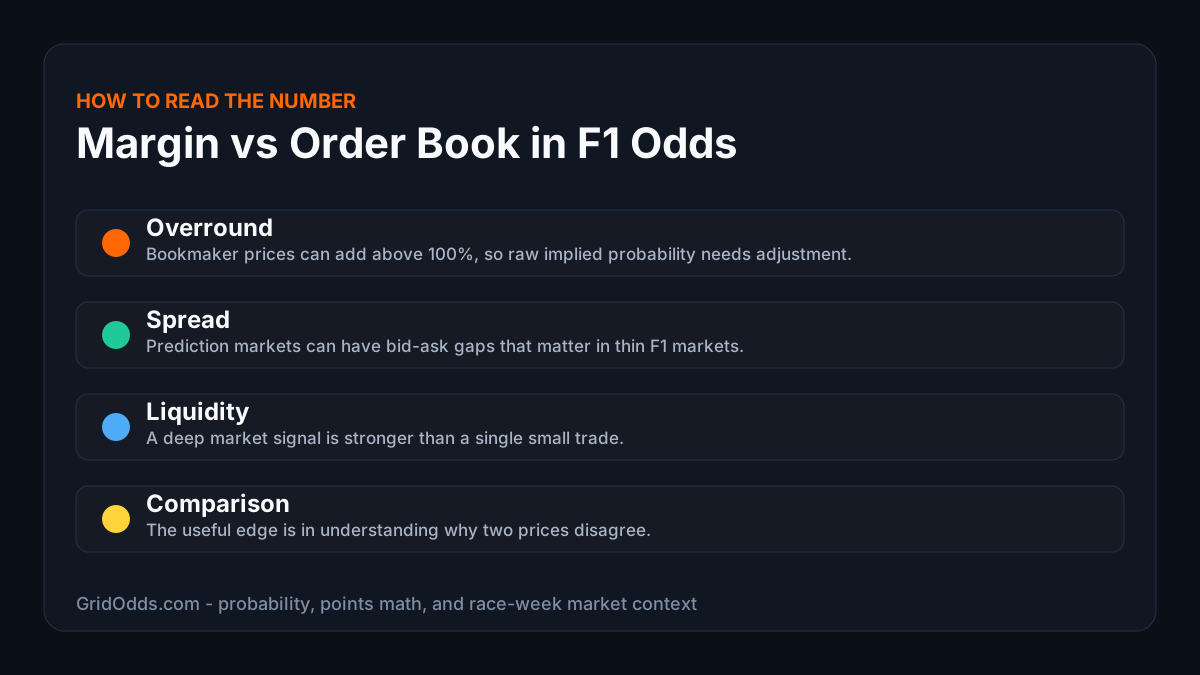
A clean-looking price can still be weak if the market is thin. In a prediction market, check the bid-ask spread and whether meaningful size is available near the displayed probability. A last trade can be stale. A thin order book can move dramatically on one small order.
Sportsbooks have their own liquidity problem from the reader's perspective: limits and availability. A price may be visible, but not equally available to all users or jurisdictions. That is why GridOdds uses price comparison as analysis, not instruction.
A Practical Comparison Workflow
Use a four-step workflow. First, confirm the outcome is the same. Second, convert both prices to implied probability. Third, adjust for sportsbook margin or at least recognize that it exists. Fourth, check timing and liquidity. If the comparison still shows a meaningful gap, then you have an analytical question worth investigating.
The investigation should ask why the gap exists. Did one market update after qualifying while the other lagged? Did weather change the race outlook? Did a title contender take a grid penalty? Did a thin prediction market move on one trade? The answer matters more than the raw difference.
How This Helps F1 Readers
F1 is a good sport for this comparison because information arrives in stages. Practice, qualifying, sprint sessions, weather forecasts and steward decisions can all move probabilities. A prediction market may react quickly to one type of information, while a sportsbook may react differently because its trading model and customer flow are different.
That creates useful content opportunities. A race-week article can compare how markets moved after qualifying. A championship article can explain why prediction markets shortened a driver while sportsbooks remained cautious. An expected value article can teach readers how to interpret disagreement without telling them what to do.
Risk, Legality and Responsible Framing
Any page comparing odds must be careful with framing. GridOdds is an informational site. It explains probabilities, market structure and F1 context. It does not promise profit, recommend bets or tell readers that a price is guaranteed value. Prediction markets and sportsbooks may be restricted by location, and users are responsible for understanding local rules.
This matters for Google as much as it matters for readers. Thin affiliate or betting pages that exist only to push users elsewhere are weak content. A strong comparison page teaches the reader something useful even if they never click an affiliate link or open an account.
Bottom Line
Polymarket odds and sportsbook odds can both be useful F1 signals, but they are not interchangeable. Convert prices to probability, account for margin and liquidity, verify that the outcomes match, and then ask why any difference exists. The edge is not in seeing two different numbers. It is in understanding what those numbers are actually measuring.
Comparison Mistakes to Avoid
The biggest comparison mistake is treating a visible price as a clean probability without checking how it was produced. A Polymarket price can be stale if the market is thin or the bid-ask spread is wide. A sportsbook price can be distorted by margin, liability or market limits. The displayed number is the start of the comparison, not the conclusion.
The second mistake is comparing markets with different resolution rules. A championship winner contract, a race winner price and a points-finish market are not interchangeable. Even similar-looking driver markets can have different settlement terms. Always read the market definition before drawing a probability conclusion.
When Prediction Markets Are More Useful
Prediction markets are especially useful when the outcome is binary and the market is liquid. A championship Yes/No contract can be easier to read than a large sportsbook board because the price maps directly to a probability. It can also update continuously as traders respond to qualifying, penalties, weather and points swings.
But the advantage depends on liquidity. A thin F1 market with a wide spread can look precise while being fragile. In that case, a sportsbook price or a broader consensus may provide useful context. GridOdds should explain both the signal and the confidence level behind the signal.
When Sportsbooks Are More Useful
Sportsbooks can be useful when they offer mature markets with deep trading history, especially for popular race-week outcomes. They may also be faster to list certain props or head-to-heads. The weakness is that the price includes margin and may reflect risk management rather than pure probability.
For readers, the best use is not blind copying. Convert the sportsbook number, adjust for the overround where practical, and compare it with prediction-market probability. If the two disagree, investigate the cause before assuming one side is wrong.
How to Turn This Into Helpful Content
A strong comparison page should teach a method. It should not simply say one platform is better. The reader should leave knowing how to convert prices, how to check spread and liquidity, how to identify margin, and how to verify that two markets resolve to the same outcome.
This approach also keeps affiliate content from becoming thin. If an article includes affiliate links, the informational value must stand on its own. The page should be useful even for a reader who only wants to understand why two F1 probability signals disagree.
Example: Same Driver, Different Probability
Imagine a driver is priced near 40% on a prediction market and around 2.20 decimal at a sportsbook. The sportsbook number converts to about 45.5% before margin adjustment. That does not automatically mean the sportsbook is more optimistic. The bookmaker market may include margin, may have moved at a different time, or may be managing exposure from customers who favour that driver.
The useful comparison starts after normalization. If the adjusted sportsbook probability still sits well above the prediction-market price, ask why. Did the sportsbook update after a qualifying session that the prediction market has not absorbed? Is the prediction market thin? Are both markets settling on exactly the same championship or race outcome? Only after those checks does the difference become meaningful.
Example: Thin Polymarket Price vs Mature Sportsbook Market
A thin prediction market can move sharply on one trade. If the displayed F1 price changes from 18% to 25% but the order book has little depth, the move may be less reliable than it appears. A mature sportsbook market with many traders watching the race may be slower in some moments but more resistant to one small order.
The reverse can also happen. A sportsbook can be slow to reopen after breaking news, while a prediction market updates immediately. That is why the comparison workflow needs timing, liquidity and market rules. The goal is not to crown one source forever. The goal is to understand which source is giving the cleaner signal for this specific outcome at this specific moment.
Internal Link Role for GridOdds
This comparison page should sit between the Polymarket explainer and the expected value guide. Readers who do not know the platform should start with the Polymarket guide. Readers who already understand conversion can move to expected value. Readers who just want the current market can go to the live odds page. That is a natural path, and it keeps each article focused.
It also supports responsible affiliate use. If a reader clicks a partner link later, the article has already delivered educational value: how to convert, compare and question prices. That is the difference between a helpful odds education page and a thin affiliate page.
What GridOdds Should Track When Prices Disagree
The strongest comparison view should show the prediction-market probability, the sportsbook-implied probability, the adjusted margin estimate, the timestamp and a liquidity note. Without those fields, a price gap can look more important than it really is.
For readers, the practical habit is to write both prices as percentages before reacting. A price gap that looks large in odds format may shrink after margin and spread checks. A small gap may become more important if one market is clearly fresher after breaking F1 news.
That discipline makes the comparison useful.
Frequently Asked Questions
- Are Polymarket odds the same as sportsbook odds?
No. Polymarket prices trade through prediction-market order books, while sportsbook odds include bookmaker margin and risk management.
- How do you compare Polymarket F1 odds with sportsbook prices?
Convert both to implied probability, adjust sportsbook odds for margin where possible, then consider liquidity, timing and whether the markets are pricing the same outcome.
- Which is better for F1 probability?
A liquid prediction market can be a clean probability signal, but a thin order book can be noisy. Sportsbooks can be informative too, but margin must be considered.
- Can US readers use Polymarket or sportsbooks?
Availability depends on jurisdiction and product rules. GridOdds is informational and does not provide legal, financial or betting advice.