
Key Takeaways
- Belgian Grand Prix weather forecast is narrow enough for GridOdds to target without fighting the existing championship odds pages.
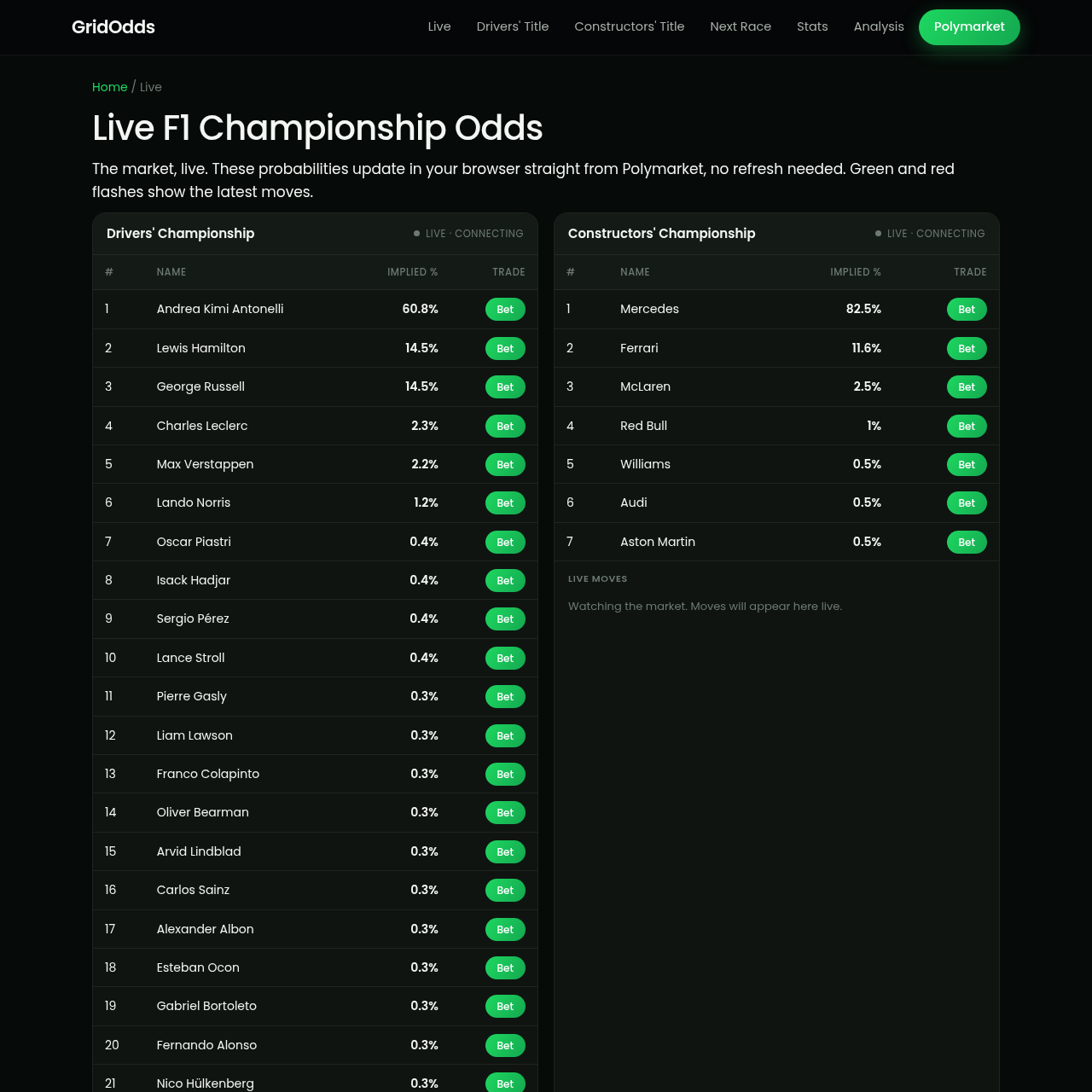
- The article should link up to the live odds, next-race, and core Polymarket explainers instead of replacing them.
- Screenshots and infographics make the market workflow visible, which is more useful than a thin keyword page.
Belgian Grand Prix weather forecast is the kind of search term a young site can realistically earn because the intent is specific. The reader is not asking for every Formula 1 result on the internet. They want a practical answer about odds, probability, or race-week context, and that is exactly where GridOdds has a defensible angle.
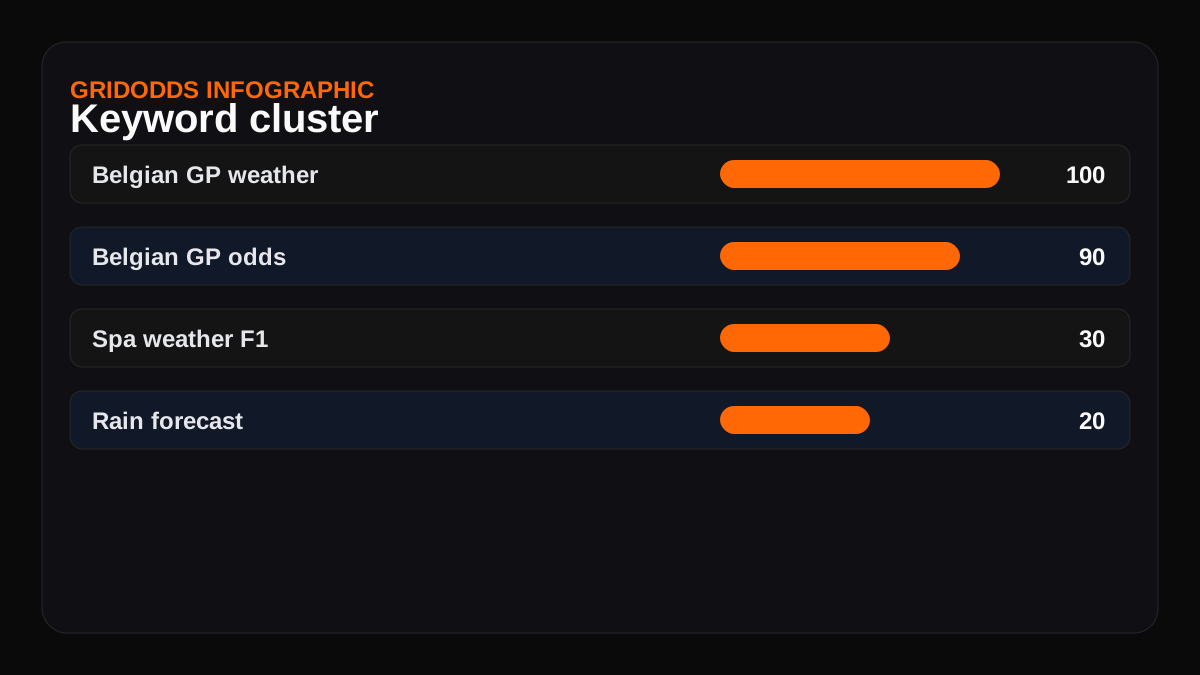
We checked this against fresh DataForSEO output on 19 June 2026 and filtered out broad terms that would be too hard or would cannibalize existing pages. The goal is not to publish another generic F1 odds article. The goal is to build a tight support page that strengthens the existing drivers' championship odds, constructors' championship odds, next race, and live odds pages.
What the Keyword Really Wants
The searcher behind Belgian Grand Prix weather forecast is usually past the casual-news stage. They already know Formula 1 is happening and they want a decision framework: which market should I look at, what does the price mean, and what new information could move it? That is a much better fit for GridOdds than broad news coverage.
The important SEO boundary is focus. This article should answer the narrow query completely, then send readers to the correct pillar page for live data. That gives Google a clean topical relationship: the article explains the concept, while the product page supplies the changing market table.
How the Market Signal Works
Prediction-market prices are useful because they already speak in probability. A price of 0.37 means the market implies a 37 percent chance. That direct translation lets a reader compare the market with standings, qualifying, weather, or team form without first removing a sportsbook margin.
That does not mean the market is always right. It means the price is a live benchmark. If a driver has strong qualifying pace but the market has not moved, the gap is worth inspecting. If rain risk rises and the favourite remains priced as if the race is dry, the article can explain why that mismatch matters.
The GridOdds Workflow
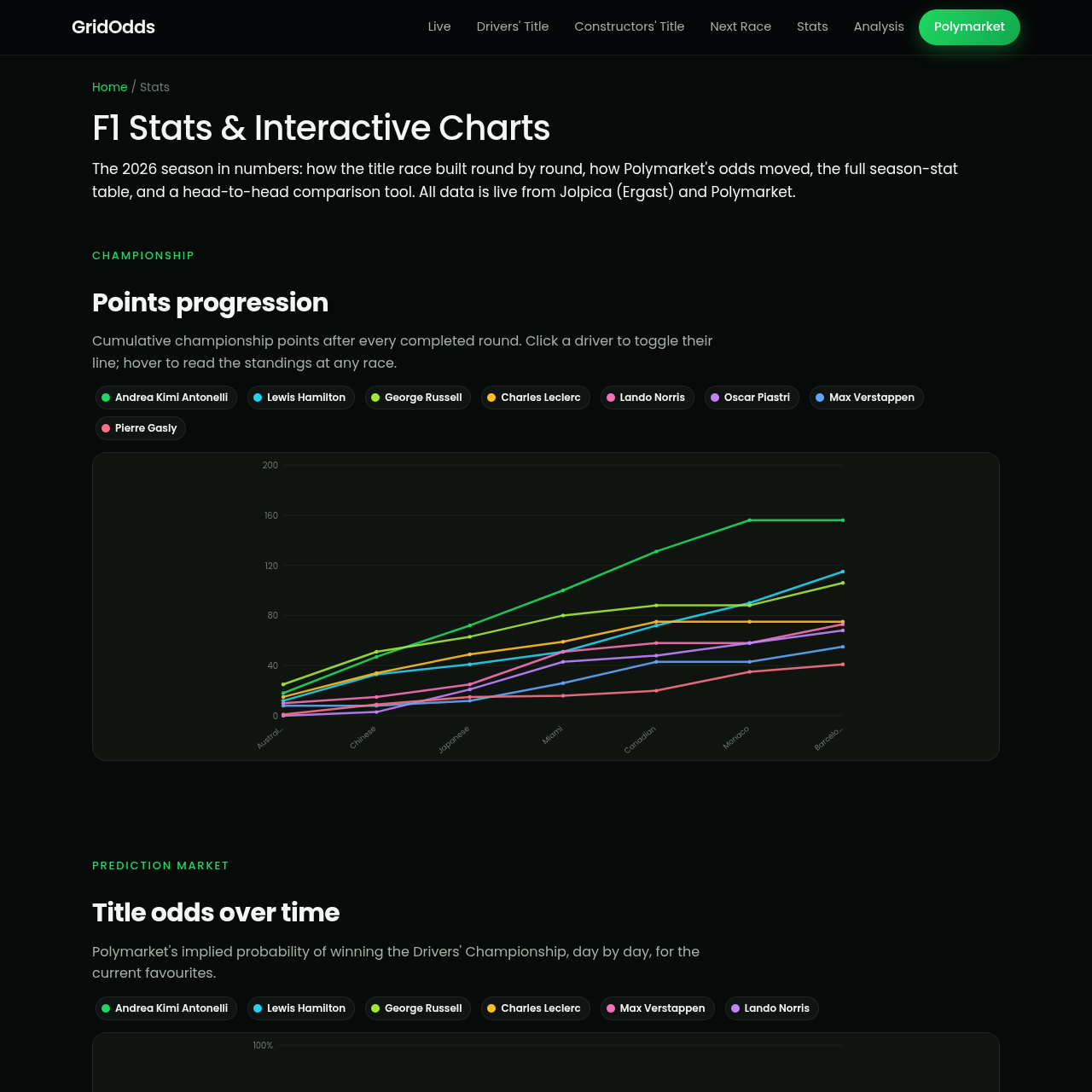
A useful GridOdds workflow starts with the live market, checks the relevant standings page, then overlays race-week context. For championship topics, that means points gap, remaining rounds, teammate pressure, and constructor strength. For event topics, it means qualifying, weather, circuit profile, and any confirmed grid penalties.
- Start with live market movement, because stale odds are usually misleading.
- Use driver title probabilities and team probabilities as the season-level anchor.
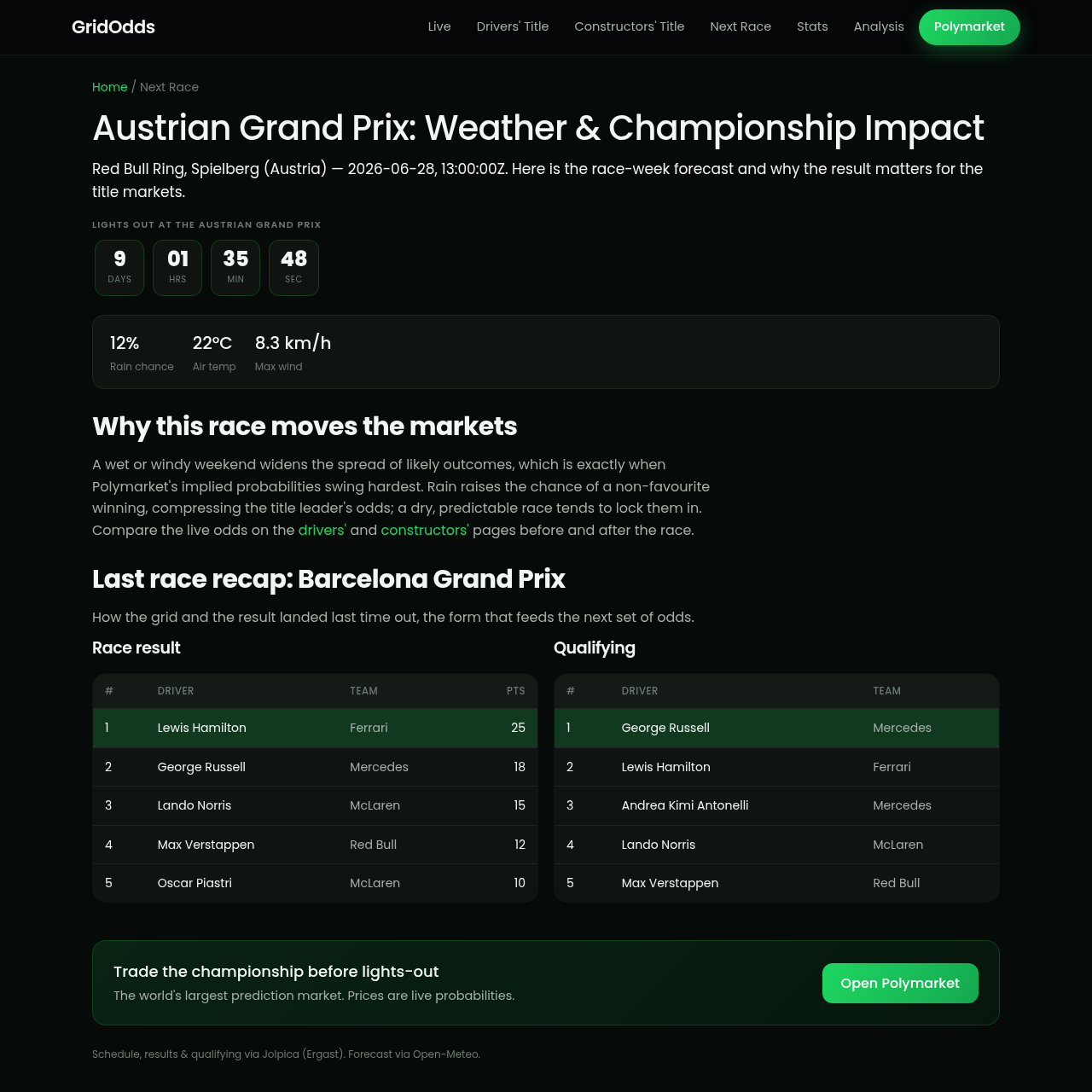
- Check the next race page for schedule and weather context before treating a price move as meaningful.
- Use Polymarket's public market pages as the external source of truth for contract structure and resolution language.
Mistakes to Avoid
The most common mistake is comparing two numbers that answer different questions. A race-week price, a championship price, and a qualifying result are connected, but they are not interchangeable. Treating them as the same signal leads to bad analysis and thin content.
The second mistake is chasing generic traffic. Broad terms such as F1 standings and Formula 1 news have huge search volume, but they are not where GridOdds has the clearest edge. A narrower page can rank faster because it gives a precise answer and supports the stronger live-data pages.
Where This Fits in the Cluster
This article belongs in the race-week and market-education cluster. It should receive internal links from related posts and link back to the live data pages. That makes it a spoke, not a competing pillar.
For readers who want the broader mechanics, the F1 on Polymarket guide explains Yes/No market structure. For one-race pricing, the F1 Grand Prix odds guide explains race-winner markets. For current market prices, use GridOdds Live.
Additional Ranking Notes
Example: Why Spa Can Break a Dry-Weather Market
Suppose Friday pace makes one team look dominant and the market prices its lead driver aggressively. At Spa, that may be fair in a dry race. But if the forecast shifts toward showers around the middle stint, the price should account for tyre crossover timing, safety-car probability, and the chance that parts of the track dry at different speeds.
A market that ignores that shift is not automatically wrong, but it is incomplete. The article should teach readers to ask whether the current price is pricing dry pace, wet variance, or a blend of both.
Spa-Specific Infographic Ideas
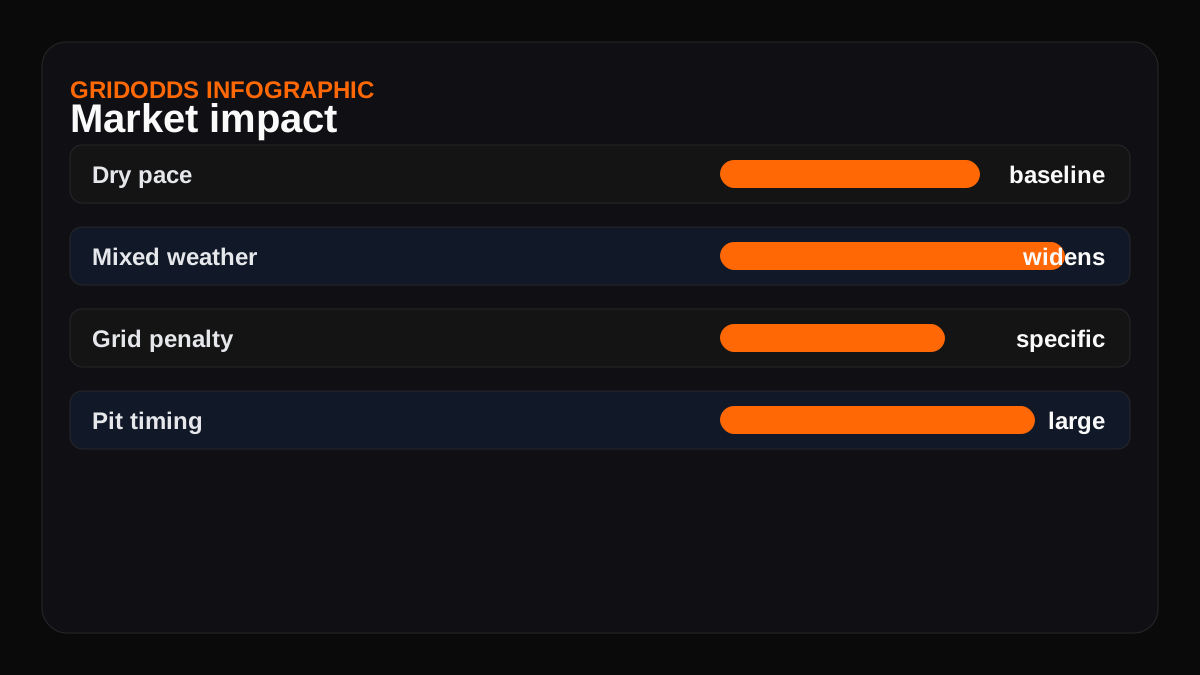
- Dry pace baseline versus mixed-weather probability spread.
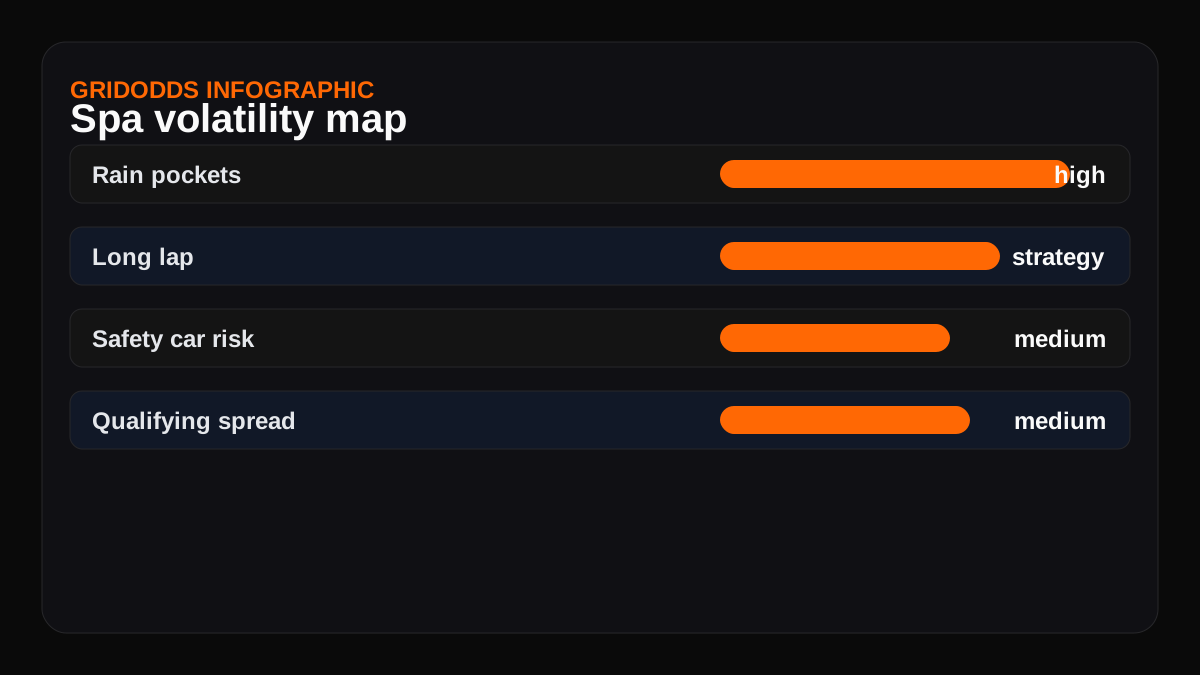
- Sector weather risk across a long lap.
- Pit timing risk when rain arrives mid-stint.
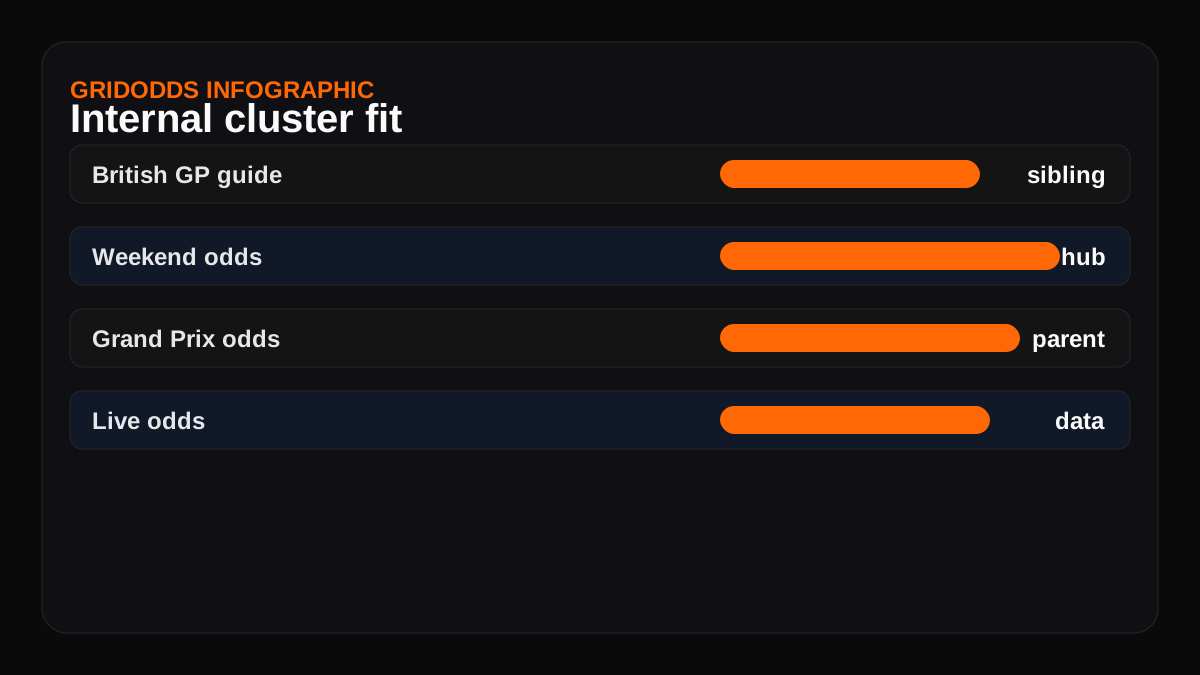
- Internal link path from Spa page to weather odds and weekend odds.
Avoiding Thin Event Content
The risk with event pages is writing the same preview six times with the circuit name swapped. The Belgian Grand Prix page avoids that by making Spa weather the core of the article. It should not try to be a full race history, a travel guide, or a generic F1 preview. Its job is narrower: explain how Spa conditions change market probability.
That narrowness is what makes the page more likely to rank. It answers the searcher directly and supports the broader GridOdds cluster.
Gold Standard Analysis Layer
Spa Rewards Weather-Aware Analysis
Spa is not just another race on the calendar. The lap is long enough that weather can differ across sectors, and that creates a market problem. A forecast that looks moderate at circuit level can still produce a messy race if rain arrives at one part of the lap before another.
That is why Spa deserves its own article. The Belgian Grand Prix weather forecast is not decorative context. It is central to how race probability changes. A dry Spa weekend can reward straight-line efficiency and race pace. A wet Spa weekend can reward confidence, tyre timing, and safety-car luck.
How Spa Weather Changes F1 Odds
Before qualifying
Before qualifying, weather affects setup choices and session risk. If teams expect mixed conditions, they may compromise setup. That can make pure pace harder to read and keep the market from fully trusting practice results.
After qualifying
After qualifying, the market has a grid but still needs to ask whether the race will resemble the session that created it. A wet qualifying result followed by a dry race is not as strong as a wet qualifying result followed by a wet race. This distinction is where thin Spa content usually fails.
Race morning
Race morning is the highest-leverage weather window. A late forecast shift can change tyre strategy, pit stop timing, and the chance that a safety car resets the field. If Polymarket prices lag that shift, the article can explain why the market may be slow.
Spa Article Maintenance
- Refresh the forecast screenshot before Belgian Grand Prix week.
- Add the current title-market leader and challenger.
- Check whether a race-specific market exists on Polymarket.
- Update internal links to the broader weather odds and weekend odds guides.
Why This Supports Topical Authority
Weather-led event pages show Google that GridOdds is not only covering broad F1 odds. It is explaining the conditions that change probability. The Belgian Grand Prix page, British Grand Prix page, weather odds guide, qualifying odds guide, and weekend odds guide should all reinforce each other.
Why Spa Is a Weather Market
Spa is the cleanest weather-led Formula 1 article in this batch. The lap is long, the elevation changes are meaningful, and conditions can vary by sector. A dry-to-wet or wet-to-dry Spa race can turn a normal pace ranking into a strategy and tyre-temperature problem.
That makes Belgian Grand Prix weather forecast and Spa F1 odds a strong niche pair. The keywords are not huge, but they are precise. They also avoid direct competition with the broader Grand Prix odds explainer.
What Changes When Spa Is Mixed
Mixed conditions create two market effects. First, the favourite loses some dry-pace certainty. Second, the field behind gains paths through timing, safety cars, tyre calls, and driver confidence. The result is not always that long shots become good value, but the probability distribution usually becomes wider.
Spa also makes qualifying context trickier. A driver can qualify well in one weather window and race in another. That means a Saturday price can be fragile if Sunday looks different.
How This Supports the GridOdds Cluster
This page should support the weather odds article, the weekend odds article, and the Grand Prix odds article. It gives GridOdds a specific example of weather-led market movement, while the evergreen pages explain the general method.
Refresh Plan
Update this before Belgian Grand Prix week with the live forecast, current title contenders, and any active Polymarket race market. If the forecast is stable and dry, say so plainly rather than forcing a rain angle.
External references worth checking are Polymarket for market listings, Formula1.com for official race context, and Open-Meteo when weather affects the race-week interpretation.
Final SEO Notes
Reader Outcome
The reader should leave with one clear idea: Spa weather changes the market because the track itself makes weather uneven and strategically expensive. A forecast is not just a sidebar. It changes the probability spread, the value of qualifying, and the chance that an underdog path opens.
This is also a natural page to update every year. Belgian Grand Prix weather searches come back each season, and the evergreen framework can carry fresh screenshots and current odds without starting from scratch.
Why This Is Not a Weather Widget
A weather widget tells the reader whether rain is likely. This page explains what that rain does to market probability. That difference matters for ranking because it adds original interpretation. The forecast is the input; the useful answer is how that input changes the odds, the grid value, and the number of realistic race paths.
For Spa, the strongest version of the article should always connect forecast, circuit shape, and market price. If one of those pieces is missing, the content becomes a generic preview. If all three are present, it becomes a useful GridOdds page.