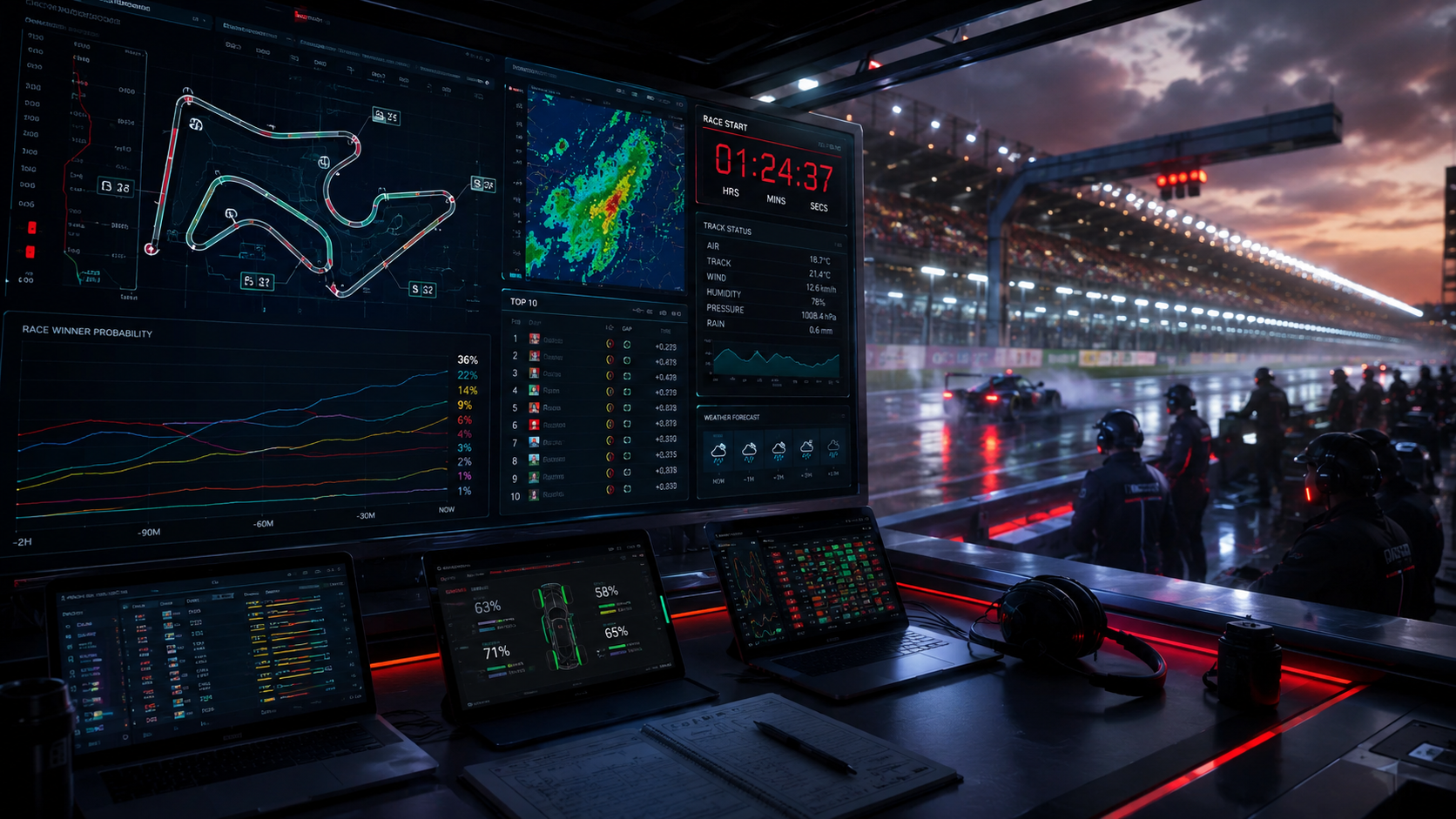
Searching for F1 odds this weekend usually returns a list of prices. That is useful, but it is not enough. Race-week odds move because new information arrives in a predictable order: practice pace, qualifying, weather, penalties, reliability warnings, and finally the race itself.
GridOdds is built around that sequence. The live odds page tracks Polymarket movement, the next-race page adds schedule and weather context, and the Grand Prix odds guide explains the difference between a race market and a title market. For the forecasting framework behind race-week prices, use the F1 prediction guide.
Key takeaways
- Do not read weekend odds without checking session timing and weather.
- Practice matters less than qualifying unless long-run pace is extreme.
- Track position, penalties, and rain are the fastest weekend price movers.
- Championship odds can move even when the weekend market is about a single race.
The Race-Week Signal Stack
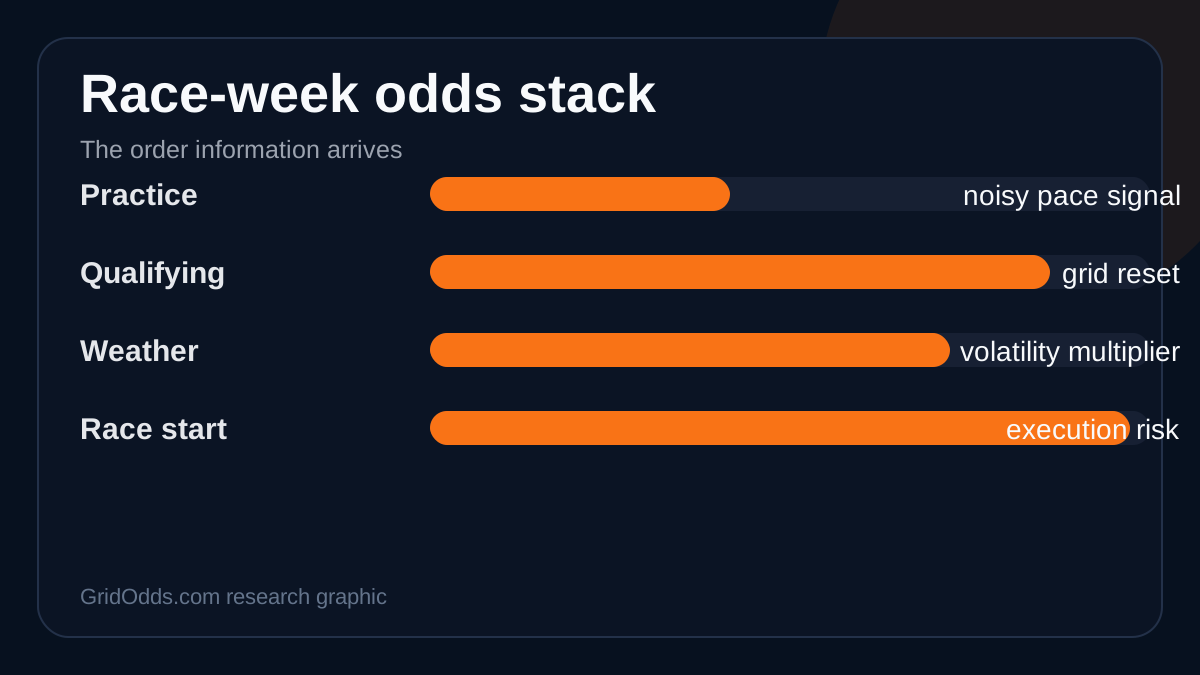
A race weekend is not one information event. It is a stack of smaller events that update probability. Friday tells us about setup direction and tyre behaviour. Saturday tells us who controls track position. Sunday tests reliability, strategy, and execution under pressure. If you watch odds without mapping those events, every move looks random.
Friday Practice: Useful, But Easy to Overrate
Practice data is noisy. Teams run different fuel loads, hide pace, test tyre life, and sometimes sacrifice headline lap time for long-run data. A big Friday lap can move casual sentiment, but serious market moves usually need confirmation. The useful practice signals are not always the fastest single lap. Look for tyre degradation, repeated long-run pace, reliability warnings, and whether a team looks comfortable across conditions.
If a driver tops FP2 by two tenths but their long-run pace is weak, the market may not move much. If a team looks average over one lap but strong over 12-lap runs, race odds may quietly tighten even before qualifying.
Qualifying: The First Major Price Reset
Qualifying is the first weekend session that usually deserves a major odds reset. It fixes track position, reveals single-lap pace, and creates or removes strategic options. On circuits like Monaco, Singapore, Hungary, and Zandvoort, qualifying can be close to half the race. On circuits with easier overtaking, race pace matters more and Saturday moves are less final.
That is why a weekend article should always connect qualifying to circuit type. Pole at Monaco means something different from pole at Bahrain. The price move should reflect that. Our dedicated F1 qualifying odds guide covers this in more detail.
Weather: The Chaos Multiplier
Weather is the biggest reason weekend odds can become mispriced. Rain compresses car performance gaps, increases safety car probability, and makes strategy more important. Wind can hurt cars that rely on a narrow aerodynamic window. Heat changes tyre degradation. A dry forecast that turns wet can move both race-winner markets and championship markets because it changes the distribution of outcomes.
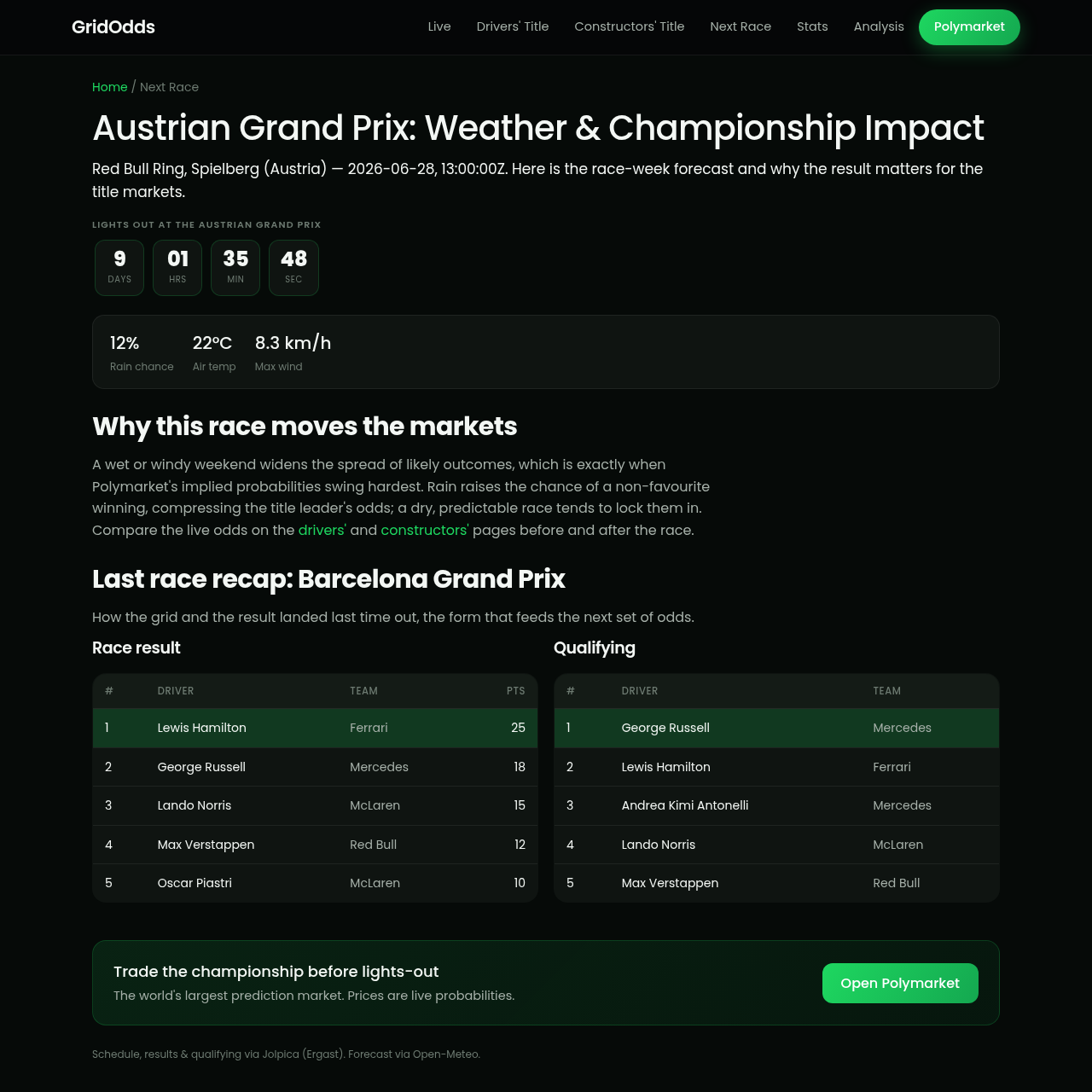
The GridOdds next-race page exists for this reason. It puts race timing and forecast context near the odds so readers do not have to treat the market as isolated from the weekend conditions.
Penalties and Reliability Warnings
Grid penalties are obvious market movers because they directly change starting position. Reliability warnings are subtler. A gearbox issue, power-unit concern, cooling problem, or repeated sensor alarm can matter even if the car still runs. The market often reacts before casual coverage does because traders watch team radio, sector times, and session interruptions closely.
A good weekend workflow is to ask whether a price move came from performance or risk. Performance moves are usually durable. Risk moves can reverse quickly if the team confirms the issue was minor.
How Weekend Odds Feed Championship Odds
A single race does not decide a 24-race championship, but it can change the trajectory. If a title leader qualifies poorly on a wet weekend, their race-win price drops first. If the result threatens a large points swing, the championship market follows. This is why GridOdds keeps the race-week context connected to the drivers title odds and constructors title odds pages.
Weekend Odds Checklist
- Check the circuit: overtaking easy or track position heavy?
- Check practice: long-run pace, not just headline lap time.
- Check qualifying: did track position match race pace?
- Check weather: dry, mixed, wet, wind, heat, and timing.
- Check penalties: grid drops, component changes, pit-lane starts.
- Check reliability: repeated issues matter more than one-off alarms.
- Check market move size: did price overreact to a single noisy session?
GridOdds is an odds research site, not a sportsbook or financial adviser. Use this as educational analysis only, and only participate in prediction markets or betting products where it is legal for you.
Frequently Asked Questions
- When should I check F1 odds this weekend?
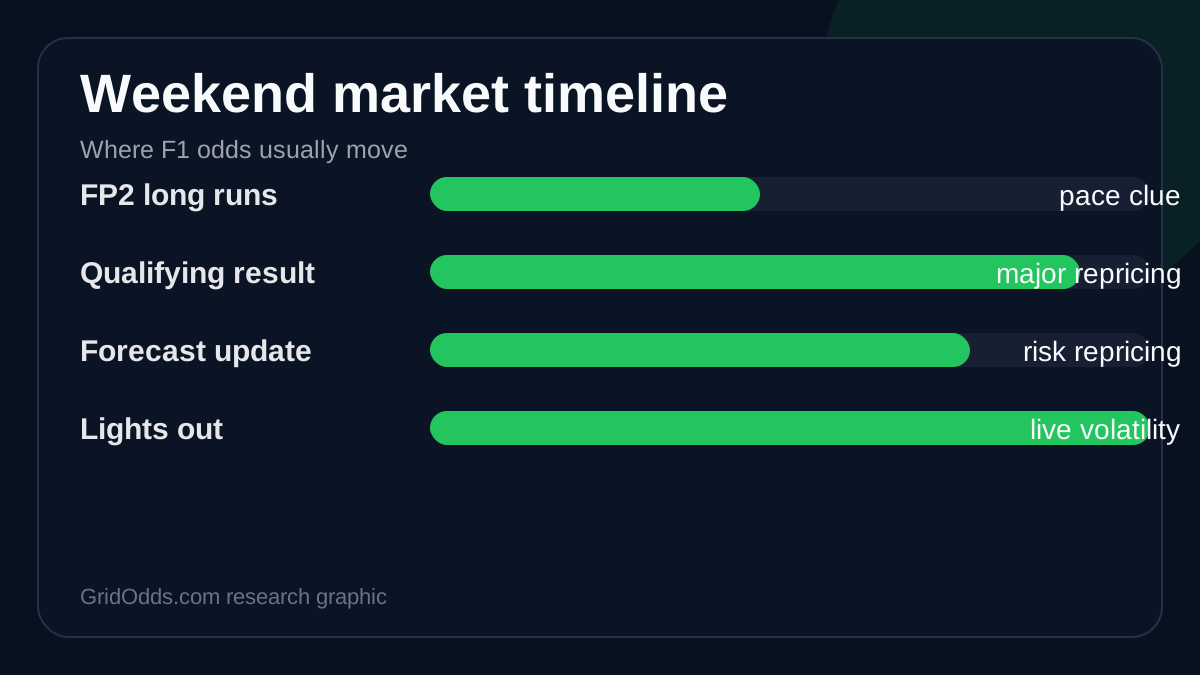
The best windows are after practice long runs, immediately after qualifying, after major forecast updates, and before the race start.
- Do F1 weekend odds affect championship odds?
Yes. A single race can move title probability when it changes expected points, reliability confidence, or car development assumptions.
- Are Polymarket F1 odds live during race weekends?
Championship markets can update continuously while open. GridOdds tracks those public market prices for analysis.
Gold Standard Analysis Layer
A Friday to Sunday Reading Plan
The cleanest way to read F1 odds this weekend is to separate the weekend into decision windows. Friday is evidence gathering. Saturday is grid repricing. Sunday is execution. If you blend all three together, you will overreact to practice and underreact to confirmed grid position.
Friday: look for repeatable pace
Friday practice is useful when the signal repeats. One purple sector can be noise. A full long run that holds tyre life better than rivals is more meaningful. If a team looks quick on low fuel but weak on race simulation, the market may hold back from a major move. That hesitation is rational.
Saturday: price the grid, not the headline
After qualifying, the first question is how much the grid matters at that circuit. Pole at Monaco carries a much larger premium than pole at Spa. A second-row start can be fine at tracks with strong overtaking. A sixth-place start can be damaging if the driver is trapped behind slower cars on a street circuit.
Sunday morning: check what changed overnight
Race morning often brings the final useful update: weather, parc ferme notes, pit-lane starts, replacement components, and any confirmed grid changes. This is when stale Saturday reactions can be corrected. A market that moved too hard after qualifying can drift back if the Sunday context weakens the pole-sitter or strengthens a rival.
How to Use This Article During a Live Weekend
This article should behave like a checklist. The reader lands from a weekend query, learns what matters, then clicks to live pages for the current state. That keeps the article evergreen and prevents it from pretending to be a live blog.
- Use /next-race for the race name, date, circuit, countdown, and weather context.
- Use /live for current Polymarket movement.
- Use /drivers-championship after qualifying to see whether expected points changed the title market.
- Use /stats when circuit history matters, especially pole conversion or safety-car risk.
Common Weekend Traps
The first trap is assuming every odds move is information. Sometimes a move is just thin liquidity. If a market has little depth, a small trade can move the displayed price more than the underlying probability changed. That is why volume and liquidity matter.
The second trap is treating the fastest practice lap as race pace. Teams run different programs, and practice timing screens rarely tell the whole story. A useful race-week page should remind readers to separate headline lap time from stint quality.
The third trap is ignoring championship context. A driver can be poor value for the race and still gain title probability if the main rival starts worse. Race-week content should always ask how the weekend result affects the season, not only who wins on Sunday.
Why This Is a Good Niche Keyword
DataForSEO showed enough combined interest around F1 odds this weekend to justify a standalone page, while the competition score stayed low enough for a new topical site. The phrase also has recurring demand. It refreshes naturally every race week, which gives GridOdds a reason to update screenshots, examples, and internal links throughout the season.
Additional Ranking Notes
Example: A Normal Weekend vs a Volatile Weekend
On a normal weekend, the market usually narrows. Practice points to two or three realistic contenders, qualifying orders them, and the weather does not disturb the picture. In that case, odds movement should become more confident as the weekend progresses. The favourite shortens, the second contender holds a fair price, and the long tail of unlikely winners fades.
On a volatile weekend, the market widens. A mixed forecast, awkward grid, penalties, or safety-car-heavy circuit creates more paths for the race to break away from pure pace. The favourite may still be the favourite, but the price should not look as dominant as it would in a dry, predictable race.
This distinction is useful for readers because it gives them a mental model before they open any market. If the market is behaving like the weekend is normal while the evidence says it is volatile, the price deserves closer inspection.
How This Page Should Be Updated Every Race Week
The evergreen body can stay the same, but the intro should be refreshed with the current Grand Prix, current title leader, and the most important weekend variable. For Monaco, that might be qualifying. For Silverstone, it might be wind and tyre temperature. For Spa, it might be mixed weather across sectors.
- Update the first screenshot from the next-race page.
- Confirm the current race name and date.
- Add one sentence on the largest market mover before qualifying.
- Check internal links to event-specific pages when they exist.
- Keep the article educational, not a race prediction post.
Cannibalization Boundary
This article should not target F1 Grand Prix odds as its main term because that job already belongs to the Grand Prix odds explainer. It should not target F1 weather odds because that job belongs to the weather article. The phrase F1 odds this weekend is about workflow and timing: what to check this weekend, in what order, and why it matters.
That boundary matters. If each page owns a clean role, the cluster gets stronger. If every page tries to rank for the same broad phrase, the site competes with itself.
Final SEO Notes
Reader Outcome
By the end of the page, the reader should know exactly what to check before trusting a weekend price. That outcome matters more than word count. The article should leave them with a sequence: check circuit type, check practice quality, check qualifying, check weather, check penalties, then compare the live market move with the championship table.
That sequence is also what gives the article internal-link value. Each step points naturally to another GridOdds page without forcing links into unrelated text.