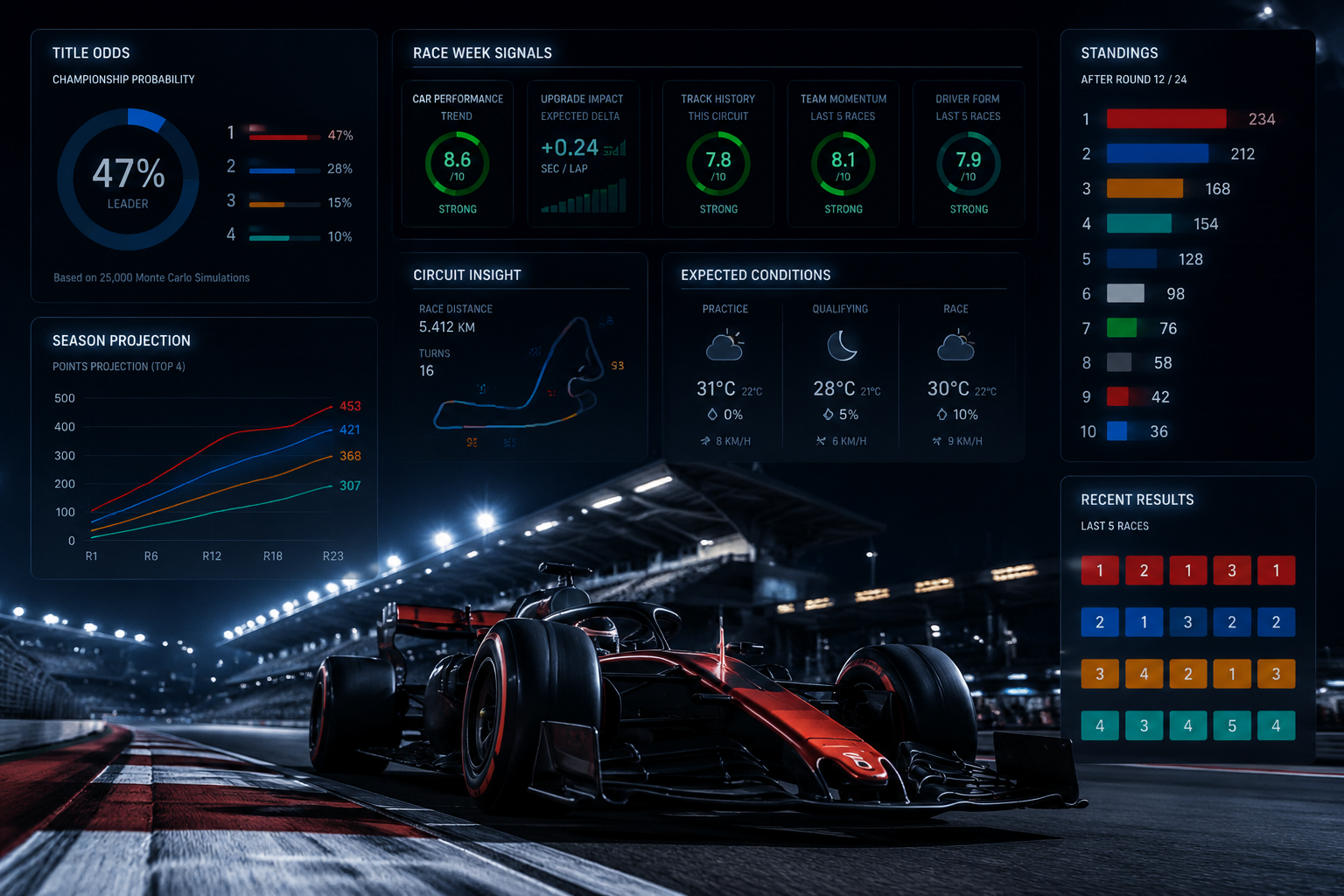
F1 prediction gets messy because Formula 1 has two clocks running at once. There is the race-week clock, where one qualifying lap, a rain shower or a safety car can rewrite Sunday. Then there is the championship clock, where every result compounds into a points gap that gets harder to close as the calendar runs out.
The useful way to predict F1 is not to ask who is definitely going to win. Nobody knows that. The useful question is: what probability does the best available evidence support right now? GridOdds starts with live market prices, converts them into implied probability, then compares those numbers with standings, race pace, circuit type, weather and remaining points. That gives you a forecast you can update rather than a hot take that expires after FP1.
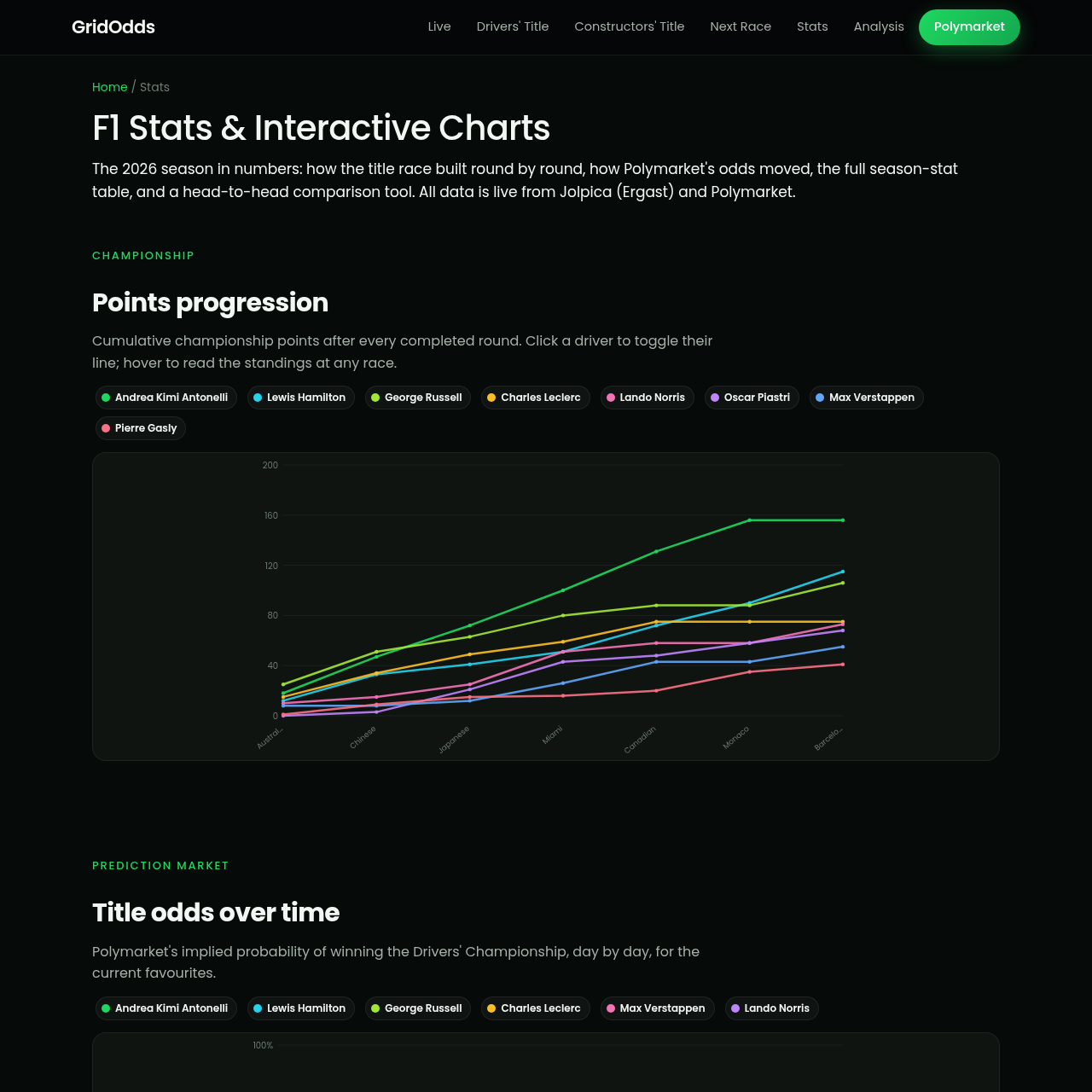
This guide is the hub for reading Formula 1 predictions on GridOdds. For season-level forecasts, start with the 2026 F1 predictions market breakdown. For live title prices, use the drivers championship tracker and constructors championship tracker. For the immediate race-week setup, the next race page is where circuit and timing context belongs.
What an F1 Prediction Should Actually Mean
A serious F1 prediction is a probability statement. If the market prices a driver at 47%, that does not mean the driver is expected to win in the casual sense. It means that across a large set of possible season paths, the current price implies roughly 47 winning paths out of 100. The other 53 paths still exist.
That distinction matters because F1 outcomes are fragile. The fastest car can start behind traffic after a compromised qualifying session. The championship leader can lose 25 points to a power-unit failure. A lower-probability driver can suddenly become live if a wet race creates chaos. Good prediction work keeps those branches alive instead of collapsing everything into one confident sentence.
On GridOdds, the first input is market-implied probability. Prediction markets are useful because they force disagreement into a price. If one trader thinks a driver should be 35% and another thinks 50%, the order book finds the point where real money changes hands. That price is not perfect, but it is more informative than a single pundit's frozen pick.
The Five Inputs Behind Better Formula 1 Predictions
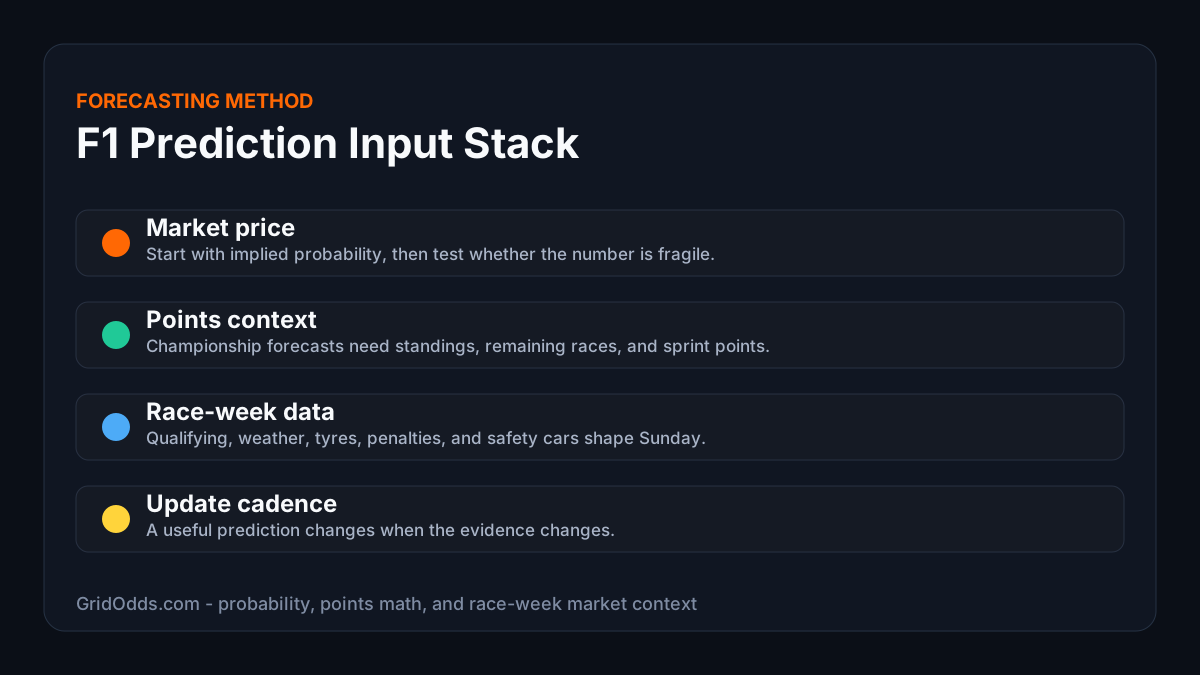
The market price is the starting point, not the whole answer. The best F1 forecast comes from checking whether the market probability agrees with five core inputs.
1. Standings and remaining points
Championship predictions are constrained by arithmetic. A driver 40 points behind with 17 races left is in a very different position from a driver 40 points behind with four races left. Early in the season, probabilities can swing violently because the remaining points pool is huge. Late in the season, the same gap becomes more decisive because fewer events remain to repair it.
That is why the F1 points calculator is a useful companion to any title forecast. It turns vague comeback talk into a concrete question: how many points are left, and how many perfect weekends would the challenger need?
2. Car pace across circuit types
A car that dominates one kind of circuit may not carry the same advantage everywhere. Monaco rewards qualifying, traction and track position. Spa and Monza reward efficiency and straight-line performance. Singapore stresses tyre temperature, cooling and driver precision. A prediction that ignores circuit type is usually just a standings recap with extra words.
When a team performs across low-speed street circuits, high-speed tracks and mixed layouts, the market tends to trust that performance more. When performance is circuit-specific, the forecast should stay wider.
3. Qualifying position
For race prediction, qualifying is often the biggest pre-race update. A driver can have the best long-run pace and still be a poor race pick if they start behind slower cars on a circuit where overtaking is difficult. Conversely, a clean pole position can make a merely competitive car look like the strongest Sunday forecast.
This is why broad race prediction pages should be updated after qualifying rather than written once on Monday. If you are reading odds before qualifying, treat them as a preliminary forecast. If you are reading them after qualifying, the range has narrowed.
4. Weather and safety car risk
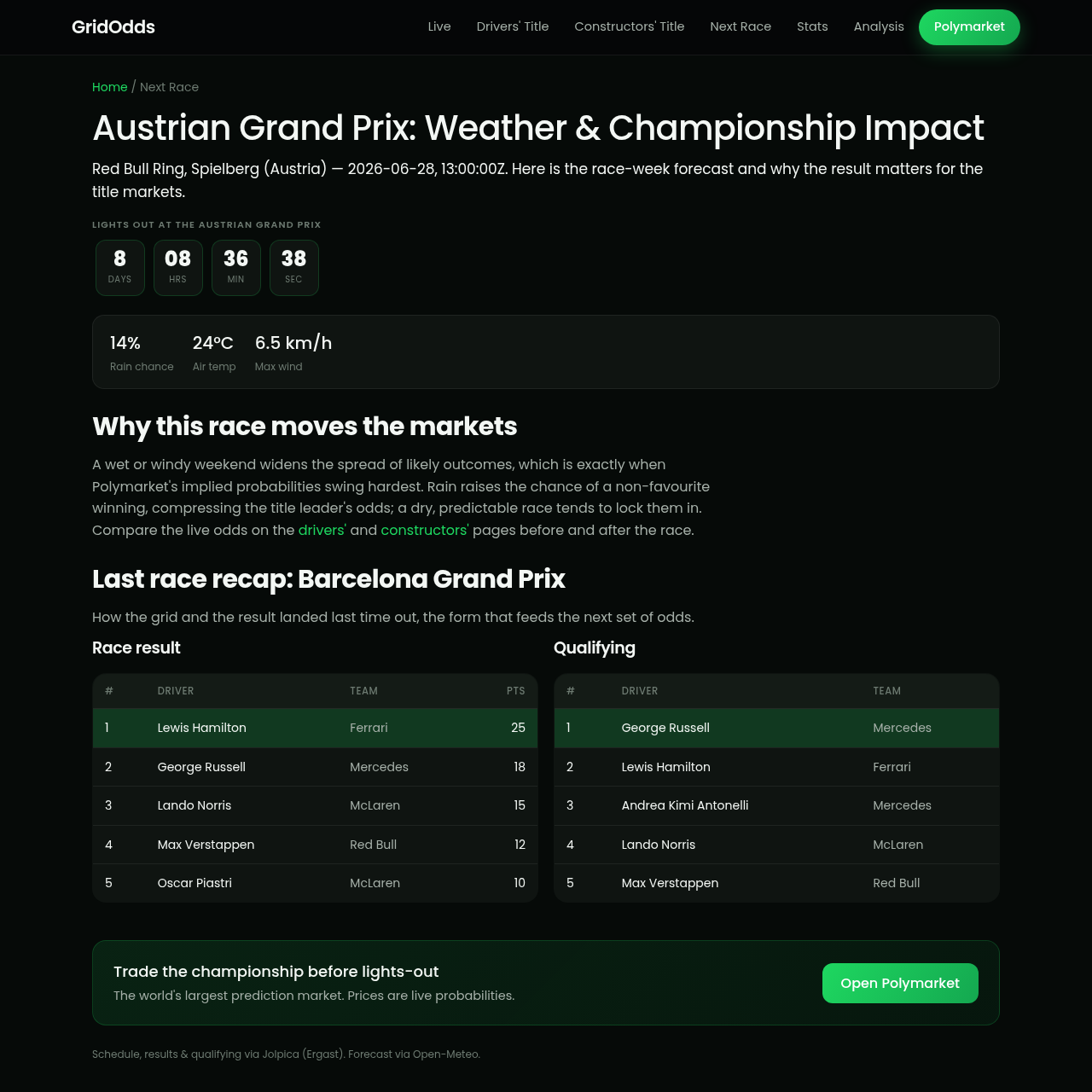
Weather changes the shape of an F1 prediction because it increases variance. Rain compresses pace gaps, raises mistake probability and gives strategy teams more chances to win or lose the race from the pit wall. A wet race does not make every driver equally likely, but it does pull probability away from the clean dry-race favourite and spread it across more outcomes.
For weather-heavy weekends, use the F1 weather odds guide and any race-specific weather page before treating the market favourite as stable.
5. Reliability and penalties
Reliability is the least glamorous input and one of the most important. A driver with a dominant car but a looming power-unit penalty has a different forecast from the same driver with a clean component pool. Gearbox changes, grid penalties, parc ferme setup misses and sprint-weekend damage all belong in the prediction.
The market often reacts quickly to confirmed penalties, but it can underprice risk before official confirmation. That is where monitoring team news and practice-session behaviour can add context.
F1 Race Prediction vs Championship Prediction
Race predictions and championship predictions use overlapping evidence, but they should not be blended into the same mental model.
An F1 race prediction is short-horizon. It cares heavily about the specific circuit, qualifying order, tyre allocation, weather, safety car probability and the gap between practice pace and race pace. It can change in hours. A rain cell moving over the circuit or a five-place grid penalty can turn the forecast upside down.
An F1 championship prediction is long-horizon. It cares about points gaps, development trajectory, team consistency, reliability, teammate dynamics and the remaining calendar. One bad qualifying session matters, but it usually matters only through the points it is expected to cost.
This is why a driver can be the race favourite without being the title favourite, or the title favourite without being the best pick for the next grand prix. The time horizon changes the forecast.
How Prediction Markets Fit In
Prediction markets are especially useful for F1 because the season produces constant new information. Every practice session, qualifying result, strategy call, retirement and steward decision can move probabilities. A static article cannot keep up with that by itself. A live market can.
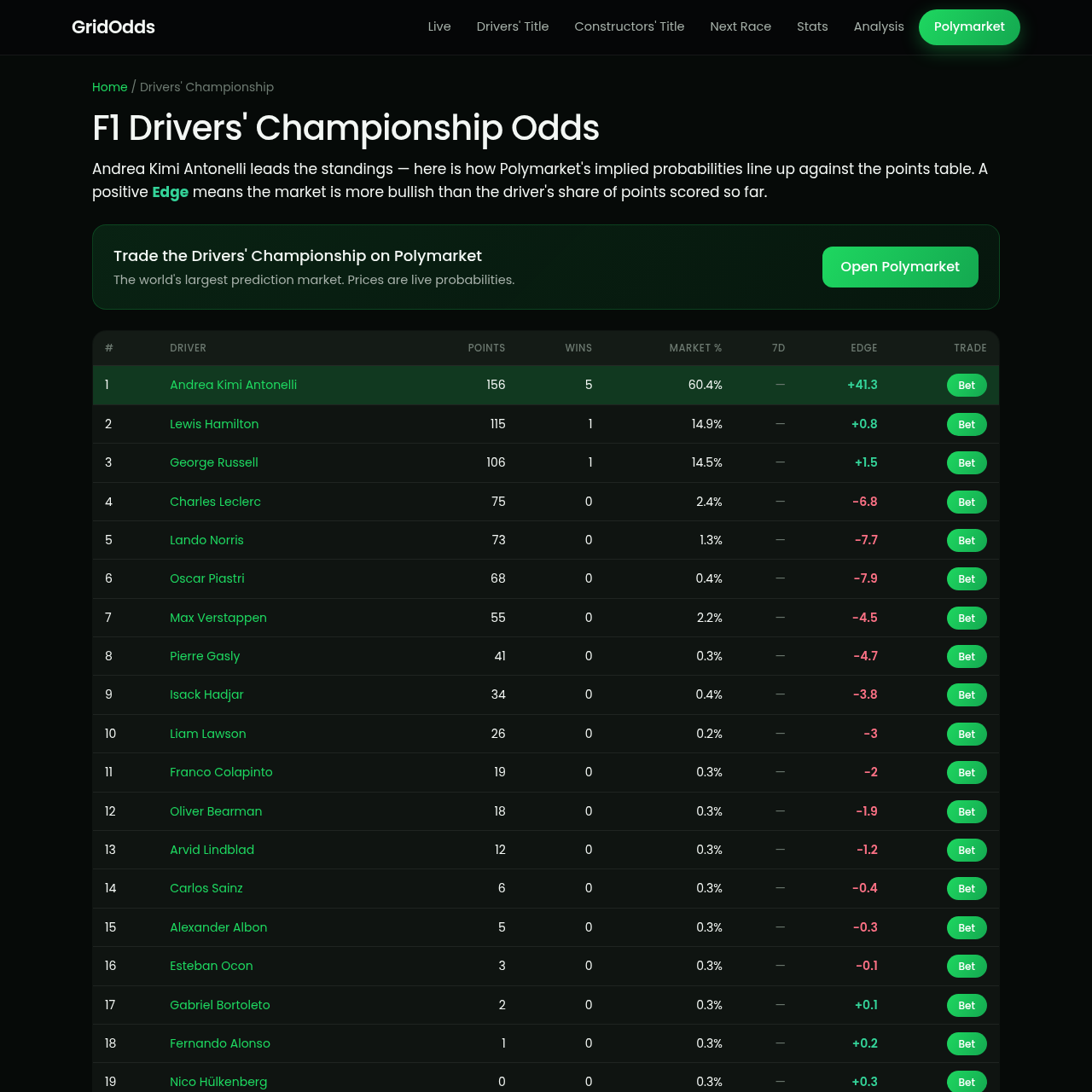
On a platform such as Polymarket, a championship contract trades between $0 and $1. A Yes price of $0.31 implies about a 31% market probability. If the driver wins the championship, the contract resolves to $1. If not, it resolves to $0. The exact mechanics are explained in the F1 on Polymarket guide, but the important point for prediction readers is simple: the market price is a live probability signal.
Markets still have weaknesses. They can overreact to dramatic incidents, underreact to technical development, and carry popularity premiums for famous drivers. Liquidity also matters. A deep championship market deserves more trust than a thin novelty market. But when the market is liquid, it is one of the cleanest public forecasting signals available.
How to Build a Practical F1 Prediction Workflow
If you want a repeatable workflow, use this order:
- Start with the market price. Convert the odds or contract price into implied probability.
- Check the standings. For title forecasts, compare the probability with the actual points gap and remaining races.
- Check the circuit. For race forecasts, decide whether the circuit rewards qualifying, tyre life, straight-line speed or wet-weather execution.
- Wait for qualifying when possible. Pre-qualifying race predictions should stay broad; post-qualifying forecasts can be sharper.
- Layer in weather and reliability. Rain, penalties and component risk are the biggest sources of forecast drift.
- Re-check after each session. The value of a prediction is how quickly it updates when the evidence changes.
This workflow sounds simple, but it prevents the most common mistake: treating a single number as if it explains the whole weekend. The market price tells you where consensus is. The supporting inputs tell you whether that consensus is fragile.
Where the Current Keyword Opportunity Sits
The search data behind this page is straightforward. People search for broad terms like F1 prediction and Formula 1 predictions, but the results are a mixed set of prediction games, academic models, market pages and forum threads. That leaves room for a practical forecasting hub that explains how to read the numbers and then points readers into live GridOdds data.
The stronger cluster is not just one page. It is a hub-and-spoke set:
- F1 prediction for the overall method.
- F1 race prediction for the next-grand-prix workflow.
- F1 prediction model for probability, implied odds and data inputs.
- F1 podium prediction for race-prop style forecasts.
- F1 prediction market for the Polymarket/Kalshi-style information angle.
This page is the hub. The existing GridOdds championship, weather, Polymarket and odds pages are the proof base. Future race-specific articles can link back here when they need to explain why a 35% favourite is still a risky pick.
Common F1 Prediction Mistakes
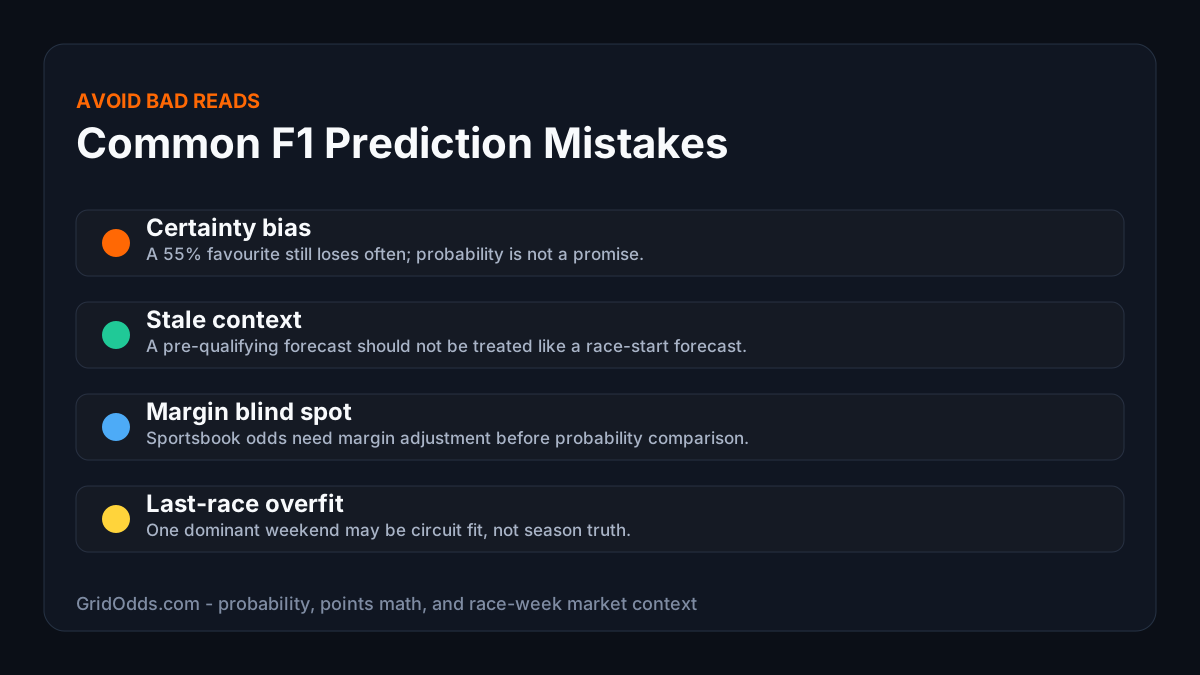
The first mistake is confusing probability with confidence. A 55% favourite is still expected to lose 45 times out of 100. If you read that as certainty, the market will feel wrong whenever the underdog wins. The market was not necessarily wrong; the low-probability branch happened.
The second mistake is ignoring bookmaker margin. Traditional odds include an overround, so raw implied probabilities often add up to more than 100%. Prediction markets are cleaner as probability signals, though they bring their own liquidity and jurisdiction constraints.
The third mistake is using stale context. F1 changes quickly. A prediction written before qualifying, before rain arrives or before a grid penalty is confirmed can be directionally useful but no longer precise. The timestamp matters.
The fourth mistake is overfitting to the last race. A dominant win can reveal real pace, but it can also be circuit-specific. A poor result can expose weakness, but it can also come from one safety car or one bad pit stop. Good forecasts update without treating every new event as the whole truth.
The Bottom Line
The best F1 prediction is not the loudest pick. It is the forecast that states the probability, explains the inputs and updates when the evidence changes. That is the standard GridOdds is built around.
Use the market to anchor the forecast. Use standings and remaining points to test championship claims. Use qualifying, weather and circuit traits to sharpen race predictions. Then keep checking the live boards, because Formula 1 is a sport where the truth can move between Saturday afternoon and lap one.
If you want the live version of this framework, start with the drivers championship probabilities, compare them with the constructors championship market, and then check the next race context before making any read on the weekend.
Frequently Asked Questions
- What is the best way to make an F1 prediction?
Start with the market-implied probability, then adjust your interpretation using standings, car pace, qualifying form, weather, circuit type, reliability and remaining points. A good F1 prediction is a probability range, not a guaranteed winner.
- Are F1 prediction markets better than pundit predictions?
Prediction markets are often more useful because they update continuously and attach a probability to each outcome. Pundit predictions can still add context, but a liquid market price shows what traders are willing to risk money on right now.
- Can F1 race predictions be accurate before qualifying?
Pre-qualifying race predictions are weaker because grid position is one of the strongest inputs for most circuits. Before qualifying, use a wider range and focus on car pace, weather and circuit fit. After qualifying, the race forecast can tighten.
- How do I turn F1 odds into prediction probability?
On prediction markets, a Yes price of $0.42 implies roughly a 42% probability. For decimal sportsbook odds, divide 1 by the decimal price and then account for bookmaker margin. GridOdds focuses on implied probability so the forecast is easier to compare.
- What moves an F1 prediction the most during a race weekend?
Qualifying position, weather changes, safety car risk, power-unit reliability news and long-run pace from practice usually move the forecast most. For championship predictions, points swings and DNFs are the largest single-race drivers.
- Is an F1 prediction the same as betting advice?
No. GridOdds uses market data for informational analysis. A probability can help explain what the market believes, but it is not financial, legal or betting advice. Prediction markets and wagering products involve risk and may be restricted by jurisdiction.