
F1 title race scenarios for 2026 look settled if you only read the market, and wide open if you only read the table. Kimi Antonelli arrives at Monza with 242 points and a 59-point lead, yet 283 points are still available. Both statements are true at the same time, and the distance between them is the whole story of the run-in.
This guide does the arithmetic properly. How many points are genuinely left, what each contender needs per event to close the gap, when the first drivers drop out of the maths, and the earliest round at which the championship can physically be settled. Then it puts that arithmetic next to what Polymarket is actually charging, because the two disagree in a way worth understanding.
Standings are current after the Dutch Grand Prix at Zandvoort on 23 August 2026, and market prices come from the GridOdds snapshot of 1 September 2026. For the live version, the drivers championship page updates through the race weekend.
Key takeaways
- 283 points remain for a driver: 11 Grands Prix and one sprint, at Singapore.
- Antonelli's 59-point lead is only about 21 per cent of what is still on the table.
- Nobody is mathematically eliminated yet, which is exactly why that phrase is close to meaningless in September.
- The earliest possible clinch is Singapore on 11 October, and only on a perfect-sweep assumption.
- Polymarket moved the chasing pack hard across the Dutch GP weekend and left the leader almost untouched.
Where the 2026 Title Race Stands
After twelve rounds, Antonelli leads on 242. George Russell and Lewis Hamilton are tied on 183, with Russell ahead on countback after winning the Zandvoort sprint and finishing third in the Grand Prix. Lando Norris is fourth on 159, Charles Leclerc fifth on 155, Max Verstappen sixth on 112 and Oscar Piastri seventh on 104.
The constructors' table reads Mercedes 425, Ferrari 338, McLaren 263, Red Bull 186. Those top two numbers are simply the drivers' table rearranged: Mercedes is Antonelli plus Russell, Ferrari is Hamilton plus Leclerc. The runner-up fight in the drivers' championship and the lead fight in the constructors' championship are the same argument seen from two angles.
Zandvoort mattered on both counts. Norris won it ahead of Antonelli and Russell for his second victory in a row after Hungary, while Verstappen crashed out of his home race on the opening lap. That single weekend is doing a lot of work in the current prices.
How Many Points Are Actually Left
Eleven rounds remain. Italy at Monza is round 13 on 4-6 September, and the season ends at Abu Dhabi, round 23, on 4-6 December. One sprint is left, at Singapore on 9-11 October, the last of the six sprints on the 2026 calendar.
A Grand Prix win is worth 25 points on the 25-18-15-12-10-8-6-4-2-1 scale. A sprint win is worth 8 on the 8-7-6-5-4-3-2-1 scale for the top eight only. The fastest-lap bonus point has not existed since 2025, so there is nothing else to add. The maximum a driver can still score is therefore 11 x 25 + 8, which is 283. For a team running two cars, the maximum is 11 x 43 + 15, which is 488.
Set the lead against that pool and the picture changes. A 59-point advantage is 20.8 per cent of 283: a two-goal lead at half time, not in the ninetieth minute. The F1 points calculator guide walks through the same maths driver by driver if you want to run other scenarios.
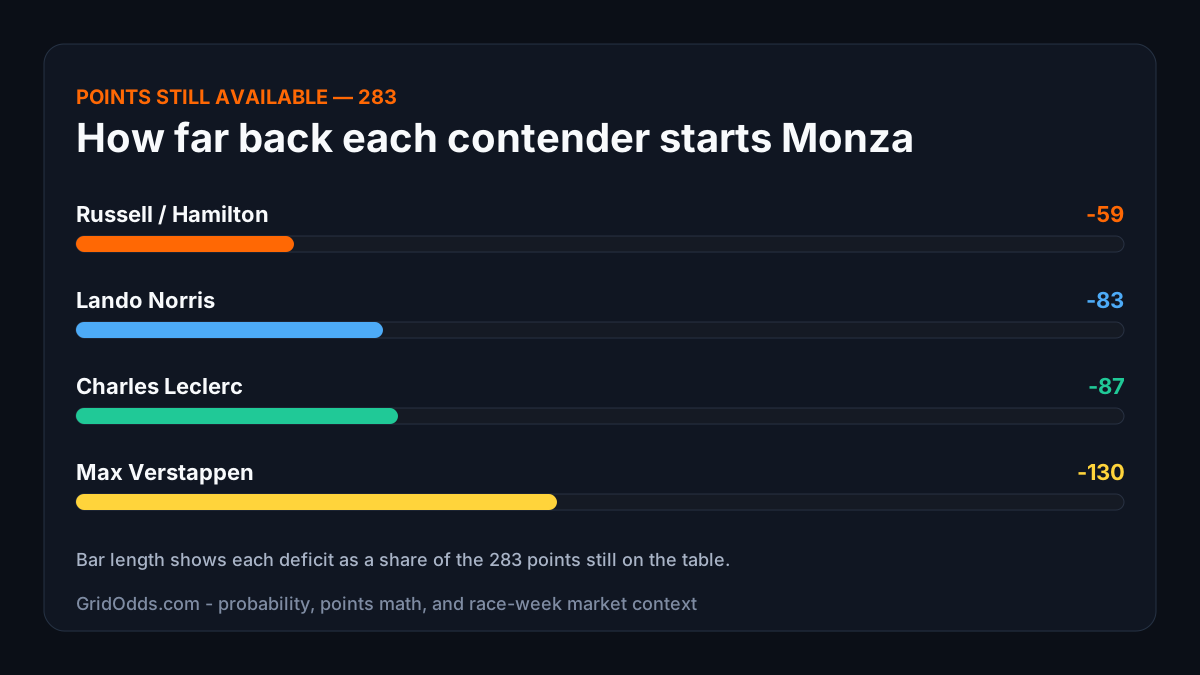
What Each Contender Needs Per Event
Twelve scoring events remain: eleven Grands Prix plus the Singapore sprint. Divide each deficit by twelve and the required rate looks almost gentle. Russell and Hamilton need 4.9 net points per event. Norris needs 6.9. Leclerc needs 7.3. Verstappen needs 10.8.
The word doing the heavy lifting is net. Gaining 4.9 points per event does not mean scoring 4.9 points. It means finishing that far ahead of Antonelli, every single time, for three months. One retirement resets the whole schedule.
Russell and Hamilton: Closest, and in Each Other's Way
The two drivers nearest the lead are tied on 183 and driving for different teams, which sounds like the ideal setup for a fight. In practice it is the opposite. Every weekend where one of them takes a chunk out of Antonelli, the other is usually close enough behind to be splitting the same swing. Their duel resolves who finishes second in the championship far more efficiently than it closes a 59-point gap on the driver in front.
Russell has the additional problem of sharing a garage with the leader. Mercedes has no incentive to engineer a fight that costs it a drivers' title it is currently winning.
Norris: The Form Pick the Market Rates Above the Points
Norris is fourth in the standings and second in the market. Polymarket had him at 8.0 per cent on 1 September, ahead of Russell at 6.9 and Hamilton at 6.2, both of whom are 24 points further up the table. That is a deliberate statement about form: two consecutive wins, and a reigning champion who took the 2025 title by two points at the final round in Abu Dhabi.
The arithmetic is less flattering. At Zandvoort, Norris beat Antonelli by exactly 7 points, 25 against 18. Repeat that precise margin at all eleven remaining Grands Prix and he gains 77, which still leaves him short of the 84 he needs to lead by a single point. Add a sprint win against an Antonelli second place and the total reaches 78. In other words, winning every single remaining round with Antonelli second every single time is not quite enough. Norris does not just need to keep winning; he needs Antonelli to fall off the podium somewhere.
Leclerc, Verstappen and the Outside Chances
Leclerc is 87 back and priced at 2.0 per cent. Verstappen is 130 back at 0.6 per cent, and the Zandvoort crash removed one of the few remaining chances to cut into that. Piastri sits on 104 points and 0.4 per cent.
Verstappen's required rate of 10.8 net points per event is roughly a race win against a rival who scores nothing, repeated a dozen times. The arithmetic permits it. Nothing else does. The drivers' championship odds guide covers why a market prices that distinction better than a table can.
Why Nobody Is Eliminated Yet, and Why That Means Little
The formal elimination test is simple. A driver is out when their current points plus the maximum still available fall below the leader's current total. With 283 available and Antonelli on 242, everybody clears that bar. A driver on zero points can still theoretically reach 283, which is more than the leader has today.
That changes quickly. After round 14 in Madrid on 11-13 September, the maximum still available drops to 233. Since Antonelli already has 242, every driver still on zero will be mathematically eliminated at that point regardless of what happens at Monza or Madrid.
The useful lesson is that "not mathematically eliminated" is close to worthless as information in September. It is also precisely why a 0.1 per cent price exists on the Polymarket board at all. The outcome is possible. It is not plausible. A good market charges the difference.
The Earliest the Title Can Be Clinched
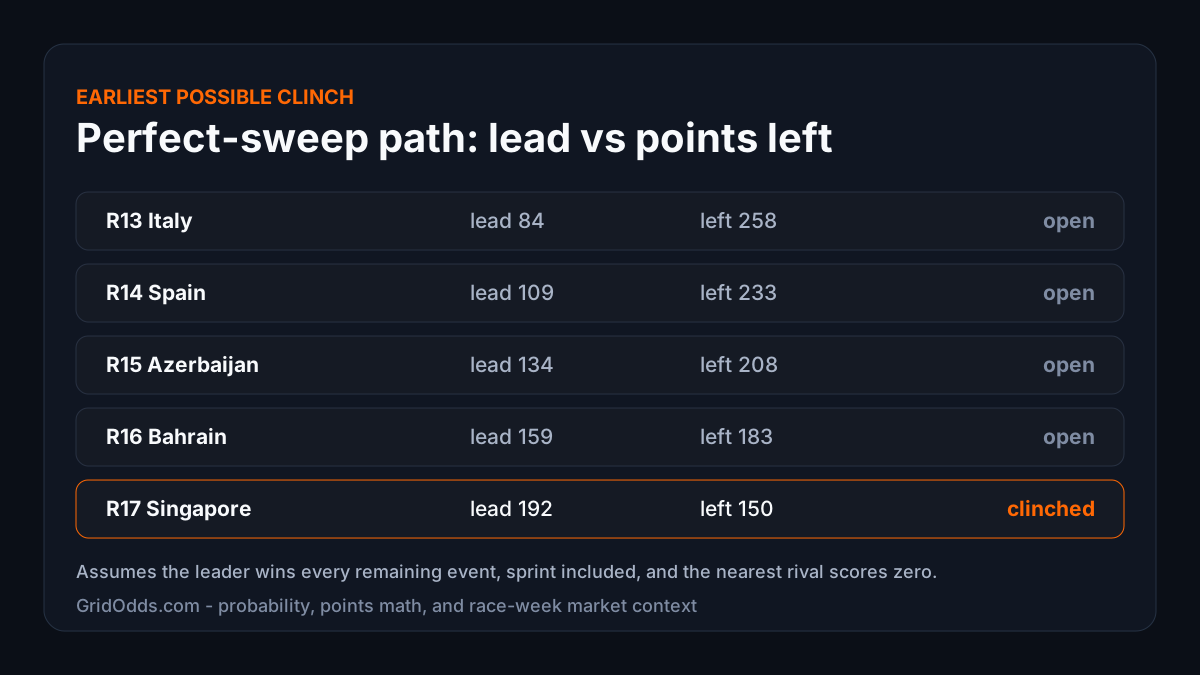
To clinch, the leader's advantage must exceed the maximum his nearest rival can still score. Every Grand Prix that Antonelli wins while that rival scores nothing swings the comparison by 50 points: 25 added to the lead, 25 removed from the pool.
Start at a 59-point lead against 283 available. Win Monza, Madrid, Baku and Bahrain with the nearest rival blanking each time and the lead reaches 159 against 183 still available, which is not enough. Take the Singapore sprint and it is 167 against 175, still short by 8. Win the Singapore Grand Prix itself and it becomes 192 against 150, and the championship is over.
So the earliest mathematically possible clinch is round 17, the Singapore Grand Prix on 11 October, and only on the assumption of five consecutive perfect weekends against a rival who scores nothing at all. Any realistic version of the same run pushes the decision into November, and the November stretch of Mexico, Brazil, Las Vegas and Qatar is not where anyone would choose to be defending on the edge.
What the Market Actually Did Across the Dutch GP Weekend
The GridOdds snapshot archive covers 20 August to 1 September, which brackets Zandvoort neatly. The movements are more interesting than the levels.
Antonelli went from 74.3 per cent on 20 August to 74.1 per cent on 1 September. Across a weekend in which he was beaten, that is effectively unchanged. Norris went from 2.4 per cent to 9.0 per cent on race day and settled at 8.0. Hamilton fell from 11.0 per cent to 6.2. Russell rose from 5.5 to 6.9.
Read as a whole, the weekend reshuffled the chasing pack almost completely while leaving the favourite alone. That is the signature of a market that has already made up its mind about who is winning and is now only re-ranking who the challenger is. The same pattern shows in the constructors' board, where Mercedes moved from 83.5 per cent to 91.5 and Ferrari fell from 13.3 to 6.9.
One more detail worth noticing. Across the full 22-name driver board, the quoted probabilities sum to roughly 99.7 per cent, with fifteen drivers pinned at 0.1. A board that lands that close to 100 is reasonably efficient, and it means the headline percentages can be read as probabilities without much adjustment. The expected value guide explains what to do when a board does not add up so tidily.
The Constructors' Race Is the Harder One to Reopen
Ferrari is 87 points behind Mercedes with 488 available to a two-car team, which as a ratio is not far off the drivers' gap. The market treats it very differently: Mercedes 91.5 per cent against Ferrari's 6.9.
The reason is structural. Closing a drivers' gap needs one car to beat one car. Closing a constructors' gap needs both cars to beat both cars, again and again. Ferrari would need Hamilton and Leclerc to out-score Antonelli and Russell by an average of more than seven points per round for eleven rounds. Single-car brilliance does not move that number; only a genuine pace advantage across the garage does. The constructors championship page tracks the live version of that gap.
How to Track This Through the Run-In
Three numbers are worth checking after every round: the lead against the points still available, whether the chasing pack is consolidating behind one challenger or splitting between several, and whether the market moved the leader's price at all. A weekend that changes the running order without changing the favourite has changed nothing important.
The stats page carries the round-by-round points and market history behind these figures.
Bottom Line
The 2026 championship is arithmetically open and practically narrow. Antonelli's 59-point lead covers only about a fifth of what remains, no driver has been eliminated, and the title cannot be settled before October even in the most lopsided scenario imaginable. Against that, the market has him at roughly three chances in four, because it is pricing the shape of the race rather than the size of the pool: a leader with the fastest package, two rivals splitting each other's points, and a challenger in Norris whose form is excellent but whose deficit needs more than winning to erase.
The honest summary is that the points say this is not over and the market says it very nearly is. Both are defensible. The thing to watch is which one starts moving toward the other, and Monza is the first chance to find out.
GridOdds publishes probability context and points analysis for education. It is not financial, legal or betting advice.