Mercedes won the 2026 constructors’ championship weeks ago and Kimi Antonelli wrapped up the drivers’ title at Mexico City. So if you search for F1 constructors’ third place 2026 odds right now, you are looking for the last thing in the team standings that is still undecided — and you will not find a price on it anywhere.
Red Bull are third on 415 points, McLaren fourth on 398, and there are three races left. Seventeen points, 129 still available, and the difference between third and fourth in the constructors’ table is the kind of money teams restructure departments over. It is the one championship question Las Vegas, Qatar and Abu Dhabi can still answer.
Polymarket has no market on it. Neither do the sportsbooks. What Polymarket does have is three per-race constructor books that are completely untraded placeholders, and one genuinely liquid race-winner book — so I pulled all four, checked the standings against the official FIA classification and the Jolpica feed, and did the clinch arithmetic by hand. Every price and points total below was read on 18 November 2026, after round 20 in Brazil.
Key takeaways
- McLaren need a net 18 points on Red Bull in three races — an average of six a race. Not impossible, but they have not out-scored Red Bull by that margin in any single race this season without help.
- No market anywhere prices the constructors’ finishing order. The 2026 constructors’ championship book resolved to Mercedes and closed. Nothing replaced it for the places behind.
- The three per-race constructor books are noise, not signal. Las Vegas sums to 493%, Qatar to 510.75%, Abu Dhabi to 506%, on combined volume of about $140. Cadillac is priced at 4¢ in Las Vegas and 45.75¢ in Qatar.
- The liquid book answers the question indirectly. Aggregate the Las Vegas winner market by team and Red Bull are 38.85% to win the race against McLaren’s 13.70% — 2.8 times more likely, on $6,273 of real volume.
- Red Bull’s earliest clinch is Qatar, and it needs them to out-score McLaren by 27 across Las Vegas and Qatar. Any less and this goes to Abu Dhabi on 6 December.
- Where the constructors’ standings actually stand
- Third is the only fight left in the table
- What McLaren need: 18 points in three races
- When Red Bull can mathematically seal third
- Nobody prices the constructors’ order
- What the one liquid book says instead
- Where each team’s 2026 points came from
- How to track the clinch yourself
- Sources and method
Where the constructors’ standings actually stand
Round 20 in Brazil is complete and three rounds remain: Las Vegas on 22 November, Qatar on 29 November and Abu Dhabi on 6 December. None of the three is a sprint weekend, which matters for the arithmetic — a team’s maximum haul per race is 43 points, a one-two finish, with no sprint points and no fastest-lap bonus in the current system.
That caps what is still on the table at 129 points per team. Here is the full classification as the FIA has it after Brazil, with the gap to the car in front and what each team could theoretically still add.
| Pos | Team | Points | Gap ahead | Max available | Theoretical ceiling |
|---|---|---|---|---|---|
| 1 | Mercedes | 652 | — | 129 | 781 (champion) |
| 2 | Ferrari | 510 | 142 | 129 | 639 |
| 3 | Red Bull | 415 | 95 | 129 | 544 |
| 4 | McLaren | 398 | 17 | 129 | 527 |
| 5 | Racing Bulls | 114 | 284 | 129 | 243 |
| 6 | Alpine | 69 | 45 | 129 | 198 |
| 7 | Haas | 31 | 38 | 129 | 160 |
| 8 | Audi | 28 | 3 | 129 | 157 |
| 9 | Williams | 12 | 16 | 129 | 141 |
| 10 | Aston Martin | 7 | 5 | 129 | 136 |
| 11 | Cadillac | 0 | 7 | 129 | 129 |
The theoretical ceiling column is there to be ignored, mostly. Two cars cannot both finish first, so every team in the table cannot simultaneously score 129. It is useful for exactly one purpose: working out who is mathematically eliminated from what, which is the next section.

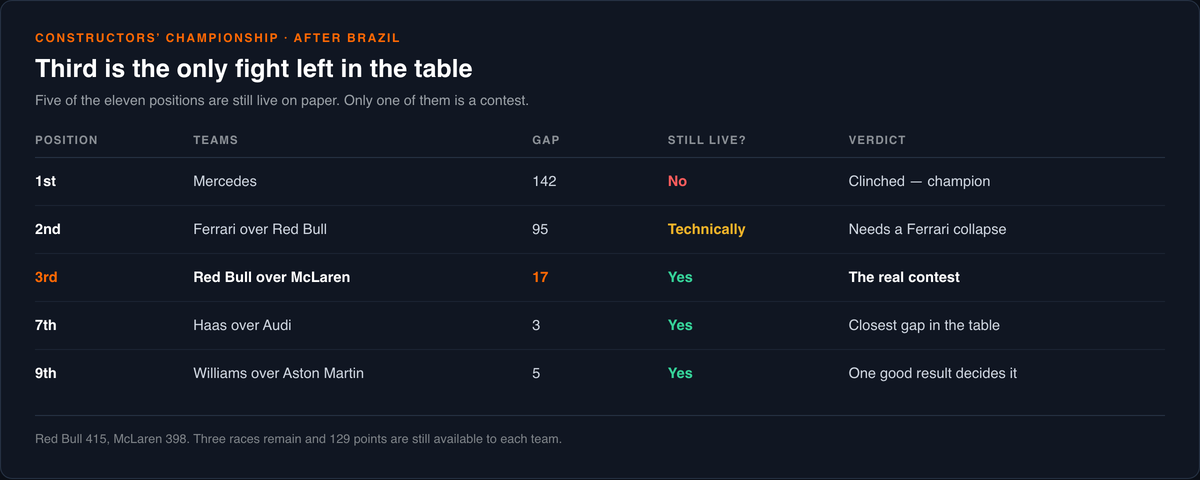
Third is the only fight left in the table
Mercedes are champions and 142 clear of Ferrari, so the top of the table is finished. The interesting boundary is the one between second and third, and it is closer to settled than the raw 95-point gap suggests.
Ferrari need only to avoid a collapse. With 129 available, Red Bull are not yet mathematically eliminated from second — but closing 95 points in three races requires Red Bull to average a one-two while Ferrari average almost nothing. For that to happen Ferrari would need roughly three retirements across two cars and three races. I would price that in the low single digits, and the market, as we will see, agrees by implication.
| Position fight | Teams | Gap | Still live? | Verdict |
|---|---|---|---|---|
| 1st | Mercedes | 142 | No | Clinched — champion |
| 2nd | Ferrari over Red Bull | 95 | Technically | Needs a Ferrari collapse |
| 3rd | Red Bull over McLaren | 17 | Yes | The real contest |
| 7th | Haas over Audi | 3 | Yes | Closest gap in the table |
| 9th | Williams over Aston Martin | 5 | Yes | One good result decides it |
Two of those midfield fights are tighter in absolute points than the Red Bull–McLaren one. Haas and Audi are separated by three points and Williams and Aston Martin by five. They get less attention because the prize-money steps are smaller, but if you want a genuinely coin-flip constructors’ outcome to watch in Abu Dhabi, seventh place is the better television.
Third, though, is the fight with four race-winning cars in it, and it is the one with a number attached.
What McLaren need: 18 points in three races
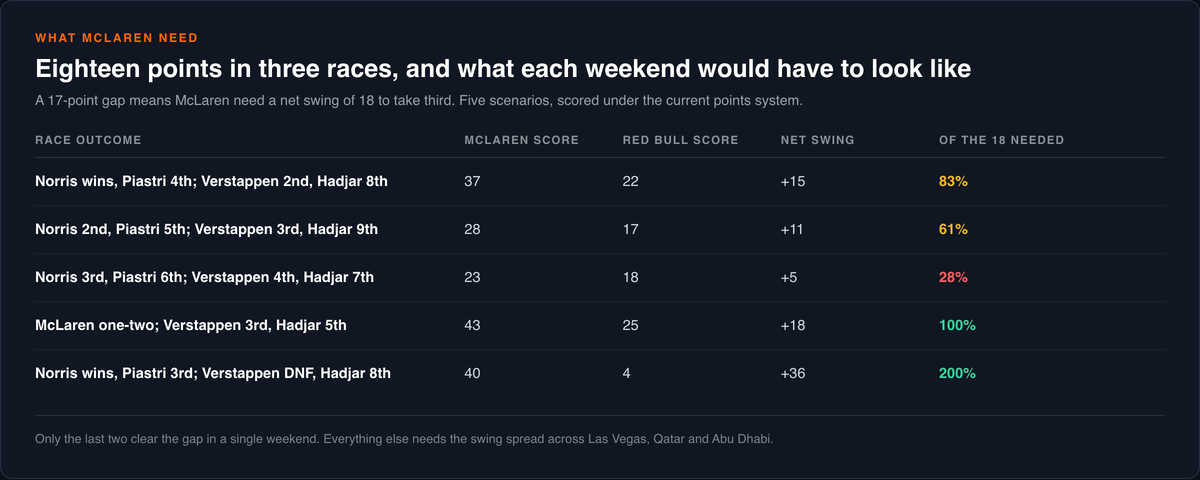
A 17-point deficit means McLaren need a net swing of 18 points to finish third, because a dead heat on points would go to countback on best finishes. Across three races that is an average of six points a race — which sounds trivial until you convert it into finishing positions.
A net six points is McLaren finishing third and fifth while Red Bull finish fourth and sixth. It is not a disaster for Red Bull; it is a mildly worse Sunday, three times running. The table below converts plausible race outcomes into the net swing each one delivers.
| Race outcome | McLaren score | Red Bull score | Net swing | Of the 18 needed |
|---|---|---|---|---|
| Norris wins, Piastri 4th; Verstappen 2nd, Hadjar 8th | 37 | 22 | +15 | 83% |
| Norris 2nd, Piastri 5th; Verstappen 3rd, Hadjar 9th | 28 | 17 | +11 | 61% |
| Norris 3rd, Piastri 6th; Verstappen 4th, Hadjar 7th | 23 | 18 | +5 | 28% |
| McLaren one-two; Verstappen 3rd, Hadjar 5th | 43 | 25 | +18 | 100% |
| Norris wins, Piastri 3rd; Verstappen DNF, Hadjar 8th | 40 | 4 | +36 | 200% |
Read the bottom two rows together and the shape of McLaren’s problem is clear. A clean McLaren one-two against a podium Verstappen delivers exactly the 18 they need — in one race, needing nothing from the other two. But they have not managed a one-two this season, and the far likelier route is the last row: a Verstappen retirement, which hands them double what they need in a single afternoon.
So McLaren are not really betting on their own pace. They are betting on Red Bull losing a car, and Verstappen has won three of the last four races.
McLaren’s own racing director puts it more diplomatically. Randy Singh told the F1 Nation podcast the team would “do our best to make sure it goes down to the wire and in our favour”, and that it “doesn’t feel like any less pressure than the last couple of season finales”. The venue does not help them: by Singh’s own account McLaren have taken just 17 points from the last three Las Vegas races, on a circuit where he notes the grip “can be very low”.
When Red Bull can mathematically seal third
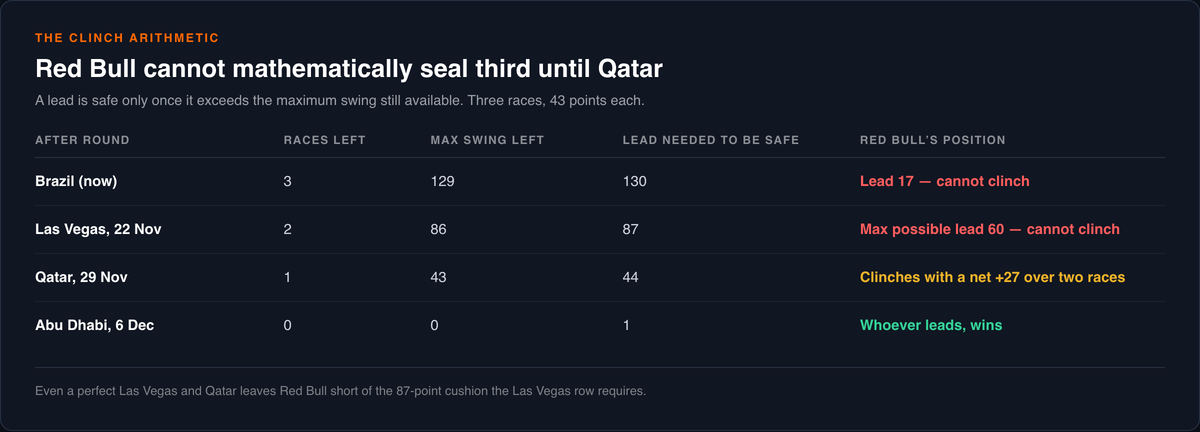
A lead is safe when it is larger than everything the chasing team can still take out of it. With 43 points available per race, the threshold drops in 43-point steps, and that gives three clean checkpoints.
| After round | Races left | Max swing left | Lead needed to be safe | Red Bull’s position |
|---|---|---|---|---|
| Brazil (now) | 3 | 129 | 130 | Lead 17 — cannot clinch |
| Las Vegas, 22 Nov | 2 | 86 | 87 | Max possible lead 60 — cannot clinch |
| Qatar, 29 Nov | 1 | 43 | 44 | Clinches with a net +27 over two races |
| Abu Dhabi, 6 Dec | 0 | 0 | 1 | Whoever leads, wins |
Red Bull cannot wrap up third in Las Vegas no matter what happens there. Even a Red Bull one-two against a pointless McLaren weekend only takes the lead to 60, and 60 is not safe when 86 is still available. That is worth knowing before Sunday: no result in Nevada ends this.
Qatar is the first real opportunity. Red Bull need a 44-point lead with one race to go, which from 17 means out-scoring McLaren by 27 across Las Vegas and Qatar — roughly a podium-and-points weekend against a McLaren double-miss, twice. Possible, not likely.
The honest expectation is that this goes to Abu Dhabi, which is also what the fight deserves. And the same arithmetic run on Ferrari produces a sharper line: Ferrari’s 95-point lead needs to still be 87 after Las Vegas, so Ferrari seal second place in Las Vegas unless Red Bull out-score them by nine points or more on the night.
Nobody prices the constructors’ order
Here is the gap that sent me down this road. The 2026 constructors’ championship market on Polymarket resolved to Mercedes and closed. Nothing opened to replace it for the places behind. There is no “constructors’ runner-up” book, no third-place book, no finishing-order market of any kind — which is odd, because Polymarket did open second-, third-, fourth- and fifth-place books on the drivers’ championship in October.
The drivers got a placement ladder. The teams did not. What the teams have is three per-race “which constructor scores first” books, one for each remaining round, and they are in no state to tell you anything.
| Book | Outcomes | Book sums to | Volume traded | Cadillac priced at |
|---|---|---|---|---|
| Las Vegas: Which Constructor Scores 1st? | 11 | 493.00% | $122.15 | 4.00¢ |
| Qatar: Which Constructor Scores 1st? | 11 | 510.75% | $17.45 | 45.75¢ |
| Abu Dhabi: Which Constructor Scores 1st? | 11 | 506.00% | no volume | 46.00¢ |
A one-winner market should sum to about 100%. These sum to roughly 500%, because every line is parked near 46–49¢ and nothing has traded against it. Mercedes and Cadillac are quoted within four cents of each other in Qatar — Mercedes being the champion and Cadillac being a team on zero points after 20 races. That is not an opinion about Qatar; it is an untouched placeholder.
The giveaway is Cadillac itself: 4¢ in Las Vegas, where a trader clearly did touch the line, and 45.75¢ in Qatar, where nobody has. Same team, same form, same three-week window, a 42-cent difference. If you have read our piece on why a fair podium book sums to 300%, this is the same pathology with the overround cranked up five times.
So the direct answer to “what are the odds on F1 constructors’ third place” is that there are none, and the three numbers that look like odds should be ignored. The useful signal is one market over.
What the one liquid book says instead
The Las Vegas race-winner market is the exception: $6,273 traded, $228,221 of resting liquidity, and a book that sums to 103.65% — a 3.65% overround, which is tighter than most sportsbooks manage on a Formula 1 race. That one is worth reading.
It prices drivers, not teams. But a constructors’ championship is just two drivers added together, so adding the two lines per team converts a driver market into the team market nobody opened.
| Team | Driver 1 | Driver 2 | Team win probability | Combined podium probability |
|---|---|---|---|---|
| Red Bull | Verstappen 37.50% | Hadjar 1.35% | 38.85% | 90.50% |
| Mercedes | Antonelli 21.00% | Russell 13.50% | 34.50% | 109.00% |
| McLaren | Norris 11.50% | Piastri 2.20% | 13.70% | 48.50% |
| Ferrari | Hamilton 5.00% | Leclerc 4.50% | 9.50% | 44.00% |
The podium column is a sum of three-slot probabilities, so it reads as expected podium appearances rather than a chance of anything — Mercedes’ 109% means they are expected to fill slightly more than one of the three places, not that they are certain of one.
Red Bull are 2.8 times more likely than McLaren to win in Las Vegas, and 1.9 times more likely to appear on the podium. A market that genuinely thought McLaren were about to take 18 points out of Red Bull would not look like that. The traders with real money on this weekend are pricing Red Bull as the stronger car, and the 17-point gap as more likely to grow than shrink.
Which is exactly what the missing constructors’ market would have told you, if anyone had opened it.
Where each team’s 2026 points came from
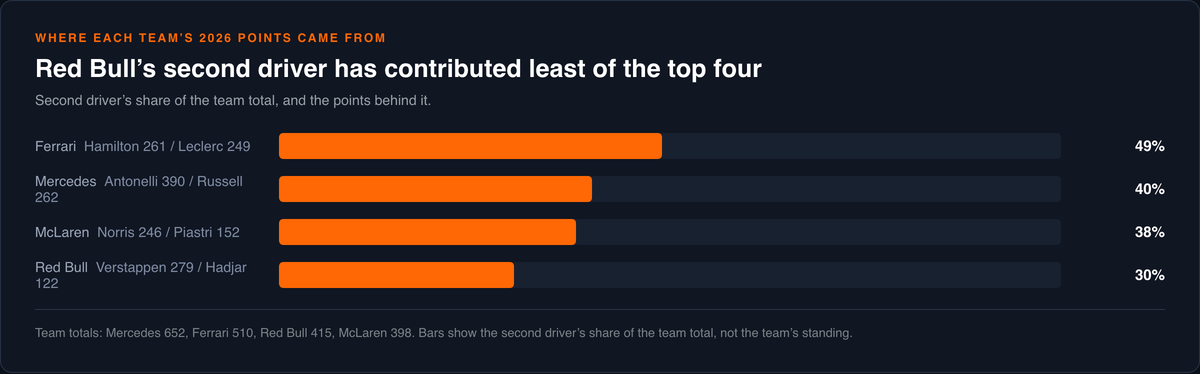
One more thing the standings hide: a team’s total is a story about two drivers, and these two teams got to within 17 points of each other by completely different routes.
| Team | Lead driver | Second driver | Second driver’s share | Team total |
|---|---|---|---|---|
| Mercedes | Antonelli 390 | Russell 262 | 40% | 652 |
| Ferrari | Hamilton 261 | Leclerc 249 | 49% | 510 |
| Red Bull | Verstappen 279 | Hadjar 122 | 30% | 415 |
| McLaren | Norris 246 | Piastri 152 | 38% | 398 |
Ferrari are the balanced team — Hamilton and Leclerc within 12 points of each other — and it has them second. Red Bull are the most lopsided: Verstappen has scored more than twice what Hadjar has, and 279 of the team’s points sit in one car.
That concentration is the whole risk in Red Bull’s position. A Verstappen retirement does not cost them a podium, it costs them most of a weekend’s scoring, and Hadjar’s 1.35% win line in Las Vegas says the market does not expect the second car to cover for him. McLaren’s 38% second-driver share is healthier, but Piastri’s 2.20% win line says the same thing in a quieter way: both of these teams are one-car operations on current form.
If you want to run these splits yourself as the last three races land, the constructors’ points calculator takes the per-race scores and shows the comeback paths directly.
How to track the clinch yourself
Three numbers decide this, and you can check all three on a Sunday evening in about a minute.
One: the gap. Take Red Bull’s total minus McLaren’s from the FIA classification once the race is official, not from a live timing screen — penalties after the flag have swung this by points before.
Two: what is left. Multiply the remaining races by 43. Two races left is 86, one is 43.
Three: compare them. If the gap is bigger than what is left, third place is settled. If the gap is bigger than 43 going into Abu Dhabi, it is over before the lights. Everything else is noise, including the per-race constructor books.
And if you want the market’s read rather than the arithmetic, use the race-winner book rather than the constructor book: add the two drivers per team, and check the book sums near 100% before you trust it. A book at 500% is not telling you anything.
Sources and method
Standings are the FIA/Formula 1 official 2026 team classification after round 20, cross-checked against the Jolpica F1 feed; both return the same totals (Mercedes 652, Ferrari 510, Red Bull 415, McLaren 398). The official table is published at formula1.com. Market prices are from the Polymarket Gamma and CLOB APIs, read on 18 November 2026; the Las Vegas constructor book is public here. The Randy Singh quotes are as reported by news.gp from the F1 Nation podcast.
One discrepancy worth flagging, because it affects the driver-contribution table rather than the standings: Red Bull’s official 415 is 14 points more than Verstappen’s 279 and Hadjar’s 122 add up to. The public driver feed attributes those 14 points to a driver now listed against Racing Bulls, whose own driver totals correspondingly exceed its team total by the same 14. The constructors’ figures are confirmed by two independent sources and are the ones used for every calculation here; I have left the 14 points where the official table puts them and flagged the mismatch rather than guessing at its cause.
Points arithmetic assumes the current system — 25-18-15-12-10-8-6-4-2-1, no fastest-lap point, no sprint at Las Vegas, Qatar or Abu Dhabi — giving a 43-point per-race maximum per team and 25 per driver.
Related analysis
- F1 Constructors’ Championship Odds & Standings 2026 — the full-season market view of the team table.
- F1 Constructors’ Title 2026: When Can Mercedes Clinch? — the same clinch arithmetic applied to the title Mercedes have now won.
- F1 2026 Final Standings Odds: Five Drivers, 40 Points — the drivers’ placement books, which did open.
- Las Vegas Grand Prix Odds 2026 — the race that cannot settle third but can shape it.
- F1 Podium Odds 2026: Why a Fair Book Sums to 300% — how to read an overround before you trust a price.