Mercedes lead the 2026 F1 constructors' championship by 122 points with ten rounds to run, and almost every version of the "when do they clinch it" answer floating around the internet is wrong. The two I keep seeing are Singapore and "it is already over". Singapore requires Ferrari to score nothing for four consecutive weekends. "Already over" is not a thing the points table can say until the arithmetic says it.
So I did the arithmetic properly. I took the official classification after round 13 at Monza, the confirmed 2026 points scale, and the remaining calendar including its one surviving sprint, and ran the clinch condition round by round under three different assumptions about how the rest of the season goes.
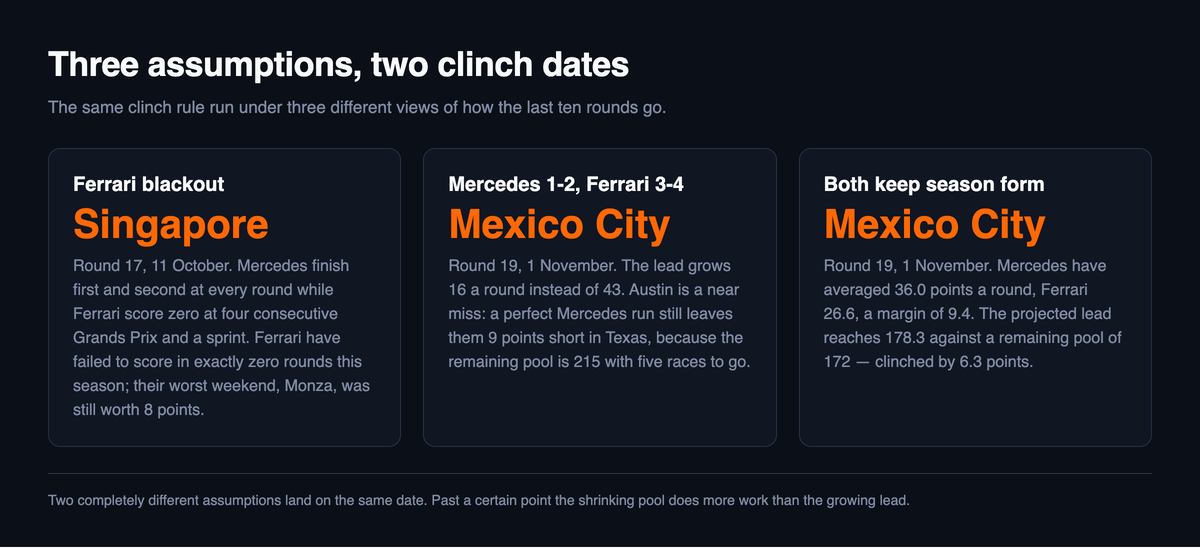
The short version: the earliest mathematically possible clinch is the Singapore Grand Prix on 11 October, but it needs a Ferrari blackout that has not happened once this year. On any path where Ferrari keep scoring like a normal second-place team, the title is sealed at the Mexico City Grand Prix on 1 November, round 19 of 23. Polymarket already prices Mercedes at 93.6 per cent, which is a reasonable forecast and a terrible description of the standings.
Key takeaways
- Mercedes have 468 points to Ferrari's 346 after 13 of 23 rounds, a lead of 122 with 445 still available to any single team.
- The earliest possible clinch is Singapore, round 17 on 11 October — and only if Mercedes finish first and second at every round while Ferrari score zero points four weekends running.
- On the realistic paths, both the "Mercedes 1-2, Ferrari third and fourth" case and the "both teams keep their season averages" case land on the same date: the Mexico City Grand Prix, round 19 on 1 November.
- Ferrari need to outscore Mercedes by 12.3 points per round for ten straight rounds. Their best single weekend of 2026 was worth 20, and they have outscored Mercedes in only 4 of 13 rounds.
- Polymarket has Mercedes at 93.6 per cent, and the whole constructors' board summed to just 96.9 per cent on Madrid Saturday — 3.1 points of probability that simply left the table rather than moving to a rival.
Where the Constructors' Title Stands After Monza
Round 13 at Monza was the round that turned a lead into a position. Mercedes took 43 points there, Ferrari took 8, and a 87-point gap became 122. Here is the full table, with the thing most standings pages leave out: what each team's maximum possible final score is, and therefore whether they are still alive at all.
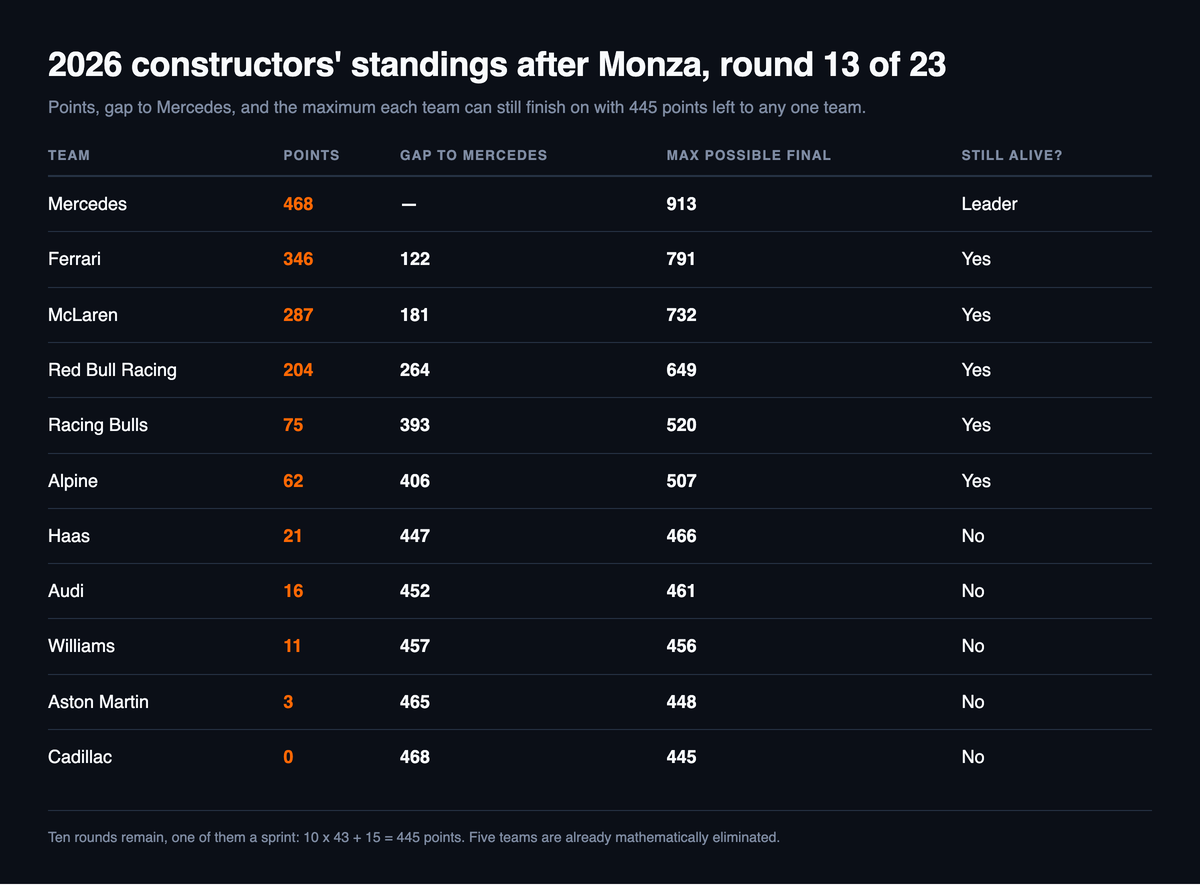
Both cars score and the team total is the sum, as Formula 1's own guide to the constructors' championship sets out, so a team can score at most 43 points at a Grand Prix (a first and second finish, 25 plus 18) and 15 at a sprint (8 plus 7). Ten rounds remain, one of them — Singapore — carrying a sprint. That is 10 x 43 + 15 = 445 points still on the table for any one team.
| Team | Points | Gap to Mercedes | Max possible final | Still alive? |
|---|---|---|---|---|
| Mercedes | 468 | — | 913 | Leader |
| Ferrari | 346 | 122 | 791 | Yes |
| McLaren | 287 | 181 | 732 | Yes |
| Red Bull Racing | 204 | 264 | 649 | Yes |
| Racing Bulls | 75 | 393 | 520 | Yes |
| Alpine | 62 | 406 | 507 | Yes |
| Haas | 21 | 447 | 466 | No |
| Audi | 16 | 452 | 461 | No |
| Williams | 11 | 457 | 456 | No |
| Aston Martin | 3 | 465 | 448 | No |
| Cadillac | 0 | 468 | 445 | No |
Five teams are already mathematically eliminated from the 2026 constructors' championship: Haas, Audi, Williams, Aston Martin and Cadillac cannot reach 468 even by winning everything left. Alpine, on 62 points, technically can. That is what "mathematically alive" is worth in September, and it is exactly why a clinch date is a more useful number than an elimination list. Standings figures throughout this piece come from the official Formula 1 team standings, cross-checked against the race-by-race classifications.
The Clinch Rule: Lead Versus Points Left
The rule is one line. A team clinches the constructors' title the moment its lead over the second-placed team is larger than the maximum that second-placed team can still score. Not equal to — larger, because a tie goes to countback on wins, and nobody wants to clinch on a tiebreak.
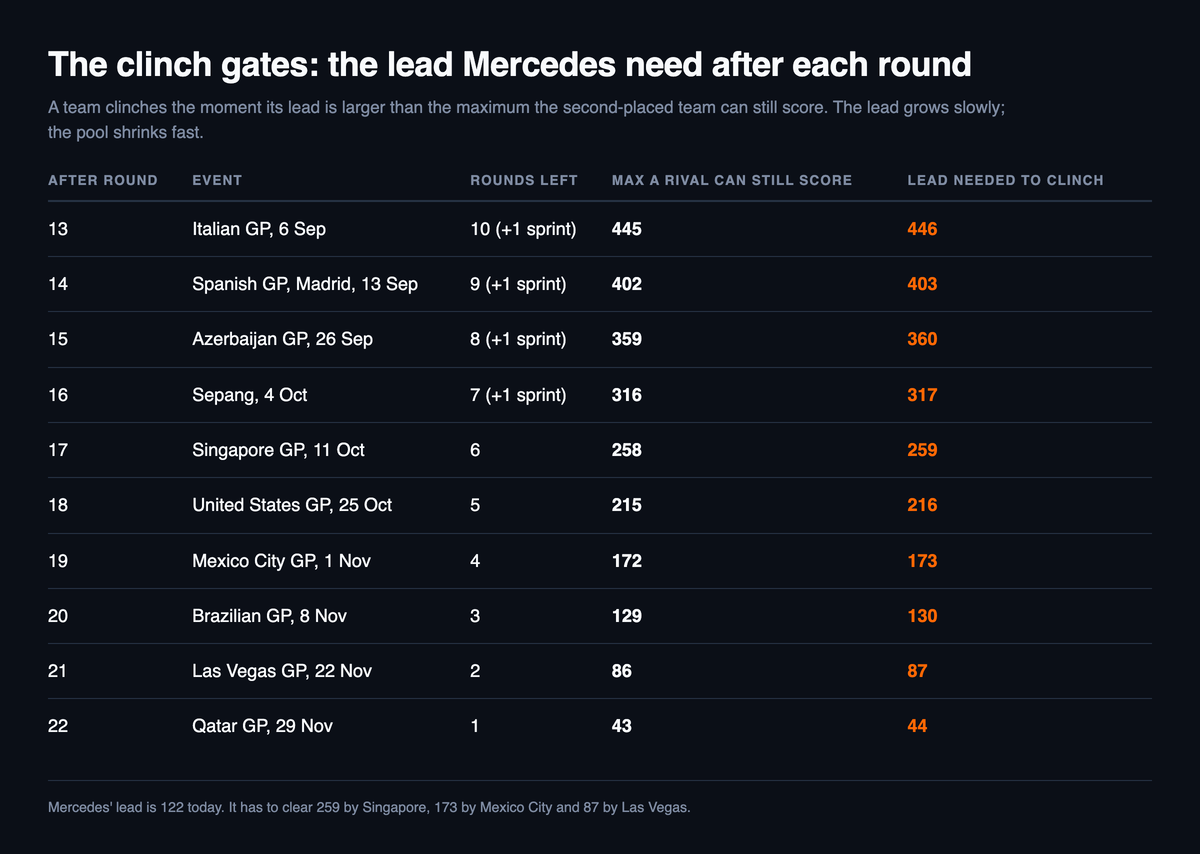
So the clinch date is a race between two numbers: a lead that grows slowly, and a pool of remaining points that shrinks fast. The pool is the part people forget. Every round removes 43 points from what a rival can still take, and the Singapore sprint removes another 15 in one weekend.
This table is the spine of the whole article. It is also evergreen: whatever happens at Madrid, these are the leads Mercedes need at each stage of the run-in.
| After round | Event | Rounds left | Max a rival can still score | Lead needed to clinch |
|---|---|---|---|---|
| 13 | Italian GP, 6 Sep | 10 (+1 sprint) | 445 | 446 |
| 14 | Spanish GP, Madrid, 13 Sep | 9 (+1 sprint) | 402 | 403 |
| 15 | Azerbaijan GP, 26 Sep | 8 (+1 sprint) | 359 | 360 |
| 16 | Sepang, 4 Oct | 7 (+1 sprint) | 316 | 317 |
| 17 | Singapore GP, 11 Oct | 6 | 258 | 259 |
| 18 | United States GP, 25 Oct | 5 | 215 | 216 |
| 19 | Mexico City GP, 1 Nov | 4 | 172 | 173 |
| 20 | Brazilian GP, 8 Nov | 3 | 129 | 130 |
| 21 | Las Vegas GP, 22 Nov | 2 | 86 | 87 |
| 22 | Qatar GP, 29 Nov | 1 | 43 | 44 |
Read the right-hand column as a set of gates. Mercedes' lead has to clear 259 by Singapore, 173 by Mexico City, 87 by Las Vegas. It is currently 122. Everything below is just a question of how fast that number grows, and the answer depends entirely on what you assume Ferrari do.
The Earliest Clinch Is Singapore, and It Needs a Ferrari Blackout
Start with the version that produces the earliest date, because it is the one quoted everywhere and it is worth seeing what it actually assumes. Mercedes finish first and second at every remaining round. Ferrari score nothing at all — no points from either car, at four consecutive Grands Prix and a sprint.
| Round | Event | Date | Mercedes lead | Max Ferrari can still score | Clinched? |
|---|---|---|---|---|---|
| 14 | Spanish GP (Madrid) | 13 Sep | 165 | 402 | No |
| 15 | Azerbaijan GP | 26 Sep | 208 | 359 | No |
| 16 | Sepang | 4 Oct | 251 | 316 | No |
| 17 | Singapore GP | 11 Oct | 309 | 258 | Yes |
That is where the Singapore answer comes from, and the arithmetic is right. The scenario is not. Ferrari have failed to score in exactly zero rounds this season; their worst weekend was Monza, and even there they took 8 points. Asking for four consecutive blanks from the second-best car on the grid is asking for a mechanical epidemic.
Why the sprint matters here. Singapore is the only sprint left on the 2026 calendar. It is worth 15 points to a team that goes one-two in it, which is why the Mercedes lead jumps 58 in a single weekend in this scenario rather than the usual 43, and why the pool of remaining points drops 58 at the same time. Sprints pull clinch dates forward from both ends.
On Any Realistic Path It Is Mexico City
Now hold the Mercedes assumption at its maximum but let Ferrari do the best they can in a world where Mercedes finish one-two: third and fourth, worth 27 points a race. The lead now grows by 16 a round instead of 43, and 4 at the sprint.
| Round | Event | Date | Mercedes lead | Max Ferrari can still score | Clinched? |
|---|---|---|---|---|---|
| 14 | Spanish GP (Madrid) | 13 Sep | 138 | 402 | No |
| 15 | Azerbaijan GP | 26 Sep | 154 | 359 | No |
| 16 | Sepang | 4 Oct | 170 | 316 | No |
| 17 | Singapore GP | 11 Oct | 190 | 258 | No |
| 18 | United States GP | 25 Oct | 206 | 215 | No, by 9 points |
| 19 | Mexico City GP | 1 Nov | 222 | 172 | Yes |
Austin is the near miss that tells you how tight this is. A perfect Mercedes run still leaves them nine points short of clinching in Texas, because the remaining pool is still 215 with five races to go. The title goes to Mexico City.
Then run the least heroic assumption of all: both teams simply keep doing what they have done for 13 rounds. Mercedes have averaged 36.0 points per round, Ferrari 26.6, a margin of 9.4 a round.
| Round | Event | Projected lead | Max Ferrari can still score | Clinched? |
|---|---|---|---|---|
| 14 | Spanish GP (Madrid) | 131.4 | 402 | No |
| 15 | Azerbaijan GP | 140.8 | 359 | No |
| 16 | Sepang | 150.1 | 316 | No |
| 17 | Singapore GP | 159.5 | 258 | No |
| 18 | United States GP | 168.9 | 215 | No |
| 19 | Mexico City GP | 178.3 | 172 | Yes, by 6.3 |
Two completely different assumptions, the same date. That convergence is not a coincidence: past a certain point the shrinking pool of remaining points does more work than the growing lead, so the clinch date becomes insensitive to how fast Mercedes score. What it is sensitive to is the margin at Mexico City being only 6.3 points in the season-form case. One damp Sunday where Ferrari take a one-two and Mercedes limp home fifth and sixth, and the clinch slides to Brazil on 8 November. Our points calculator explainer walks through how to redo this yourself after each round.
What Ferrari Would Actually Have to Do
Flip the question. Forget when Mercedes clinch and ask what the comeback requires. Ferrari need to make up 122 points across ten rounds, which is 12.3 points per round, every round, starting at Madrid. Here is every round of 2026 measured against that bar.
| Round | Event | Mercedes | Ferrari | Swing | Running lead |
|---|---|---|---|---|---|
| 1 | Australian GP | 43 | 27 | +16 MER | 16 |
| 2 | Chinese GP (sprint) | 55 | 40 | +15 MER | 31 |
| 3 | Japanese GP | 37 | 23 | +14 MER | 45 |
| 4 | Miami GP (sprint) | 45 | 20 | +25 MER | 70 |
| 5 | Canadian GP (sprint) | 39 | 37 | +2 MER | 72 |
| 6 | Monaco GP | 25 | 18 | +7 MER | 79 |
| 7 | Barcelona GP | 18 | 25 | +7 FER | 72 |
| 8 | Austrian GP | 40 | 14 | +26 MER | 98 |
| 9 | British GP (sprint) | 31 | 51 | +20 FER | 78 |
| 10 | Belgian GP | 25 | 30 | +5 FER | 73 |
| 11 | Hungarian GP | 21 | 22 | +1 FER | 72 |
| 12 | Dutch GP (sprint) | 46 | 31 | +15 MER | 87 |
| 13 | Italian GP | 43 | 8 | +35 MER | 122 |
Ferrari have outscored Mercedes in 4 of 13 rounds, and in those four the average gain was 8.3 points. Their single best weekend of the season, Silverstone, was worth 20 — and they would need to repeat something close to that ten times consecutively. The last time the running lead actually moved their way for two rounds in a row was Spa and the Hungaroring, and it netted them six points.
There is one more framing that makes the size of the task obvious. Ferrari's absolute ceiling is 791 points. For that to be enough, Mercedes must score no more than 322 from ten rounds, an average of 32.2 — below their season rate of 36.0 — while Ferrari win every single race one-two. Those two conditions are close to mutually exclusive: Ferrari cannot take 43 a round without Mercedes being shoved to third and fourth, which is 27 a round, which is 270 over ten rounds and not the collapse the scenario needs.
The Market Is at 93.6 Per Cent, Six Races Early
Here is where a prediction market earns its keep. Polymarket's constructors' champion market priced Mercedes at 93.6 per cent at 20:44 UTC on 12 September 2026, with Ferrari at 2.3 and McLaren at 0.7. The points table says the title cannot be decided for at least four more rounds and probably six. Those two statements are not in conflict; they are answering different questions. The market is forecasting an outcome, the table is certifying one.
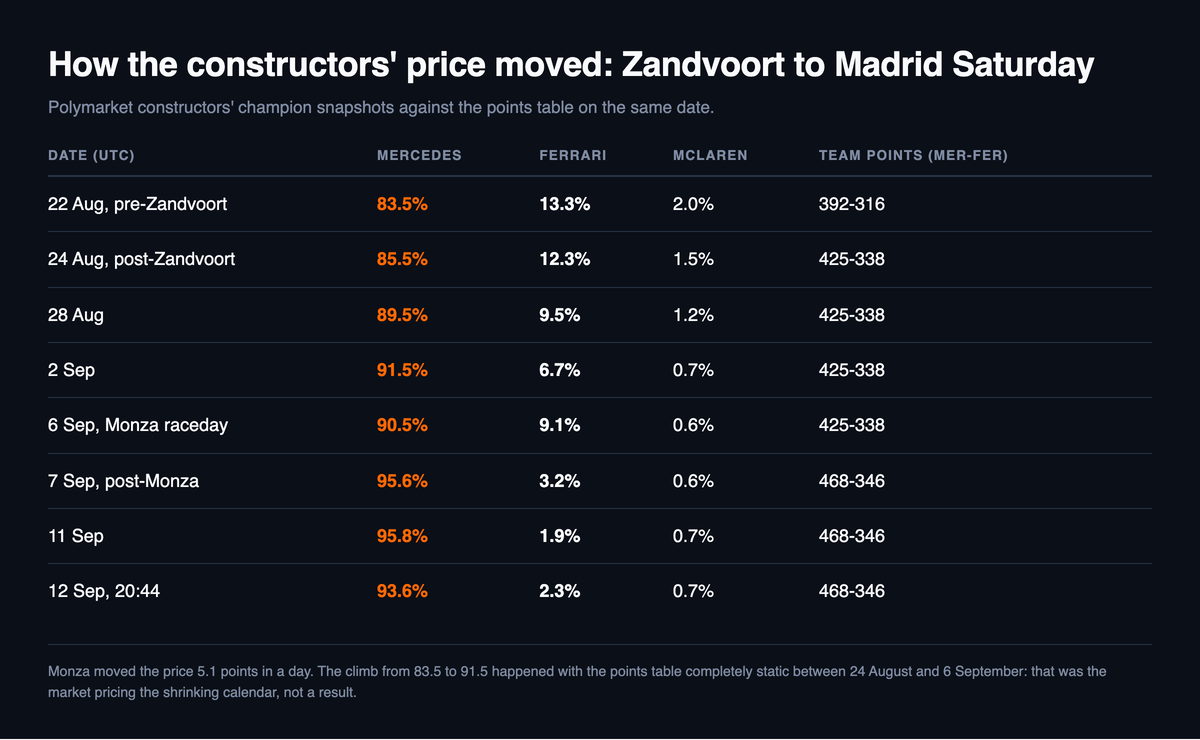
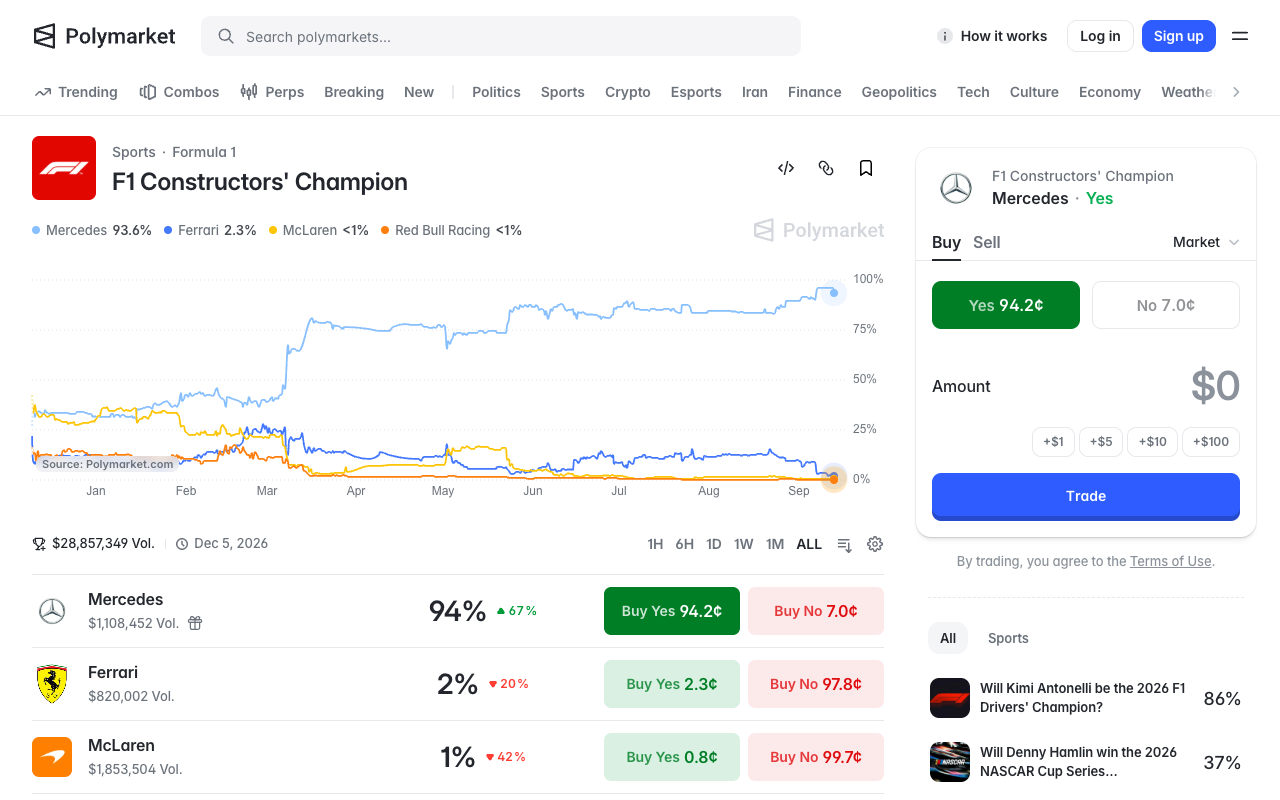
What is genuinely interesting is the path the price took. We snapshot this market several times a day, and the series across the Dutch and Italian Grands Prix shows the repricing happening in two discrete jumps rather than a drift.
| Date (UTC) | Mercedes | Ferrari | McLaren | Team points (MER-FER) |
|---|---|---|---|---|
| 22 Aug, pre-Zandvoort | 83.5% | 13.3% | 2.0% | 392-316 |
| 24 Aug, post-Zandvoort | 85.5% | 12.3% | 1.5% | 425-338 |
| 28 Aug | 89.5% | 9.5% | 1.2% | 425-338 |
| 2 Sep | 91.5% | 6.7% | 0.7% | 425-338 |
| 6 Sep, Monza raceday | 90.5% | 9.1% | 0.6% | 425-338 |
| 7 Sep, post-Monza | 95.6% | 3.2% | 0.6% | 468-346 |
| 11 Sep | 95.8% | 1.9% | 0.7% | 468-346 |
| 12 Sep, 20:44 | 93.6% | 2.3% | 0.7% | 468-346 |
Monza moved the price 5.1 points in a day, which is roughly what a 35-point swing in the standings should be worth this late. The slower climb from 83.5 to 91.5 across the previous fortnight happened with the points table completely static between 24 August and 6 September — that was the market pricing the shrinking calendar rather than any new result, which is precisely the mechanism this article's tables describe. The Monza write-up covers the drivers' side of the same afternoon, and the constructors' page carries the live board.
The Board Stopped Adding Up on Madrid Saturday
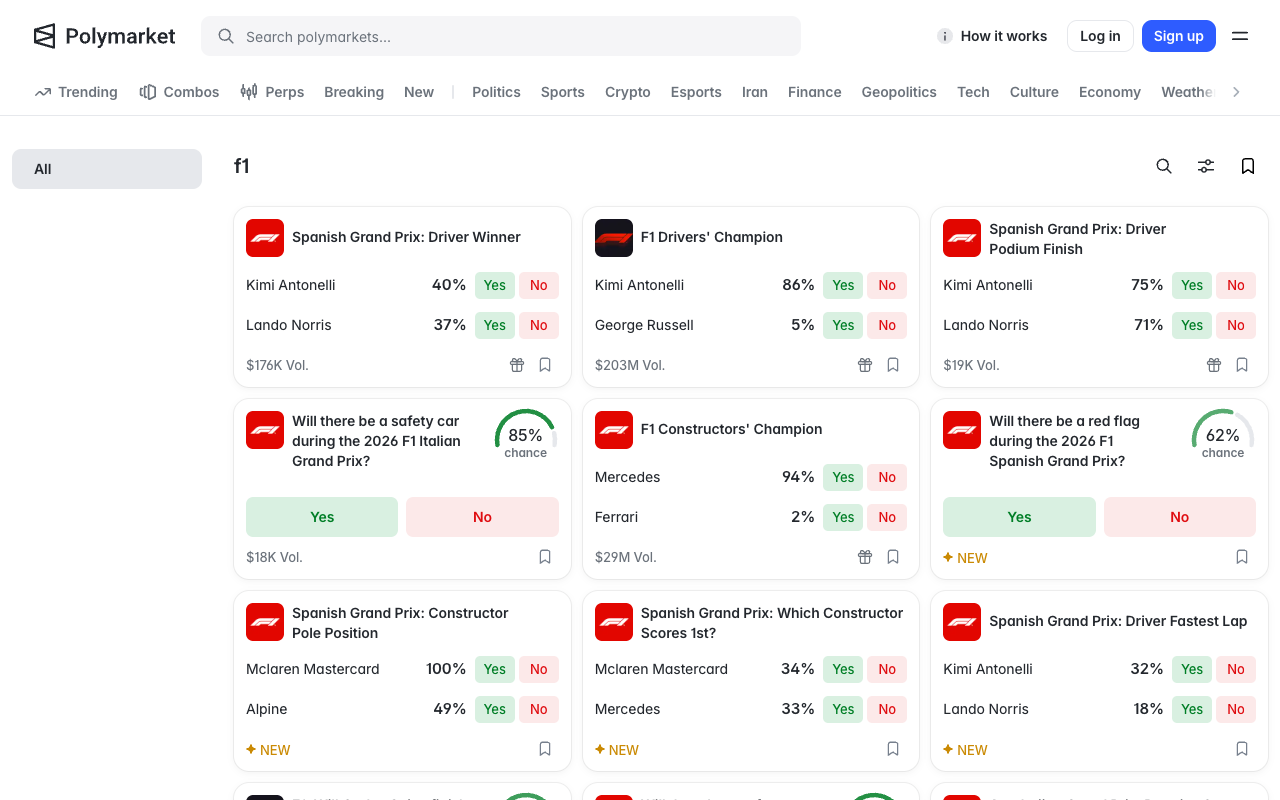
One warning about reading any exchange board too literally, and it happened while I was writing this. On Madrid qualifying day the Mercedes price fell from 95.7 per cent to 93.5 — a 2.2-point drop with no race run and no news. Ferrari did not gain it. Nobody gained it.
| Snapshot (UTC) | Mercedes | Ferrari | McLaren | Whole book sums to |
|---|---|---|---|---|
| 11 Sep, 22:09 | 95.8% | 2.6% | 0.7% | 99.4% |
| 12 Sep, 08:57 | 95.8% | 2.6% | 0.7% | 99.4% |
| 12 Sep, 12:40 | 95.7% | 2.6% | 0.7% | 99.3% |
| 12 Sep, 15:57 | 94.6% | 2.3% | 0.7% | 97.9% |
| 12 Sep, 18:06 | 93.5% | 2.3% | 0.7% | 96.8% |
| 12 Sep, 20:44 | 93.6% | 2.3% | 0.7% | 96.9% |
The book went from summing to 99.4 per cent to summing to 96.9 in eight hours. On a sportsbook the sum runs above 100 and the excess is the margin; on an exchange it can sit below 100, and when it does it usually means the best bids have thinned out rather than that the crowd has changed its mind. Read that 2.2-point fall as liquidity leaving the table on a race Saturday, not as a signal about Ferrari. If you want the mechanics of comparing an exchange price with a bookmaker's, we covered it in Polymarket vs sportsbook F1 odds.
How to Track the Clinch Yourself
You need three numbers after every round, and only one of them changes in a way that is hard to look up.
- The lead. Mercedes' points minus Ferrari's, straight off the table.
- The pool. 43 for every Grand Prix left, plus 15 for the Singapore sprint if it has not happened yet. The "lead needed to clinch" column above has these pre-computed for the rest of 2026.
- The price. Whether the market is ahead of or behind the arithmetic, which is the only one of the three that can ever be a trade.
When the lead exceeds the pool, it is over. Until then it is not, whatever the price says. The live board carries the current prices for both championships, the next-race page tracks the weekend that changes them, and our constructors' odds explainer covers how those prices convert to probabilities.
Bottom Line
Mercedes will almost certainly win the 2026 constructors' championship, and they cannot do it in September. The earliest date the maths permits is Singapore on 11 October, on an assumption — four straight Ferrari blanks — with no precedent in this season's results. The date to circle is Mexico City, 1 November, which is where two very different models of the run-in both land.
Ferrari's side of it is a 12.3-point-per-round deficit that they have cleared in four of thirteen attempts, averaging 8.3 when they do. That is not a comeback path, it is a hope. And if you are looking for the number that actually moves between now and then, it is not the Mercedes price at 93.6 per cent — it is how much of the remaining 445 points disappears each Sunday without the gap closing.
Related Analysis
- F1 Constructors' Championship Odds & Standings 2026 — how the team market prices against the table.
- F1 Constructors Points Calculator — the comeback formula and the second-car problem.
- Italian Grand Prix 2026: How Monza Reset the Title Odds — the afternoon that produced the 122-point gap.
- Madrid Grand Prix Odds 2026 — the race that starts the run-in, priced two ways.
- F1 Title Race Scenarios 2026 — the drivers' equivalent of this arithmetic.
- F1 Points Calculator 2026 — how much each driver and team can still score.
Disclosure: GridOdds earns a referral commission if you open a Polymarket account through the link below. It costs you nothing and does not change any number on this page.
GridOdds publishes probability context and points analysis for education. It is not financial, legal or betting advice. Prediction markets carry risk and may be restricted in your jurisdiction.