
The 2026 Italian Grand Prix turned a championship that still read as arguable into one that mostly does not, and it took about ninety minutes. Kimi Antonelli started 19th at Monza after an engine penalty, won the race, and watched his Polymarket price go from 71.2 per cent to 86.1 per cent while every rival on the board got cheaper. This is the full accounting: the corrected standings, the market move hour by hour from our own snapshot series, the nine drivers Monza mathematically eliminated, and what each surviving contender now needs per weekend.
Every points figure below is derived from the round-13 classification rather than a recollection, and every probability is a stored reading from the GridOdds snapshot taken at a named time on 6 September 2026. Where a number is still provisional, it says so.
For the version that keeps moving, the drivers championship page refreshes through each race weekend, and the live board carries the raw market prices.
Key takeaways
- Antonelli won from 19th on the grid and now leads by 66 points with 258 still available.
- Polymarket moved him from 71.2 to 86.1 per cent in one afternoon — the largest single-day swing in our snapshot series.
- Six of the seven title contenders scored points at Monza. Six of the seven also lost probability.
- Nine drivers were mathematically eliminated at Monza, the first eliminations of the 2026 season. Gabriel Bortoleto survived by exactly one point.
- The earliest possible clinch is still Singapore on 11 October, and it needs a perfect sweep to get there.
What Actually Happened at Monza
Pierre Gasly put an Alpine on pole, which is the sort of Saturday that usually defines a race weekend and this time barely survived contact with Sunday. George Russell lined up second. Antonelli, seventh on merit, took an engine penalty and started 19th.
The race was red-flagged on lap two when Charles Leclerc crashed heavily at the final corner and destroyed the rear of his Ferrari. That single incident is doing an enormous amount of work in the numbers further down this page: Leclerc scored nothing, and Ferrari's constructors' hopes went with him.
Antonelli was leading by lap 18. The decisive moment came later, under a virtual safety car, when Mercedes pitted him for fresh mediums and left Russell out on worn hards. He made the pass between Lesmo 2 and Ascari on lap 50 of 53 and won by about 3.9 seconds, becoming the first Italian to win at Monza since Ludovico Scarfiotti in 1966. The official race report has the lap-by-lap version.
Verstappen took third, the McLarens of Norris and Piastri were fourth and fifth, and Hamilton could manage only sixth in the second Ferrari. Keep that finishing order in mind, because the market did something counterintuitive with it.
The Championship After Round 13
Antonelli arrived at Monza on 242 points with a 59-point lead. He leaves on 267 with a 66-point lead, because the driver directly behind him finished directly behind him.
| Driver | Team | Before Monza | Monza | Total | Behind |
|---|---|---|---|---|---|
| Kimi Antonelli | Mercedes | 242 | +25 | 267 | — |
| George Russell | Mercedes | 183 | +18 | 201 | 66 |
| Lewis Hamilton | Ferrari | 183 | +8 | 191 | 76 |
| Lando Norris | McLaren | 159 | +12 | 171 | 96 |
| Charles Leclerc | Ferrari | 155 | 0 | 155 | 112 |
| Max Verstappen | Red Bull | 112 | +15 | 127 | 140 |
| Oscar Piastri | McLaren | 104 | +10 | 114 | 153 |
Ten Grands Prix remain, from Madrid on 11-13 September to Abu Dhabi on 4-6 December, plus one sprint at Singapore on 9-11 October — the last of the six sprints on the 2026 sprint calendar, after Shanghai, Miami, Montreal, Silverstone and Zandvoort. A win is 25, a sprint win is 8, and the fastest-lap bonus has not existed since 2025. The maximum any driver can still score is therefore 10 × 25 + 8, which is 258.
That number is the one to hold on to. Before Monza, Antonelli's 59-point lead covered 20.8 per cent of the 283 then available. After Monza, his 66-point lead covers 25.6 per cent of 258. He gained seven points and roughly five points of championship share, which is a bigger move than it sounds.
How the Market Repriced in a Single Afternoon
Our snapshot series has been running against the Polymarket F1 Drivers' Champion market since late August, and 6 September is comfortably the most violent day in it. Nothing else in seventeen days of readings comes close.
| Driver | Pre-race 11:09 UTC | Post-race 19:21 UTC | Change |
|---|---|---|---|
| Kimi Antonelli | 71.2% | 86.1% | +14.9 |
| George Russell | 9.6% | 5.8% | −3.8 |
| Lando Norris | 8.3% | 2.2% | −6.1 |
| Lewis Hamilton | 6.5% | 1.6% | −4.9 |
| Charles Leclerc | 1.9% | 0.8% | −1.1 |
| Max Verstappen | 0.7% | 0.5% | −0.2 |
| Oscar Piastri | 0.5% | 0.4% | −0.1 |
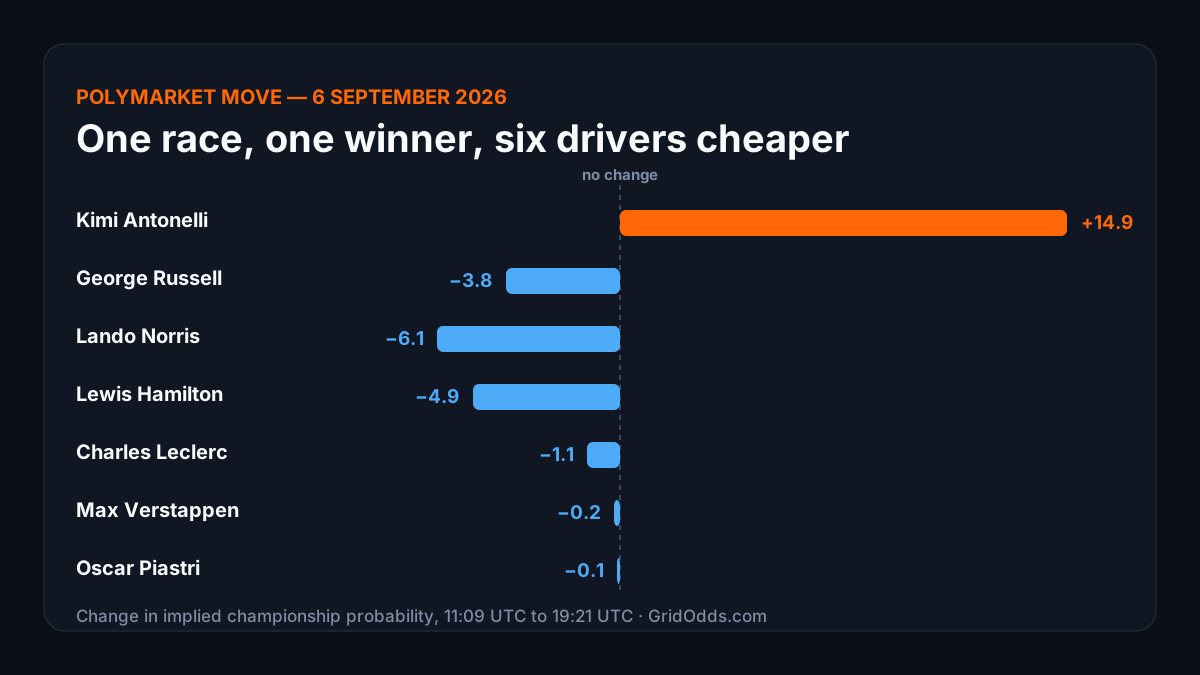
For scale: across 21 August to 5 September, the biggest single-day move for any contender was Norris gaining 5.0 points of probability on the day he won at Zandvoort. Antonelli's +14.9 is three times that. On most days in the series the leader's price moved by a tenth or two.
The intraday shape matters as much as the endpoints. At 11:09 UTC, before the start, Antonelli was 71.2. By 14:17, with the race run, he was 76.8. By 17:12 he was 85.7, and by 19:21 he had settled at 86.1. The market did not price the win instantly; it priced the win, then spent three hours pricing what the win meant for everyone else.
Points Gained, Probability Lost
Here is the part that looks wrong until you think about it. Six of the seven title contenders scored points at Monza. Six of the seven also got longer.
| Driver | Finish | Points scored | Probability change |
|---|---|---|---|
| Kimi Antonelli | 1st | 25 | +14.9 |
| George Russell | 2nd | 18 | −3.8 |
| Max Verstappen | 3rd | 15 | −0.2 |
| Lando Norris | 4th | 12 | −6.1 |
| Oscar Piastri | 5th | 10 | −0.1 |
| Lewis Hamilton | 6th | 8 | −4.9 |
| Charles Leclerc | DNF | 0 | −1.1 |
Verstappen stood on the podium and his price fell. Norris finished fourth, banked 12 points, and lost more probability than anyone — 6.1 points, from 8.3 to 2.2, a fall of nearly three quarters. Piastri scored 10 and lost ground too.
The mechanism is simple once stated: championship probability is relative, and the leader took the maximum. Scoring 12 points while the man in front scores 25 is a 13-point loss in the only currency that matters. A challenger who is not out-scoring the leader is not challenging, whatever the race classification says.
Norris is the clearest case. He came into the weekend as the market's designated challenger on the strength of back-to-back wins at Hungary and Zandvoort. One race in which he finished behind Antonelli, Russell and Verstappen was enough to undo that entirely. The title race scenarios piece written a week ago had him at 8.0 per cent and argued the arithmetic never supported the price. Monza settled the argument in one afternoon.
Monza Was the First Elimination Round of 2026
Until Sunday, every driver on the grid was still mathematically alive. That stops being true at 258 points available, and it stops being true for nine drivers at once.
| Driver | Points | Behind leader | Status |
|---|---|---|---|
| Gabriel Bortoleto | 10 | 257 | Alive by 1 point |
| Nico Hülkenberg | 6 | 261 | Eliminated |
| Carlos Sainz | 6 | 261 | Eliminated |
| Alexander Albon | 5 | 262 | Eliminated |
| Esteban Ocon | 3 | 264 | Eliminated |
| Fernando Alonso | 3 | 264 | Eliminated |
| Yuki Tsunoda | 1 | 266 | Eliminated |
| Lance Stroll | 0 | 267 | Eliminated |
| Valtteri Bottas | 0 | 267 | Eliminated |
| Sergio Pérez | 0 | 267 | Eliminated |
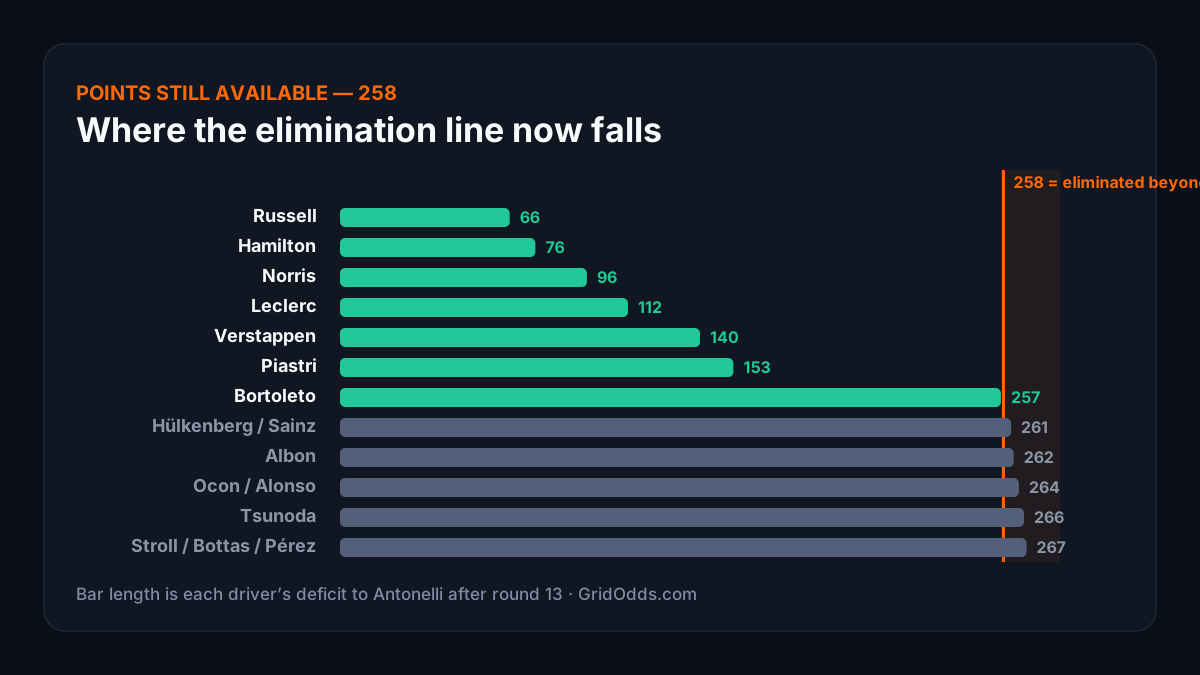
The detail worth pausing on is Gabriel Bortoleto. He is 257 points behind with 258 available, which keeps him alive by a single point and only until someone finishes ahead of him again. It is the narrowest survival on the board and it will not last past Madrid.
Elimination arithmetic is blunt and mostly ceremonial — nobody thought Lance Stroll was winning this championship in April. It is useful for one reason: it is the only genuinely objective marker of how far through a season you are. Round 13 is where 2026 stopped being theoretically open to everyone. Our F1 points calculator guide runs the same arithmetic for any driver and any round if you want to check it yourself.
What Each Contender Needs From Here
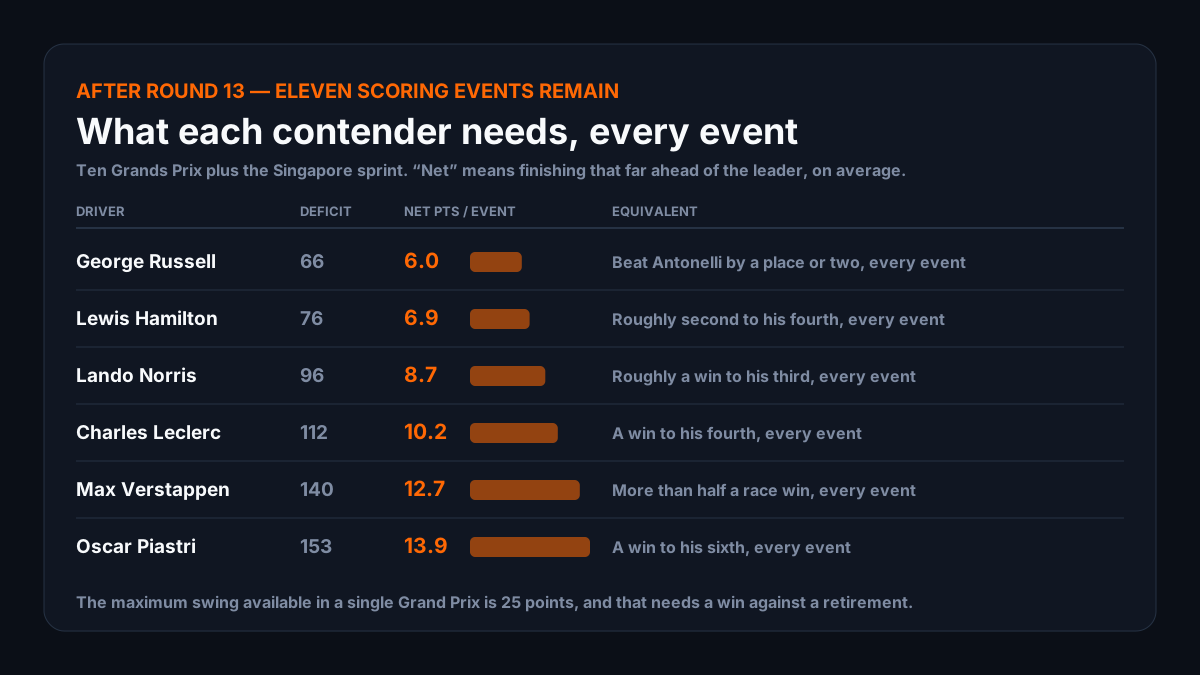
Eleven scoring events remain. Divide each deficit by eleven and you get the average margin a challenger must put on Antonelli, at every single event, for three months.
| Driver | Deficit | Net points needed per event | Equivalent |
|---|---|---|---|
| George Russell | 66 | 6.0 | Beat Antonelli by a place or two, every event |
| Lewis Hamilton | 76 | 6.9 | Roughly second to his fourth, every event |
| Lando Norris | 96 | 8.7 | Roughly a win to his third, every event |
| Charles Leclerc | 112 | 10.2 | A win to his fourth, every event |
| Max Verstappen | 140 | 12.7 | More than half a race win, every event |
| Oscar Piastri | 153 | 13.9 | A win to his sixth, every event |
The word carrying the weight is net. Russell's 6.0 is not "score six points". It is "finish 6.0 points ahead of the championship leader, on average, eleven times in a row". At Monza he did the opposite by seven.
Russell and Hamilton Are Still in Each Other's Way
Russell is nearest at 66 back, and he is also Antonelli's team-mate, which is the least useful place to be. Mercedes has both drivers, a 468-point constructors' lead, and no reason at all to engineer a fight that costs it a drivers' title it is currently winning. Hamilton at 76 has the cleaner run at it in principle, but he needs Ferrari to find pace it did not have at Monza, where he was the second-fastest Ferrari until the first one hit the wall.
Verstappen and Piastri Are Effectively Done
Verstappen needs 12.7 net points per event. The maximum swing available in a single Grand Prix is 25, and that requires a win against a retirement. He would need something close to half of the theoretical maximum, eleven times, starting now. The market has him at 0.5 per cent, and for once that looks generous rather than harsh.
The Earliest Antonelli Can Clinch
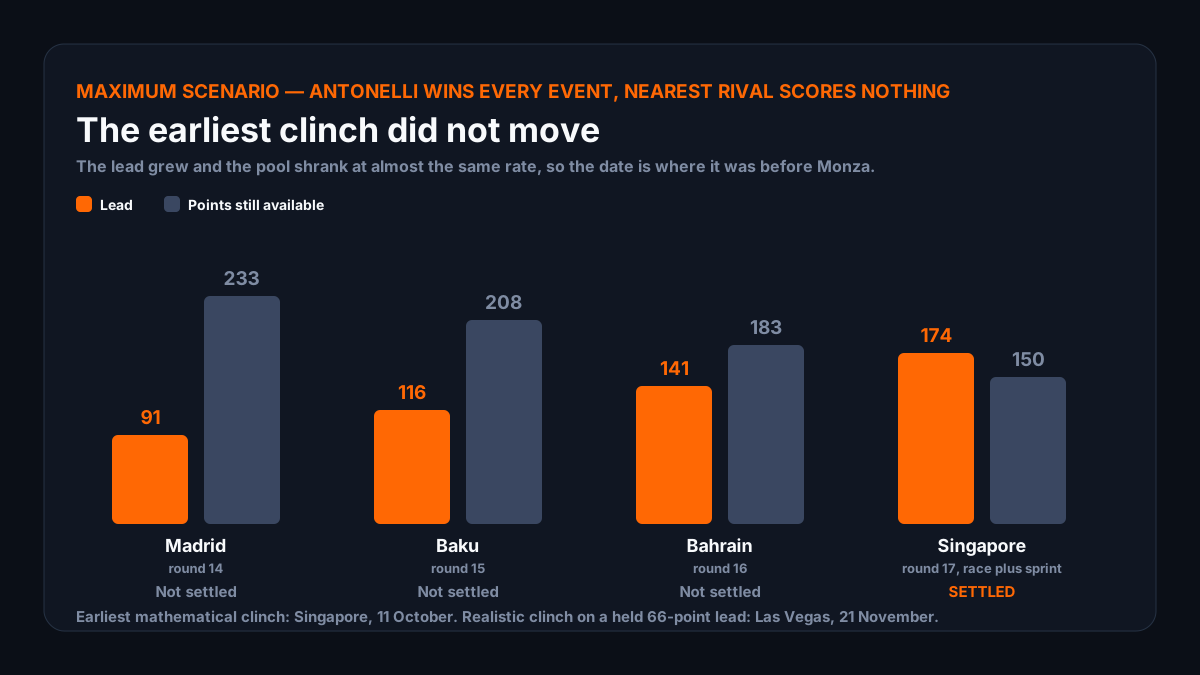
Run the most lopsided scenario that physics permits: Antonelli wins every remaining event, the nearest rival scores nothing at all.
- After Madrid (round 14): lead 91, available 233. Not settled.
- After Baku (round 15): lead 116, available 208. Not settled.
- After Bahrain (round 16): lead 141, available 183. Not settled.
- After Singapore (round 17, race plus sprint): lead 174, available 150. Settled.
So the earliest mathematical clinch is Singapore on 11 October, which is exactly where it was before Monza. The lead grew and the pool shrank at almost the same rate, so the earliest date did not move at all. That is a useful reminder that "extends his lead" and "wraps it up sooner" are different claims.
The realistic date is later and duller. If Antonelli simply holds a 66-point lead, he clinches once fewer than 66 points remain, which happens with two races to go — so Las Vegas on 21 November, leaving Qatar and Abu Dhabi as exhibition rounds. The stats page tracks the round-by-round version of that gap.
The Constructors' Title Is Nearly Closed
Mercedes leaves Monza on 468 points, Ferrari on 346, McLaren on 285. A two-car team can still score 10 × 43 + 15, which is 445, so Ferrari's 122-point deficit is arithmetically nothing like hopeless.
The market disagrees emphatically. On the Polymarket constructors' champion market, Mercedes moved from 91.0 per cent before the race to 95.5 after it; Ferrari fell from 8.8 to 3.5. Leclerc's lap-two crash cost Ferrari roughly five points of probability on its own, because a constructors' gap closes only when both cars beat both cars. Ferrari would need Hamilton and Leclerc to out-score Antonelli and Russell by 11.1 points per event for eleven events. One brilliant driver cannot produce that number; only a car advantage across the garage can, and Hamilton spent the weekend saying Ferrari is still down on the straights. The constructors championship page has the live gap.
Bottom Line: What Madrid Actually Decides
The honest reading of Monza is that the arithmetic barely moved and the market moved enormously. Antonelli gained seven points on his nearest rival, which in isolation is a decent Sunday. He gained 14.9 points of implied probability, which is the market concluding that the challenger it had been backing for a fortnight was never really there.
Three things are worth watching at Madrid on 11-13 September, F1's first visit to the new Spanish circuit. First, whether the chasing pack consolidates behind one name or keeps splitting — a divided field is worth more to the leader than any single result. Second, whether Ferrari's straight-line deficit shows up at another power circuit. Third, and most telling, whether anything at all moves Antonelli's price. A weekend that reshuffles second through fifth and leaves the favourite untouched has changed nothing that matters.
At 86 per cent with 258 points live, the market is not saying this is over. It is saying it would take an unusual season to reopen it, and 2026 has not been an unusual season since about July.
Related Analysis
- F1 Title Race Scenarios 2026 — the pre-Monza version of this arithmetic.
- F1 Points Calculator 2026 — how much each driver can still score.
- F1 Drivers' Championship Odds 2026 — market prices against the standings.
- Who Will Win the 2026 F1 Championship? — the season-long market read.
- F1 on Polymarket — how these championship markets actually work.
- Polymarket vs Sportsbook F1 Odds — converting between the two formats.
Disclosure: GridOdds earns a referral commission if you open a Polymarket account through the link below. It costs you nothing and does not affect the numbers on this page.
GridOdds publishes probability context and points analysis for education. It is not financial, legal or betting advice. Prediction markets carry risk and may be restricted in your jurisdiction.