Key takeaways
- A fair podium book sums to 300%, not 100%. Three drivers finish on the podium, so three lines resolve YES. Judging F1 podium odds against a 100% par makes an ordinary book look like a rip-off.
- Polymarket’s Interlagos podium book summed to 347.55% across 23 driver lines when I read it at 21:07 UTC on 7 November 2026. Against a 300% par that is 47.55 points of overround, or 15.85% — against 5.00% on the race-winner book beside it.
- Almost none of that margin sits where the money is. The eight lines holding 99.3% of the book’s $14,658 sum to 296.00¢ — four cents under par. The other 15 lines, carrying $96.11 between them, add the remaining 51.55¢.
- The podium book pays more than standard each-way place terms for seven of eight drivers. At 1/5 odds for a top-three finish, Isack Hadjar’s 1.25¢ win price implies 5.95% for a place; the podium book quotes him 19.50¢.
- Verstappen is 40¢ for a podium from the back of the grid, and that one line carries 60.6% of all podium money. He won here from 17th in 2024, which is the whole case for the price.
- What a fair podium book sums to
- The Interlagos podium book, line by line
- Where the 47 cents actually live
- Win price against podium price
- Verstappen at 40 cents from the back
- What it costs to get in and out
- The podium book against each-way place terms
- How I read a podium book on race week
- Sources and method
If you have ever lined up F1 podium odds against race-winner odds, decided the podium market looked grotesquely overpriced, and moved on, you were measuring against the wrong number. A race-winner book is coherent when its prices sum to 100%, because exactly one line can resolve YES. A podium book has three winners, so the same test is 300% — and not one of the five pages ranking for this query says so.
Here is what that costs you. When I read Polymarket’s top-three book for Sunday’s race at Interlagos at 21:07:31 UTC on 7 November 2026, its 23 driver lines summed to 347.55%. Against 100% that looks like a swindle. Against the 300% three podium slots imply, it is 47.55 points of overround — 15.85%, high but ordinary for a thin market, and about three times the 5.00% on the race-winner book beside it.
Then I split the book by volume, and the headline number fell apart. The eight lines carrying 99.3% of the money sum to 296.00¢, four cents under a coherent 300. Every cent of the apparent margin lives in 15 lines that have taken $96.11 between them, eleven of which have never traded at all.
I priced all 23 lines, both sides of every quote, against the winner and pole books on the same snapshot. Below is the arithmetic, and the test I run before trusting a podium price.
What a fair podium book sums to
Every Polymarket market is a set of YES/NO lines priced in cents, where the price is the probability. A line at 40¢ means a 40% chance and pays $1 if it lands — familiar enough from race-winner markets.
The part that trips people up is how many lines can win. In a winner book, one driver takes the chequered flag first, so the honest prices of all 20-odd drivers must add to 100. Anything above that is the book’s margin, and you can read it straight off the screen.
A podium book resolves YES for three drivers at once — first, second and third. So three $1 payouts leave the book on every race, and the coherent sum is 300%. Divide by the number of winning slots and you get the comparable figure: a podium book at 347.55% is running a 1.1585 ratio, or 15.85% over fair, exactly as a winner book at 105.00% is running 5.00% over.
This is not a Polymarket quirk. Any top-three market obeys it, which is why a sportsbook’s podium prices look so much shorter than its win prices for the same driver. So: divide a podium book’s total by three before you judge it. The Interlagos book then stops looking absurd and starts looking merely expensive.
The Interlagos podium book, line by line
The drivers’ title is already gone — Kimi Antonelli clinched at Mexico City on 1 November, and the champion book resolves him at 100¢ on $205.8 million traded. Race markets are the only F1 books left with anything to say, and the podium is the second-busiest this weekend.
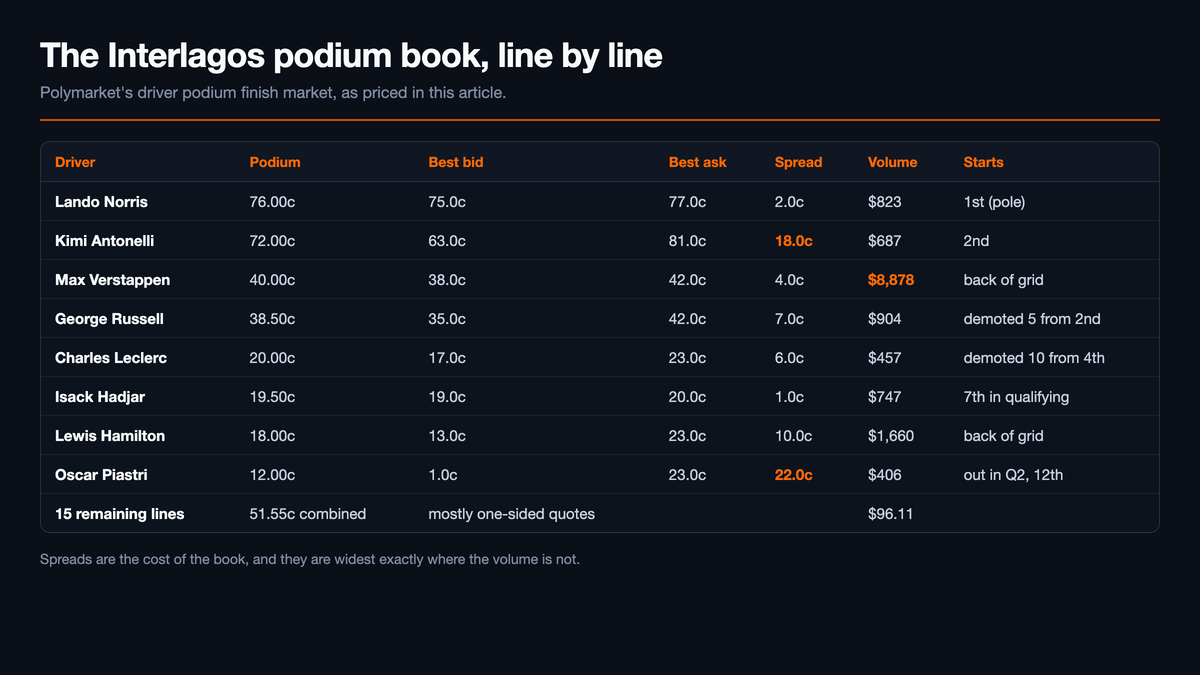
Every line that has taken more than $100, with both sides of the quote. The grid column is where the driver starts after Saturday’s penalties, which matter more than usual this weekend.
| Driver | Podium | Best bid | Best ask | Spread | Volume | Starts |
|---|---|---|---|---|---|---|
| Lando Norris | 76.00¢ | 75.0¢ | 77.0¢ | 2.0¢ | $823 | 1st (pole) |
| Kimi Antonelli | 72.00¢ | 63.0¢ | 81.0¢ | 18.0¢ | $687 | 2nd |
| Max Verstappen | 40.00¢ | 38.0¢ | 42.0¢ | 4.0¢ | $8,878 | back of grid |
| George Russell | 38.50¢ | 35.0¢ | 42.0¢ | 7.0¢ | $904 | demoted 5 from 2nd |
| Charles Leclerc | 20.00¢ | 17.0¢ | 23.0¢ | 6.0¢ | $457 | demoted 10 from 4th |
| Isack Hadjar | 19.50¢ | 19.0¢ | 20.0¢ | 1.0¢ | $747 | 7th in qualifying |
| Lewis Hamilton | 18.00¢ | 13.0¢ | 23.0¢ | 10.0¢ | $1,660 | back of grid |
| Oscar Piastri | 12.00¢ | 1.0¢ | 23.0¢ | 22.0¢ | $406 | out in Q2, 12th |
| 15 remaining lines | 51.55¢ combined | mostly one-sided quotes | $96.11 | — | ||
| Book total (23 lines) | 347.55¢ | par is 300¢ | $14,658 | — | ||
Two things stand out immediately. Norris, on pole, is the shortest line at 76¢ — not 90-something, because a podium still needs him to survive a wet Interlagos race that has eaten leaders before. And Verstappen at 40¢ is the third-shortest price in the book while starting from the very back, which is the single most interesting claim on the screen and gets its own section below.
The spread column is the other tell. Antonelli’s quote is 63¢ bid against 81¢ asked, an 18-cent gap on the driver starting second; Piastri’s is 1¢ against 23¢. Those are invitations more than prices.
Where the 47 cents actually live
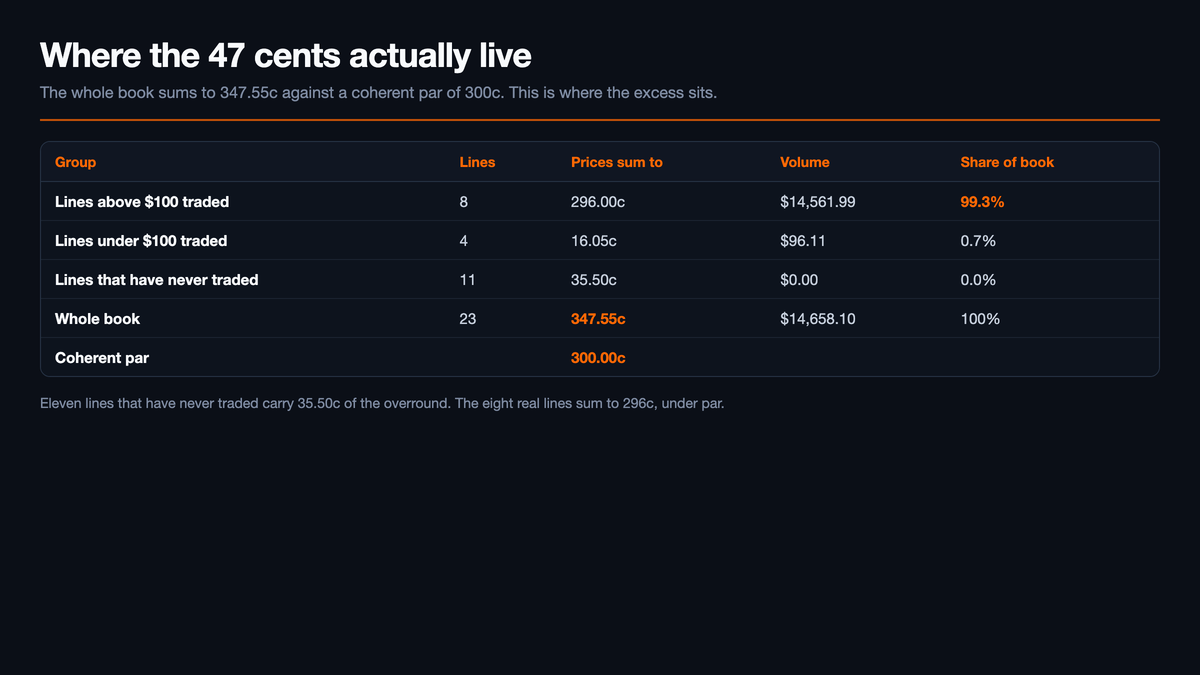
This is the part I did not expect. If a book runs 15.85% over fair, you would assume every line carries a slice of that margin. Split the Interlagos book by volume and that is flatly untrue.
| Group | Lines | Prices sum to | Volume | Share of book |
|---|---|---|---|---|
| Lines above $100 traded | 8 | 296.00¢ | $14,561.99 | 99.3% |
| Lines under $100 traded | 4 | 16.05¢ | $96.11 | 0.7% |
| Lines that have never traded | 11 | 35.50¢ | $0.00 | 0.0% |
| Whole book | 23 | 347.55¢ | $14,658.10 | 100% |
| Coherent par | — | 300.00¢ | — | — |
Read the top row again. The eight lines holding essentially all the money sum to 296.00¢ against a 300-cent par. The traded part of this book is not expensive — it is four cents cheap, which is what a genuinely contested market looks like.
The entire 47.55-cent overround is manufactured by the 15 lines nobody trades. Eleven of them have taken zero dollars and are quoted between 2.45¢ and 5¢ each, adding 35.50¢ of padding. Several show no bid at all — the ask is simply double the nominal mid, which is what an automated quote looks like with no human on the other side.
So the honest version of ’15.85% over fair’ is: the tail is unbuyable, and the real market is the top eight. A 347.55% total is not a reason to avoid this market; it is a reason to ignore everything priced under 8¢, because those lines exist to be sold rather than bought.
Win price against podium price
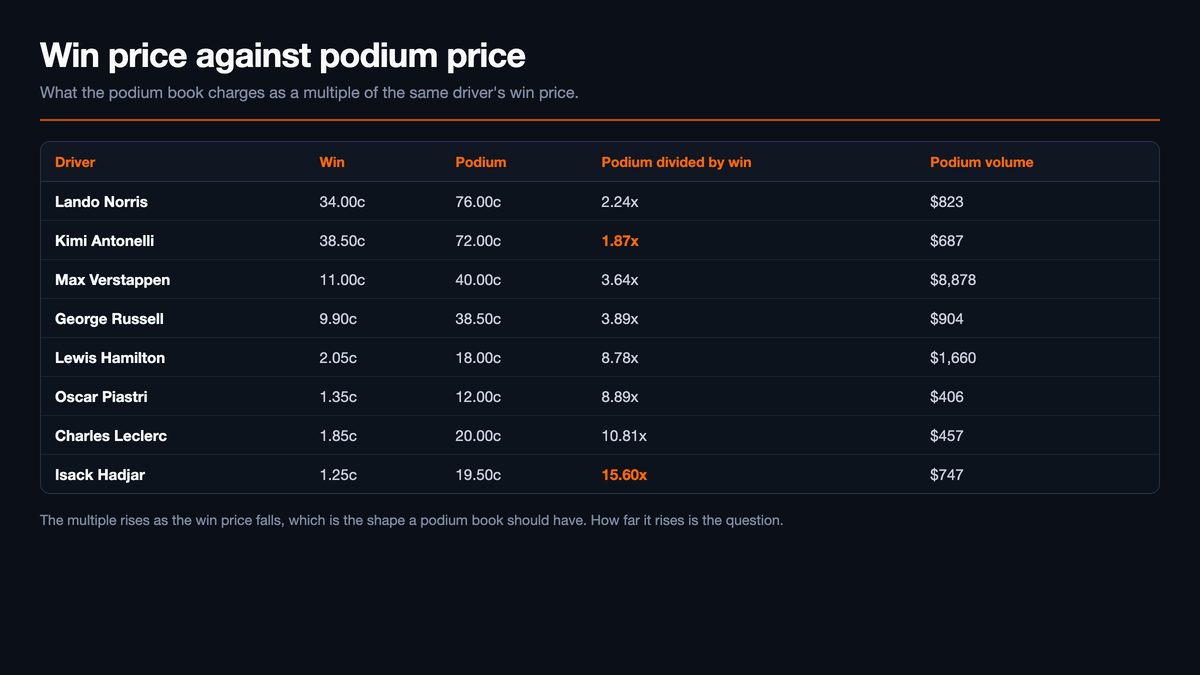
The winner book for the same race took $121,009, eight times the podium book, and sums to 105.00% against a 100% par. It is the coherent book here, so it makes a good ruler.
| Driver | Win | Podium | Podium ÷ win | Podium volume |
|---|---|---|---|---|
| Lando Norris | 34.00¢ | 76.00¢ | 2.24× | $823 |
| Kimi Antonelli | 38.50¢ | 72.00¢ | 1.87× | $687 |
| Max Verstappen | 11.00¢ | 40.00¢ | 3.64× | $8,878 |
| George Russell | 9.90¢ | 38.50¢ | 3.89× | $904 |
| Lewis Hamilton | 2.05¢ | 18.00¢ | 8.78× | $1,660 |
| Oscar Piastri | 1.35¢ | 12.00¢ | 8.89× | $406 |
| Charles Leclerc | 1.85¢ | 20.00¢ | 10.81× | $457 |
| Isack Hadjar | 1.25¢ | 19.50¢ | 15.60× | $747 |
This shape is not a mispricing, and it would be easy to shout ’arbitrage’ at a 15.60—times ratio. A high ratio is mathematically expected for a driver who cannot win but can finish third: winning means beating Norris and Antonelli outright, while a podium needs only one of them to err.
What is informative is how fast it rises. The two front-row runners sit at 1.87—2.24—times, which says the market treats their podiums as near-formalities conditional on finishing. The two penalised Mercedes-and-Red-Bull runners sit near 3.6—3.9—times. Then it jumps: Hamilton, Piastri, Leclerc and Hadjar run from 8.78 to 15.60.
That cliff is the podium book doing work the winner book will not. At 1.25¢ to win, the winner book has rounded Hadjar to zero — a cent is its smallest meaningful tick. The podium book is the only place where ’he runs seventh and two cars ahead break’ gets a real number, and 19.50¢ is a considered answer, not a rounding artefact. Comparing your own probability to the market is the game, and this is where there is room to disagree.
Verstappen at 40 cents from the back
Saturday at Interlagos was wet and chaotic, and the grid it produced is why this book is worth reading at all. Norris took pole with a 1:27.470, his third consecutive pole here. Antonelli qualified third and starts alongside him.
Behind them, the penalties reshuffled everything:
- George Russell set the second-fastest time and takes a five-place grid penalty.
- Charles Leclerc qualified fourth and loses ten places.
- Max Verstappen did not run in Q2 and starts from the back of the grid after a power-unit change.
- Lewis Hamilton was eliminated in Q2 and also starts from the back, as does Sergio Perez.
- Oscar Piastri was knocked out in Q2 after a late red flag and starts 12th.
So the market quotes 40¢ on a podium for a driver starting at the back, and 18¢ on another — 58 cents of podium probability on two cars at the rear of a 22-car grid. On a dry track at most circuits I would call that indefensible.
At this circuit, in the wet, it is not. Verstappen won the 2024 Sao Paulo Grand Prix from 17th on the grid — the first win from 17th or lower since Raikkonen at Suzuka in 2005 — in a rain-hit race shaped by a red flag. Interlagos is short, it overtakes well, and its weather turns races into lotteries. The market has seen this film.
What makes the 40¢ a genuine opinion rather than a stale quote is the money: $8,878 of the book’s $14,658 sits on that one line, 60.6% of everything traded, on a tight 38¢—42¢ spread. Nobody is asleep on Verstappen. Hamilton’s 18¢ is the softer claim — 13¢ bid against 23¢ asked shows far less conviction, and he has no equivalent Interlagos miracle on his record.
If rain arrives on Sunday these are the two lines that move most. Our guide to how rain changes race probability covers why the effect is larger here than the forecast suggests.
What it costs to get in and out
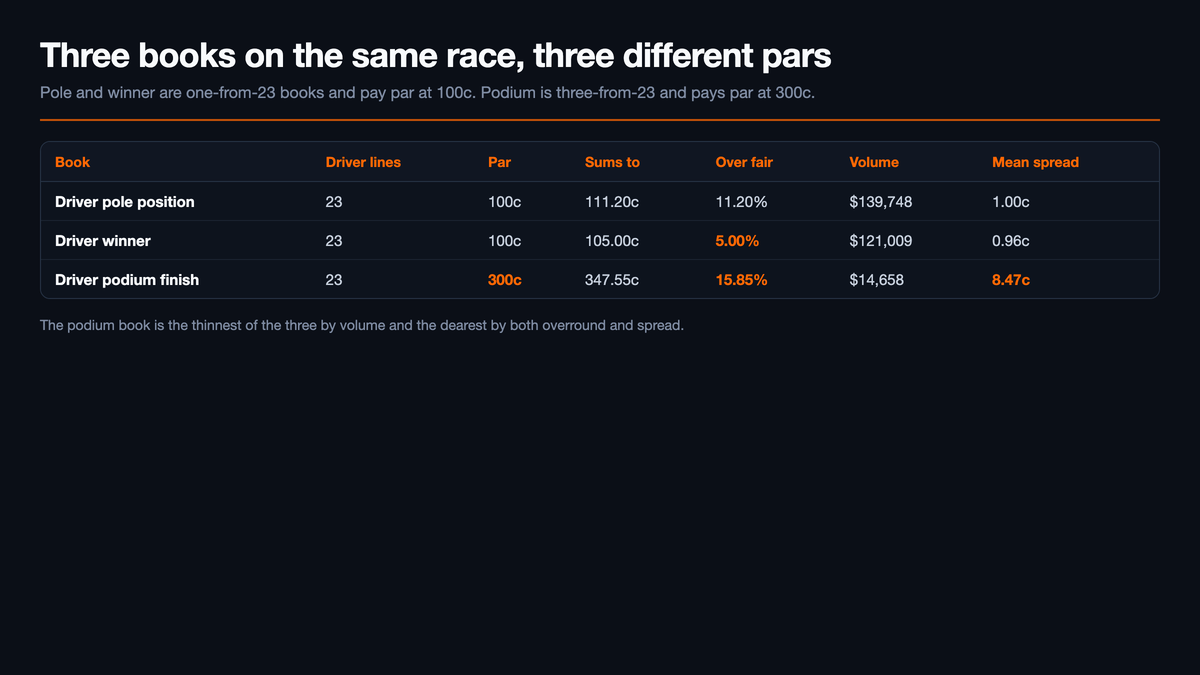
The overround is what the book charges in aggregate. The spread is what you pay on the way in, and on a thin market it is the bigger number. The weekend’s three biggest F1 books, side by side:
| Book | Driver lines | Par | Sums to | Over fair | Volume | Mean spread |
|---|---|---|---|---|---|---|
| Driver pole position | 23 | 100¢ | 111.20¢ | 11.20% | $139,748 | 1.00¢ |
| Driver winner | 23 | 100¢ | 105.00¢ | 5.00% | $121,009 | 0.96¢ |
| Driver podium finish | 23 | 300¢ | 347.55¢ | 15.85% | $14,658 | 8.47¢ |
The podium book’s mean spread is 8.47¢ against 0.96¢ on the winner book. That is nearly nine times the round-trip cost, and it dwarfs the difference in overround. Buy Antonelli’s podium at the 81¢ ask and sell at the 63¢ bid and you have lost 18 cents to the spread alone — more than the entire 15.85% margin on a 72¢ line.
Note also that only 10 of 23 podium lines quote both sides at all. On the other 13 there is an ask and nothing behind it, so the ’price’ is one dealer’s opinion with no opposing bid to discipline it. That is the mechanical reason the tail sums to 35.50¢: a one-sided quote never has to be right.
The pole book is the instructive middle case: it sums to 111.20% on the largest volume of the three, because qualifying is done and Norris sits at 99.15¢. A settled outcome parked at 99¢ while 22 dead lines keep nominal prices always inflates a total. A book’s sum reflects its housekeeping as much as its wisdom.
The podium book against each-way place terms
Most F1 bettors meet the top three through a sportsbook each-way bet rather than a dedicated podium market. Standard F1 each-way terms pay the place part at 1/5 of the win odds for a top-three finish. Comparing prediction-market prices with sportsbook lines needs care, and this is a good example of why.
I took each driver’s Polymarket win price, converted it to decimal odds, applied 1/5 place terms and converted back to a probability — the place payout an each-way structure implies from the same win estimate — then set it against the podium book’s own quote.
| Driver | Win price | Win as decimal | 1/5 place terms imply | Podium book quotes | Difference |
|---|---|---|---|---|---|
| Lando Norris | 34.00¢ | 2.94 | 72.03% | 76.00¢ | +3.97 pp |
| Kimi Antonelli | 38.50¢ | 2.60 | 75.79% | 72.00¢ | −3.79 pp |
| Max Verstappen | 11.00¢ | 9.09 | 38.19% | 40.00¢ | +1.81 pp |
| George Russell | 9.90¢ | 10.10 | 35.46% | 38.50¢ | +3.04 pp |
| Lewis Hamilton | 2.05¢ | 48.78 | 9.47% | 18.00¢ | +8.53 pp |
| Oscar Piastri | 1.35¢ | 74.07 | 6.40% | 12.00¢ | +5.60 pp |
| Charles Leclerc | 1.85¢ | 54.05 | 8.61% | 20.00¢ | +11.39 pp |
| Isack Hadjar | 1.25¢ | 80.00 | 5.95% | 19.50¢ | +13.55 pp |
For the front two the conventions land within four points of each other, which is reassuring — both are describing the same near-certain podium. For everyone further back the podium book is dramatically more generous. Hadjar is 19.50¢ where 1/5 place terms from the same win estimate imply 5.95%, and Leclerc is 20¢ against 8.61%.
The reason is structural, not charitable. Each-way terms are a fixed fraction, so they scale a longshot’s place chance down by five whether or not that is sensible — and for a 1¢ driver it is not. A podium market prices the top three directly, so it can say ’he will not win but he might finish third’, a sentence each-way cannot express. If you back midfield runners for places, that is the strongest argument for using a podium book.
How I read a podium book on race week
Five checks, in this order. They take two minutes.
- Divide the total by three before reacting. A podium book summing to 347.55% is running 15.85% over fair, not 247%. Any guide that calls a top-three book ’massively overpriced’ without dividing has not done the arithmetic.
- Split the book by volume, not by price. Sum only the lines with real money behind them. At Interlagos that sum was 296.00¢ against a 300¢ par — the contested part of the book was fair, and the headline margin was an artefact of 15 lines holding $96.
- Ignore every line quoting one side only. Thirteen of 23 here had an ask and no bid. A price with nothing bidding against it is not a probability, and you cannot exit it at anything like the quote.
- Check the podium price against the winner book. Ratios near 2—times mean the market treats the podium as a formality; ratios above 8—times mean the winner book has rounded the driver to zero and the podium book is the only real estimate. That is where your own opinion can actually pay.
- Price the spread before the edge. A mean 8.47¢ spread eats a bigger hole than a 15.85% margin. If you cannot name the bid you would exit at, you do not have a position, you have a souvenir.
Read the Brazilian Grand Prix odds page for this weekend’s race, and the qualifying odds guide for why Saturday moves these numbers. The live odds board and the drivers’ championship page refresh on their own, so nothing here needs taking on trust next week. This site earns a commission if you sign up through its Polymarket button, disclosed in the footer on every page.
Sources and method
Market data: the Interlagos driver podium finish, driver winner and driver pole position books, plus the 2026 drivers’ champion market, pulled from the Polymarket Gamma API at 21:07:31 UTC on 7 November 2026 and read outcome by outcome. ’Sums to’ adds the quoted YES midpoint of every real driver line and excludes the six unpriced placeholder lines each book carries. Spreads are best ask minus best bid, averaged only over lines quoting both sides; a line showing no bid is reported as such rather than as zero. Volume and liquidity are the API’s own US-dollar figures.
Par: a winner or pole book has one winning line, so its coherent sum is 100%; a podium book has three, so 300%. ’Over fair’ is the sum divided by par, minus one.
Qualifying, grid penalties and lap times: the official Formula 1 Sao Paulo qualifying report, cross-checked against PlanetF1’s session classification. Both give Norris’s pole lap as 1:27.470 and agree on the Russell, Leclerc, Verstappen and Hamilton penalties. Neither published a final post-penalty grid at the time of writing, so this article states the penalties as applied rather than asserting exact starting slots for the demoted drivers.
The 2024 precedent: Verstappen’s win from 17th at the 2024 Sao Paulo Grand Prix on 3 November 2024. Each-way terms of 1/5 for a top-three finish are the standard F1 convention, used here as a structural comparison only. Odds are implied probabilities, not guarantees, and every price above will have moved by the time you read this.
Related reading
- Brazilian Grand Prix odds 2026 — this weekend’s race, and the books that carry the money
- F1 Grand Prix odds — how race-winner markets work, and why they sum to 100%
- F1 qualifying odds explained — why Saturday reprices every race market
- Polymarket vs sportsbook F1 odds — comparing the two conventions without fooling yourself
- F1 expected value betting — turning a disagreement with the market into a number
- F1 safety car odds — the neutralisation that decides most wet-race podiums
- F1 2026 final standings odds — the four finishing-position books, and a 705% total