Key takeaways
- The Brazilian Grand Prix odds 2026 markets are open but untraded. Polymarket has eight Interlagos markets live for the 6–8 November weekend. At 16:14Z on 21 October, total traded volume across all eight was $122.15.
- The race-winner book sums to 757.5%. Twenty-three drivers are each quoted near 48¢. A coherent win market sums to about 100%, so these are placeholder quotes, not probabilities.
- The median bid–ask spread on that book is 94¢. You can bid a cent or pay 95¢ for the same contract. There is no price in between to read.
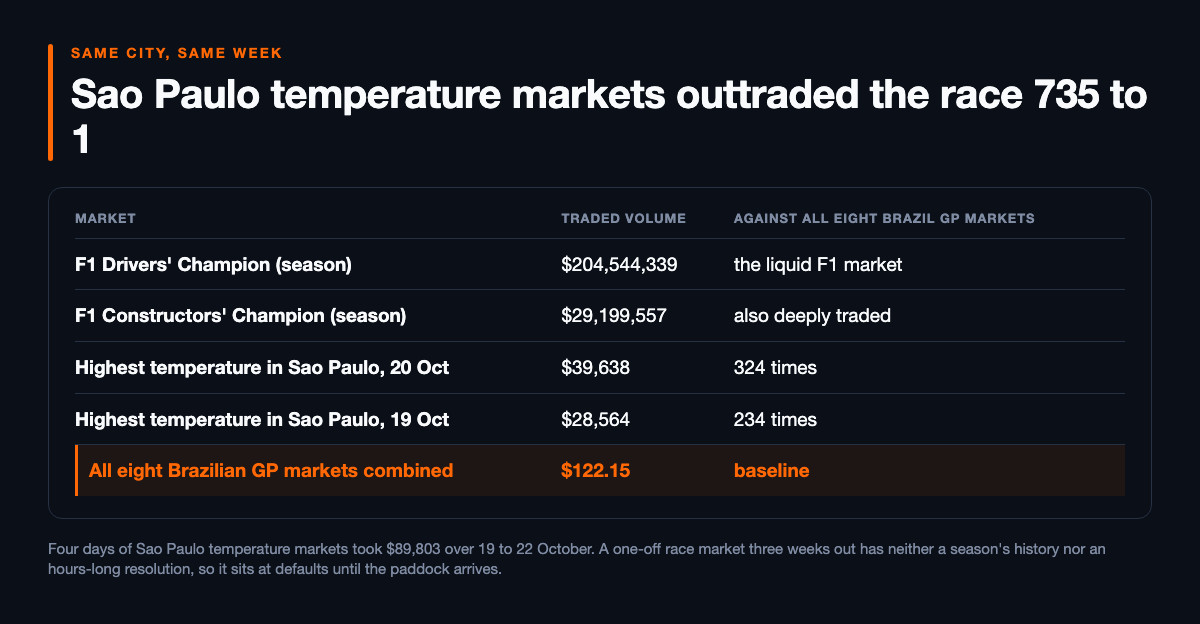
- Traders are pricing São Paulo weather instead. Four days of “highest temperature in São Paulo” markets took $89,803 over 19–22 October — 735 times every Brazilian Grand Prix market combined.
- Interlagos is wet 62% of the time in the race-date window. Across 2015–2025, 48 of 77 days in the 5–11 November window recorded at least 1 mm of rain.
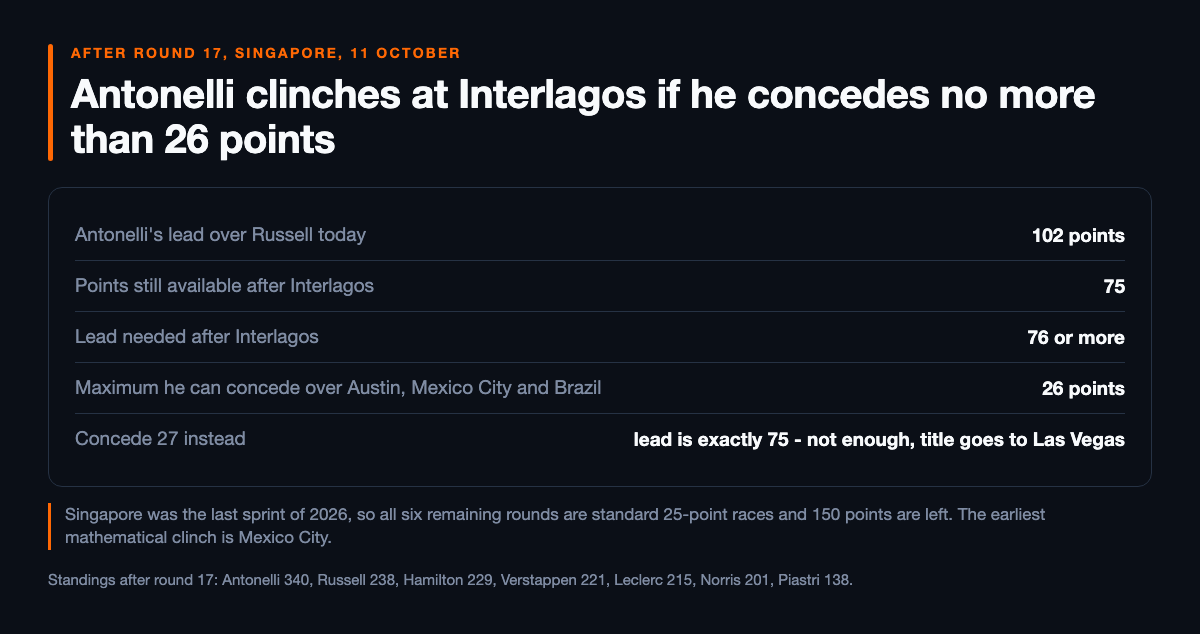
- Kimi Antonelli can clinch the title at Interlagos provided he concedes no more than 26 points to George Russell across Austin, Mexico City and Brazil.
- The Brazilian Grand Prix odds board right now
- Why a 757% book is not a forecast
- The São Paulo market traders are actually using
- Interlagos rain: eleven Novembers of data
- What the 5–11 November window says about race day
- Can Antonelli clinch the title at Interlagos?
- Who is still mathematically alive
- How I would use these markets on race week
- Sources and method
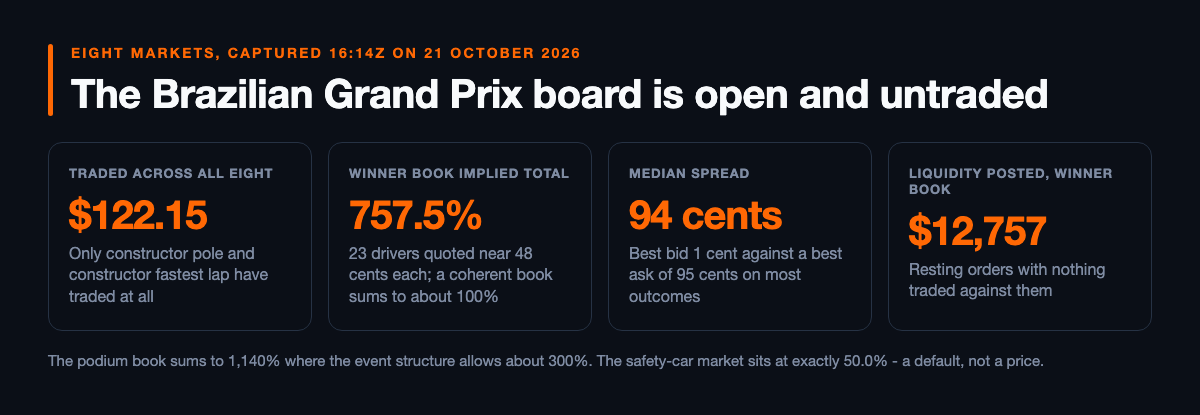
If you came looking for Brazilian Grand Prix odds 2026, the honest answer is that the market has not formed an opinion yet. Polymarket has eight Interlagos markets open for 8 November and, between them, they had taken $122.15 when I pulled every order book at 16:14Z on 21 October 2026. The race-winner book quotes twenty-three drivers at roughly 48¢ each and sums to 757.5%.
That matters because a number on a screen looks like a forecast whether or not anyone has backed it. Every ranking page I checked for this race is quoting last year’s prices, and the one 2026 preview I found cites a monthly rainfall normal for the city rather than anything measured at the circuit. So this piece does three things instead: it reads the actual order books, it pulls eleven Novembers of weather data for the Interlagos grid cell from the same API this site uses for race-week forecasts, and it works the title arithmetic to the point.
I checked every book outcome by outcome, summed the implied probabilities, measured the spreads, and cross-checked the championship standings against the official classification. Where my weather figures disagree with the Brazilian national normal, I say so and show both.
The Brazilian Grand Prix odds board right now
Here is every Brazilian Grand Prix market Polymarket had open, captured at 16:14Z on 21 October 2026. “Implied total” is the sum of the quoted YES prices across every outcome in the book — the number that tells you whether a book is coherent.
| Market | Outcomes | Implied total | Median spread | Traded volume | Liquidity posted |
|---|---|---|---|---|---|
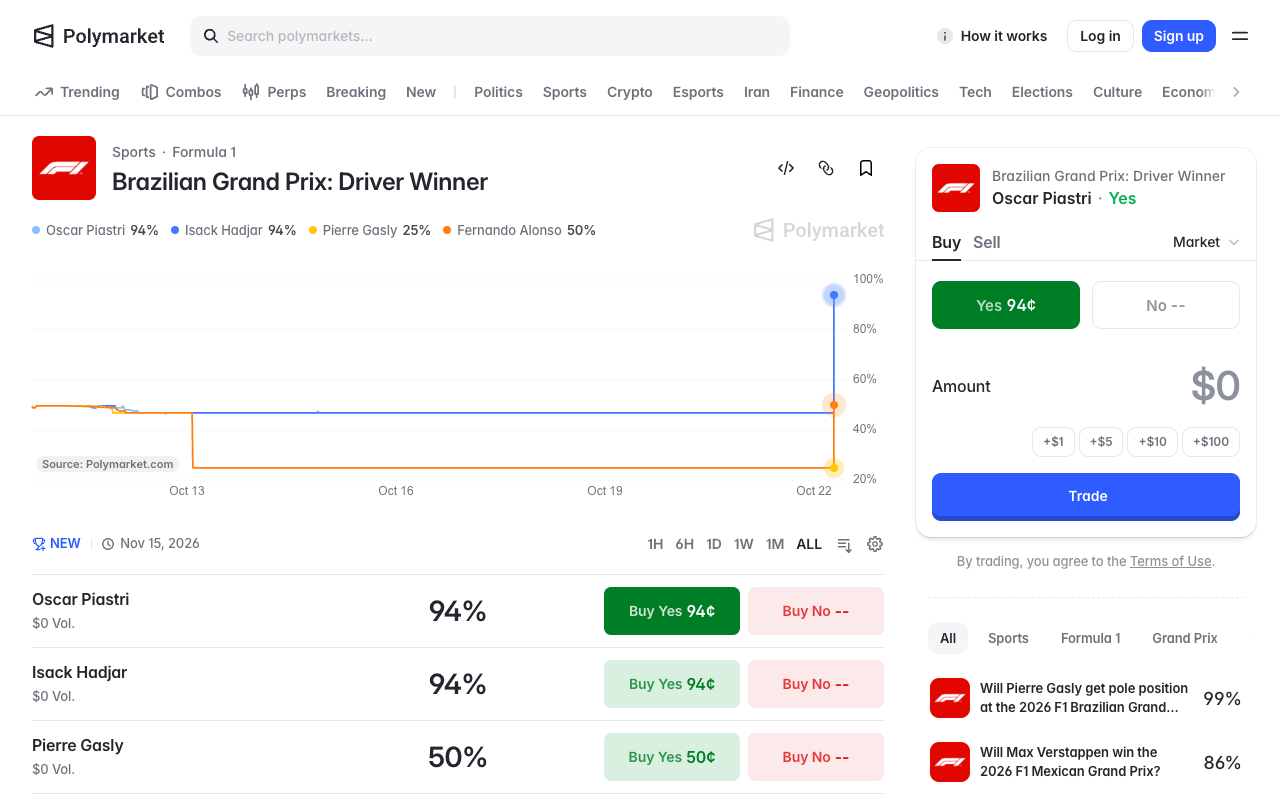
| Driver Winner | 23 | 757.5% | 94¢ | $0 | $12,757 |
| Driver Podium Finish | 23 | 1,140.0% | 98¢ | $0 | $23 |
| Constructor Pole Position | 11 | 422.5% | 98¢ | $87.25 | $2,252 |
| Constructor Fastest Lap | 11 | 494.0% | 97¢ | $34.90 | $546 |
| Practice 2 Fastest Lap | 23 | 1,138.5% | — | $0 | $44 |
| Practice 3 Fastest Lap | 23 | 1,138.5% | — | $0 | $44 |
| Safety car (yes/no) | 1 | 50.0% | 80¢ | $0 | $104 |
| Red flag (yes/no) | 1 | 45.5% | 89¢ | $0 | $103 |
Two markets have traded at all, and they are the two nobody writes previews about: constructor pole and constructor fastest lap, for a combined $122.15. The race winner, the podium, the safety car and the red flag have taken nothing, despite $12,757 of resting liquidity on the winner book alone.
The safety-car market sitting at exactly 50.0% is the clearest tell. Interlagos is one of the most interruption-prone races on the calendar; a market with any trade behind it would not be at a coin flip. For how that market behaves once money arrives, see our F1 safety car odds breakdown.
Why a 757% book is not a forecast
In a coherent win market the quoted probabilities sum to roughly 100%, plus a small margin. Twenty-three mutually exclusive outcomes summing to 757.5% is not a margin, it is an absence of trading: the quotes are sitting at defaults because no order has moved them.
The podium book is worse, and in an instructive way. Three of twenty-three drivers finish on the podium, so that book should sum to about 300%. It sums to 1,140% — nearly four times what the event structure allows.
- Best bid on most winner outcomes: 1¢
- Best ask on the same outcomes: 95¢
- Median spread across the book: 94¢
A 94¢ spread means there is no consensus price to read, only the two extremes of a book waiting for someone to trade. Treat the midpoint as decoration.
This is not a Polymarket fault, and it is not unique to Brazil. It is how pre-weekend F1 books behave on the platform: they open early, sit at defaults, and price properly in the two or three days around practice. The same thing happened for Mexico City, where the winner book sat at 684% a week after opening. If you want the mechanics of reading these books against bookmaker prices, we cover the comparison in Polymarket vs sportsbook F1 odds.
The São Paulo market traders are actually using
Here is the part I did not expect. While every Brazilian Grand Prix market sat untouched, Polymarket’s daily “highest temperature in São Paulo” markets were doing real business — on the same city, in the same week.
| Market | Traded volume | Comparison |
|---|---|---|
| F1 Drivers’ Champion (season) | $204,544,339 | the liquid F1 market |
| F1 Constructors’ Champion (season) | $29,199,557 | also deeply traded |
| Highest temperature in São Paulo, 20 Oct | $39,638 | 324× all Brazil GP markets |
| Highest temperature in São Paulo, 19 Oct | $28,564 | 234× |
| Highest temperature in São Paulo, 21 Oct | $17,072 | 140× |
| Highest temperature in São Paulo, 22 Oct | $4,529 | 37× |
| All eight Brazilian GP markets combined | $122.15 | baseline |
Four days of São Paulo temperature markets took $89,803. Every Brazilian Grand Prix market put together took $122.15. That is a ratio of roughly 735 to 1, and the single busiest day — 20 October, at $39,638 — outtraded the entire race by 324 times.
The lesson is about where attention sits, not about weather being a better bet. Season-long championship markets are liquid because they have run all year. Daily weather markets are liquid because they resolve in hours. A one-off race market three weeks out has neither property, so it stays at defaults until the paddock arrives. Our F1 weather odds guide covers how the forecast actually feeds race pricing.
Interlagos rain: eleven Novembers of data
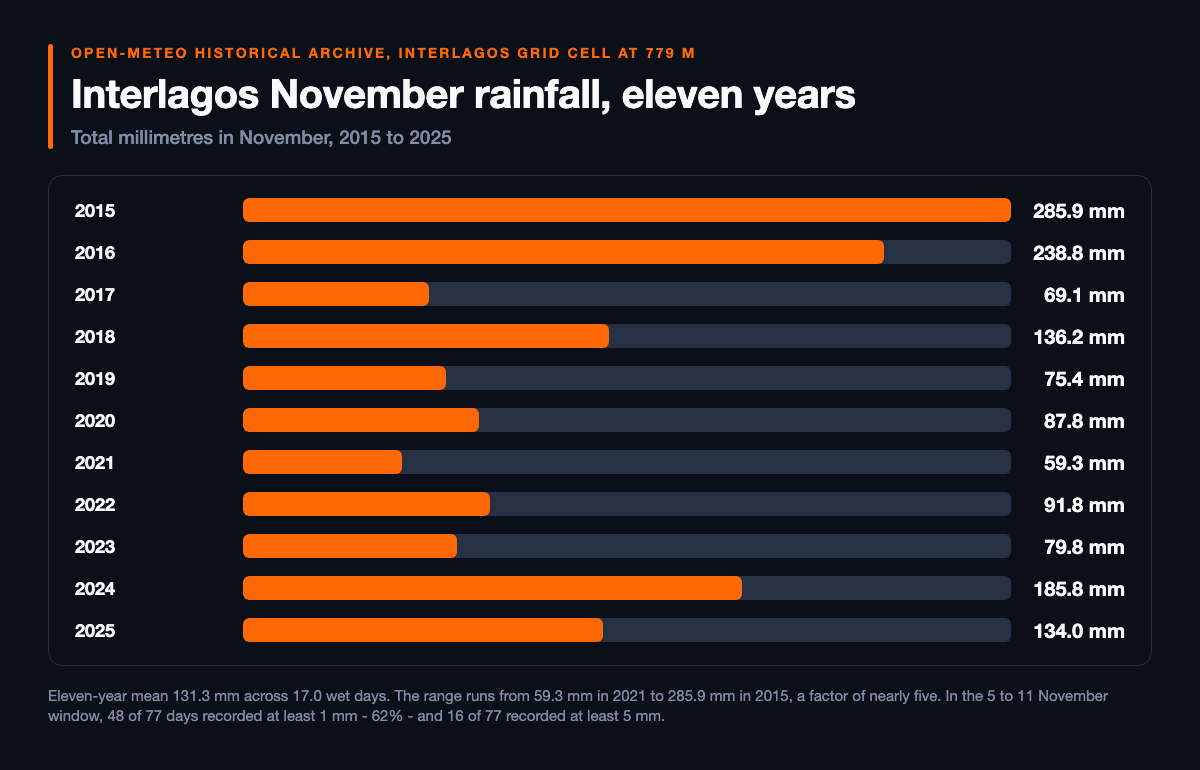
Interlagos has a reputation for rain, and reputations are worth checking. I pulled daily precipitation for the Interlagos grid cell (23.73°S, 46.66°W, elevation 779 m) from the Open-Meteo historical archive for every November from 2015 to 2025.
| November | Total rainfall | Days ≥1 mm | Days ≥5 mm | Mean daily max |
|---|---|---|---|---|
| 2015 | 285.9 mm | 25 | 15 | 24.8°C |
| 2016 | 238.8 mm | 24 | 13 | 23.4°C |
| 2017 | 69.1 mm | 16 | 5 | 23.8°C |
| 2018 | 136.2 mm | 18 | 6 | 23.5°C |
| 2019 | 75.4 mm | 15 | 4 | 23.9°C |
| 2020 | 87.8 mm | 15 | 6 | 24.0°C |
| 2021 | 59.3 mm | 10 | 3 | 23.7°C |
| 2022 | 91.8 mm | 18 | 6 | 22.4°C |
| 2023 | 79.8 mm | 14 | 4 | 27.4°C |
| 2024 | 185.8 mm | 18 | 9 | 25.5°C |
| 2025 | 134.0 mm | 14 | 7 | 24.5°C |
| 11-year mean | 131.3 mm | 17.0 | 7.1 | 24.3°C |
The mean is 131 mm across 17 wet days, but the spread is the story: November rainfall at Interlagos ranged from 59 mm in 2021 to 286 mm in 2015, a factor of nearly five. On average, 57% of November days see at least 1 mm and 24% see at least 5 mm.
So the reputation holds, with a caveat. Interlagos in November is reliably showery rather than reliably wet: a lot of days get some rain, and about one in four gets enough to matter to a race car. That asymmetry is exactly what a mispriced safety-car market would pay you for — if it were trading.
What the 5–11 November window says about race day
A monthly mean is a blunt instrument when you care about one Sunday. Narrowing to the 5–11 November window — the week the race falls in — gives 77 circuit-days across those eleven years.
| Measure | This analysis (Open-Meteo, Interlagos cell) | INMET city normal (as cited elsewhere) |
|---|---|---|
| Period | 2015–2025, 11 years | long-run climate normal |
| Location | Interlagos grid cell, 779 m | São Paulo city station |
| November rainfall | 131.3 mm | ~143.9 mm |
| November rain days | 17.0 (≥1 mm) | ~11 |
| 5–11 Nov days with ≥1 mm | 48 of 77 = 62% | not published |
| 5–11 Nov days with ≥5 mm | 16 of 77 = 21% | not published |
The two sources disagree, and I would rather show that than average it away. The rainfall totals are close — 131 mm against roughly 144 mm — but the rain-day counts differ a lot, because a “rain day” depends entirely on the threshold and the station. A 1 mm reanalysis threshold at the circuit will always count more days than a city-station normal using a higher bar.
Use the 62% figure the way it is meant: as a base rate for “some rain falls somewhere in the race-day window,” not as a probability of a wet race. The 21% figure for 5 mm days is the better proxy for a genuinely disrupted Grand Prix.
One practical note. This site’s race-week forecasts run on a 16-day window, and on 21 October that window ended on 5 November. The 8 November race enters forecast range on 24 October. Until then, anyone quoting you a Brazilian Grand Prix forecast is quoting climatology, not a forecast.
Can Antonelli clinch the title at Interlagos?
This is the question that gives the weekend its stakes, and the arithmetic is tight enough to be worth doing properly. Standings below are the official classification after round 17 (Singapore, 11 October): Antonelli 340, Russell 238, Hamilton 229, Verstappen 221, Leclerc 215, Norris 201, Piastri 138.
Six rounds remain and — this is the bit most previews miss — Singapore was the last sprint of 2026. Every remaining round is a standard 25-point race, so 150 points are still available and the maths is clean.
| Round | Grand Prix | Date | Points still available after it |
|---|---|---|---|
| 18 | United States GP, Austin | 25 Oct | 125 |
| 19 | Mexico City GP | 1 Nov | 100 |
| 20 | Brazilian GP, Interlagos | 8 Nov | 75 |
| 21 | Las Vegas GP | 22 Nov | 50 |
| 22 | Qatar GP | 29 Nov | 25 |
| 23 | Abu Dhabi GP, Yas Marina | 6 Dec | 0 |
A driver is champion once his lead exceeds the points still available. After Interlagos that figure is 75, and Antonelli leads Russell by 102 today. So the condition is simple:
102 − 26 = 76, which is more than the 75 left afterwards. Concede 27 and the lead is exactly 75, which is not enough, and the title goes to Las Vegas.
Two edges are worth stating. The earliest he can mathematically clinch is Mexico City, one round sooner, if he wins both Austin and Mexico while Russell fails to win either. And even in the brutal case where Russell wins all three of Austin, Mexico and Brazil, Antonelli still clinches at Interlagos if he finishes second each time: 394 against 313 is a lead of 81, above the 75 remaining. He only loses the Interlagos clinch if he is third or worse in that sequence. Our Antonelli title clinch page tracks the round-by-round thresholds as results land, and title race scenarios works the permutations.
Who is still mathematically alive
Mathematically alive means a driver can still exceed Antonelli’s current 340 points if Antonelli never scores again. On that test, one name has already dropped off.
| Driver | Points | Max possible final | Gap to Antonelli | Status |
|---|---|---|---|---|
| Kimi Antonelli | 340 | 490 | — | leader |
| George Russell | 238 | 388 | 102 | alive |
| Lewis Hamilton | 229 | 379 | 111 | alive |
| Max Verstappen | 221 | 371 | 119 | alive |
| Charles Leclerc | 215 | 365 | 125 | alive |
| Lando Norris | 201 | 351 | 139 | alive |
| Oscar Piastri | 138 | 288 | 202 | eliminated |
Now compare that with what the title market says. This is where the only liquid F1 book on the platform earns its keep — and it disagrees sharply with the standings.
| Driver | Championship position | Points | Polymarket title price |
|---|---|---|---|
| Kimi Antonelli | 1st | 340 | 97.90% |
| Max Verstappen | 4th | 221 | 1.65% |
| Lewis Hamilton | 3rd | 229 | 0.15% |
| George Russell | 2nd | 238 | 0.05% |
| Lando Norris | 6th | 201 | 0.05% |
| Charles Leclerc | 5th | 215 | 0.05% |
| Oscar Piastri | 7th | 138 | 0.00% |
Russell is second on points and 17 points clear of Verstappen, yet the market prices Verstappen at 33 times Russell’s chance. With $204.5m traded, that is not noise. The read is that traders treat Verstappen as the only driver who could string together the wins a comeback needs, and treat Russell’s deficit to his own team-mate as the harder problem. You can follow both against the standings on our drivers’ championship page.
How I would use these markets on race week
Nothing on the Brazilian Grand Prix board is worth acting on today, and that is a usable conclusion rather than a disappointing one. Here is the sequence I would actually follow.
- Now to 23 October: ignore the Interlagos books entirely. A 94¢ spread cannot be traded out of profitably in either direction.
- 24 October: the race day enters the 16-day forecast window. First real signal on rain.
- After Austin (25 Oct) and Mexico City (1 Nov): recompute the clinch gap. If Antonelli has conceded 27 or more to Russell, Interlagos stops being a coronation and the title market should move.
- Thursday of race week: check whether the winner book still sums above about 110%. Until it tightens, the quotes are not probabilities.
- After FP1 and FP2 (6 Nov): this is when these books historically price. Compare the safety-car line against the 21% base rate for a 5 mm day.
- Qualifying (7 Nov): pole and podium books tighten last. The constructor pole market already has $2,252 of liquidity waiting.
The one standing edge is the safety-car market. A race at a circuit where roughly one race-week day in five gets 5 mm of rain should not sit at a flat 50%. When money arrives and that line moves, the direction it moves tells you what the paddock expects from the forecast. Keep an eye on next race and the live odds board for when the books wake up.
Sources and method
Market data: every Brazilian Grand Prix book was read outcome by outcome from the Polymarket Gamma API at 16:14Z on 21 October 2026, summing quoted YES prices and taking the median of best-ask minus best-bid. You can see the Brazilian Grand Prix winner market for yourself.
Weather: daily precipitation and temperature for the Interlagos grid cell from the Open-Meteo historical weather API, November 2015 to November 2025, timezone America/São Paulo. Thresholds of 1 mm and 5 mm are stated with every figure because rain-day counts are meaningless without them. Reanalysis data describes a grid cell, not a rain gauge at the pit exit.
Standings: the official 2026 drivers’ classification, cross-checked against this site’s own snapshot series. Points maths assumes 25 points for a win with no sprints remaining, and treats a lead as decisive only when it strictly exceeds the points still available.
Related reading
- Mexico City Grand Prix odds 2026 — the previous round, and the same untraded-book problem
- F1 weather odds — how rain probability feeds race pricing
- F1 safety car odds — what the interruption market pays for
- Antonelli title clinch 2026 — round-by-round clinch thresholds
- Polymarket vs sportsbook F1 odds — reading a prediction market against a bookmaker
- F1 schedule 2026 — every remaining round, with start times