Every page that ranks for Mexico City Grand Prix odds 2026 is selling you something that does not exist. I checked the top results this afternoon: the Oddschecker page sitting on the mexican-grand-prix/winner URL is serving United States Grand Prix markets instead, the BonusDevil tips page says in its own words that it has had “no Mexican Grand Prix 2026 picks in the last 30 days”, and the Racing Post and Rotowire previews are arguing about a title fight from a previous season. Eighteen days out from a race that can decide the championship, that is the entire competitive field.
So here is the honest version. Every price, bid, ask and dollar of volume below was read from the Polymarket Gamma API at 16:27Z on 14 October 2026, the standings from the Jolpica F1 feed after Sunday’s Singapore Grand Prix, the calendar from the same feed, and the altitude from SRTM elevation data sampled at the circuit’s own coordinates.
The finding is not the one a betting page wants. Polymarket has opened thirteen Mexico City markets and priced none of them. The race-winner book sums to 684% instead of 100%, the podium book to 1,156%, and the whole weekend — all thirteen markets together — has traded $207.05. The drivers’ championship market on the same website has traded $204.3 million. Knowing which of those two numbers is a forecast is the only skill that matters here.
Key takeaways
- There are no real Mexico City Grand Prix odds yet, on Polymarket or at the books. Thirteen markets are open for 1 November; their books sum to between 397% and 1,156%, on $207.05 of total volume.
- All thirteen were created inside 42 seconds — 11:32:09Z to 11:32:51Z on 3 October. These are templated markets waiting for traders, not a price anyone has argued over.
- Mexico City on 1 November is where the drivers’ title can realistically be sealed. Kimi Antonelli leads by 102 points with six races left, and he clinches at Mexico if he loses no more than 1 point net to George Russell across Austin and Mexico City.
- Austin can do it a week earlier, but only on a near-perfect weekend: Antonelli must win while Russell finishes tenth or lower and Hamilton no better than fifth.
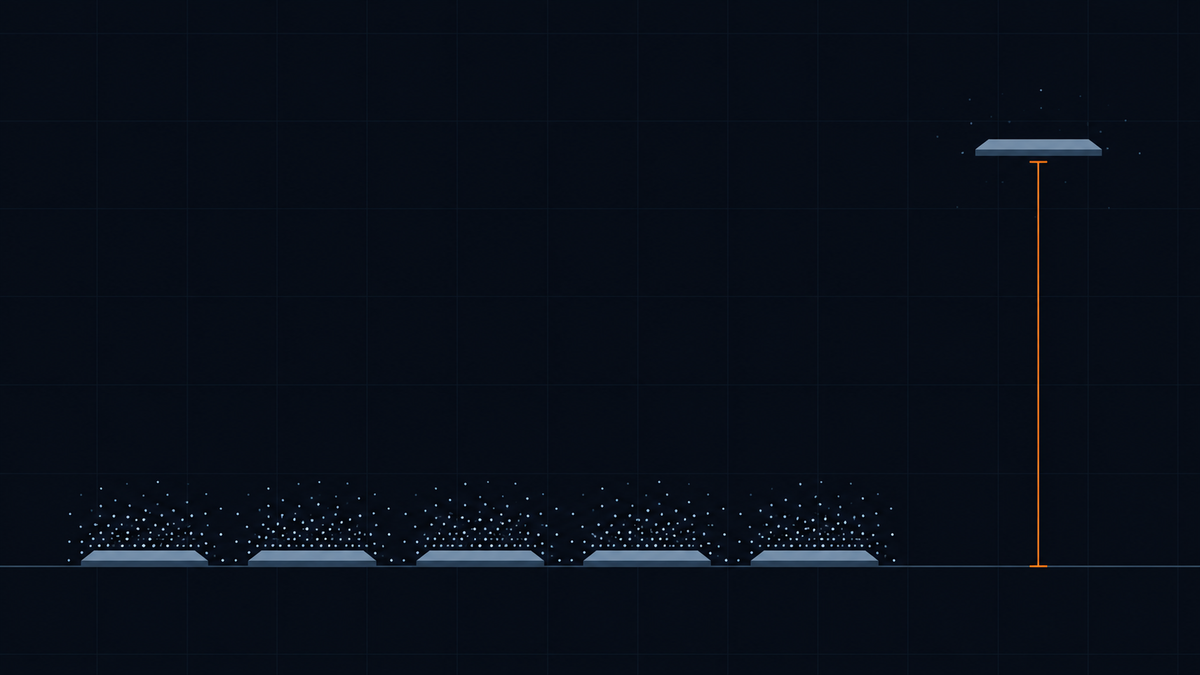
- Autódromo Hermanos Rodríguez sits at 2,242 m — nearly three times the height of the next-highest circuit, with air 20% thinner than sea level. Max Verstappen has won five of the last ten races held there.
The Mexico City Odds Board Right Now
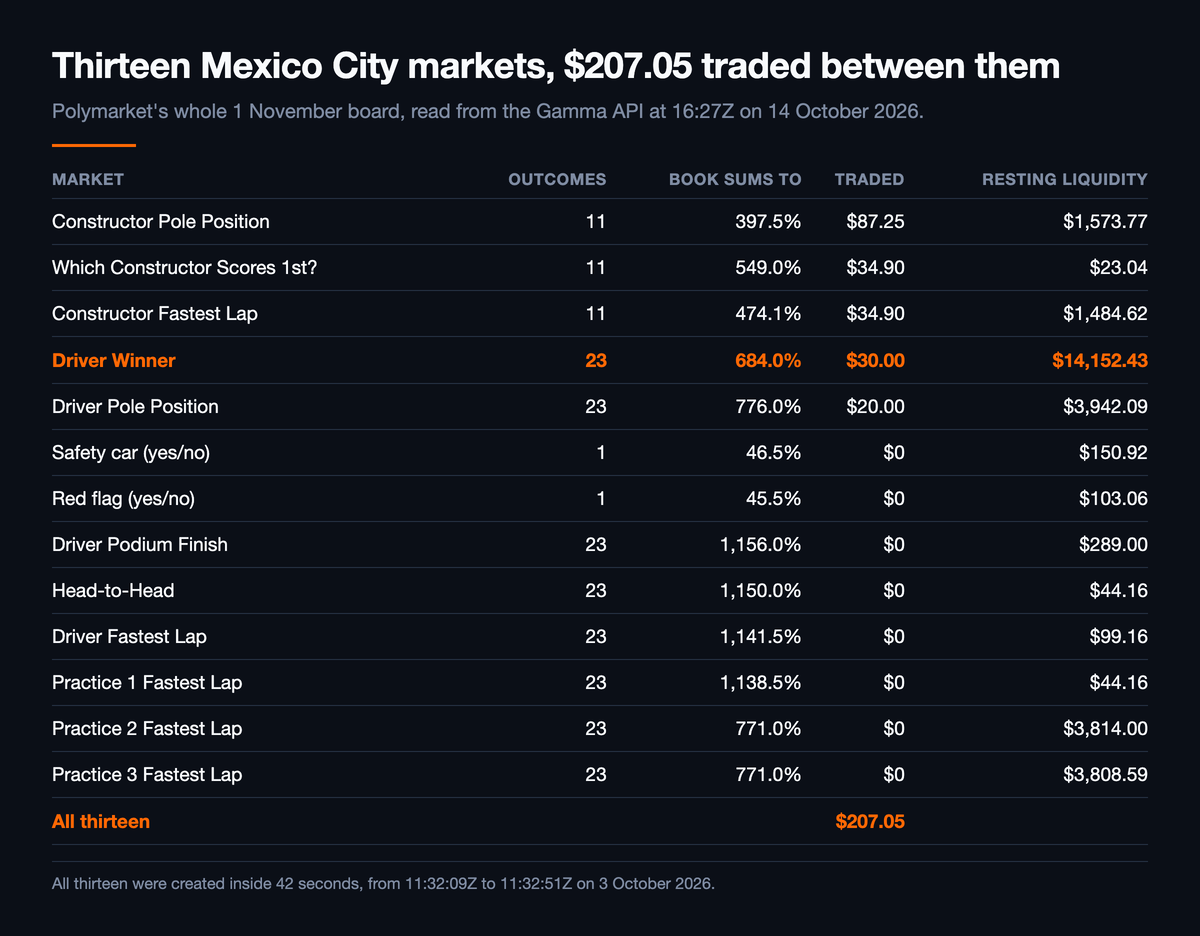
Polymarket runs the Mexico City weekend as thirteen separate events, not one, each with its own yes/no book per driver or constructor, all resolving across 30 October to 1 November. The official race name is the Mexico City Grand Prix; Polymarket labels all of them “Mexican Grand Prix”, worth knowing if you are searching for them.
Here is the whole board: real outcomes per book, what they sum to, and what has traded. A book summing to 100% is a probability distribution. One summing to 684% is a list of placeholders.
| Market | Outcomes | Book sums to | Traded | Resting liquidity |
|---|---|---|---|---|
| Constructor Pole Position | 11 | 397.5% | $87.25 | $1,573.77 |
| Which Constructor Scores 1st? | 11 | 549.0% | $34.90 | $23.04 |
| Constructor Fastest Lap | 11 | 474.1% | $34.90 | $1,484.62 |
| Driver Winner | 23 | 684.0% | $30.00 | $14,152.43 |
| Driver Pole Position | 23 | 776.0% | $20.00 | $3,942.09 |
| Safety car (yes/no) | 1 | 46.5% | $0 | $150.92 |
| Red flag (yes/no) | 1 | 45.5% | $0 | $103.06 |
| Driver Podium Finish | 23 | 1,156.0% | $0 | $289.00 |
| Head-to-Head | 23 | 1,150.0% | $0 | $44.16 |
| Driver Fastest Lap | 23 | 1,141.5% | $0 | $99.16 |
| Practice 1 Fastest Lap | 23 | 1,138.5% | $0 | $44.16 |
| Practice 2 Fastest Lap | 23 | 771.0% | $0 | $3,814.00 |
| Practice 3 Fastest Lap | 23 | 771.0% | $0 | $3,808.59 |
| All thirteen | — | — | $207.05 | — |
Two of the thirteen deserve a second look. The safety car and red flag markets are single yes/no questions, so they cannot carry an overround — at 46.5% and 45.5% they are the only Mexico City numbers here even shaped like a probability. I still would not trade them, for the reason I come back to below: the safety car market is quoted 3c bid against 90c ask.
What a 684% Book Actually Means
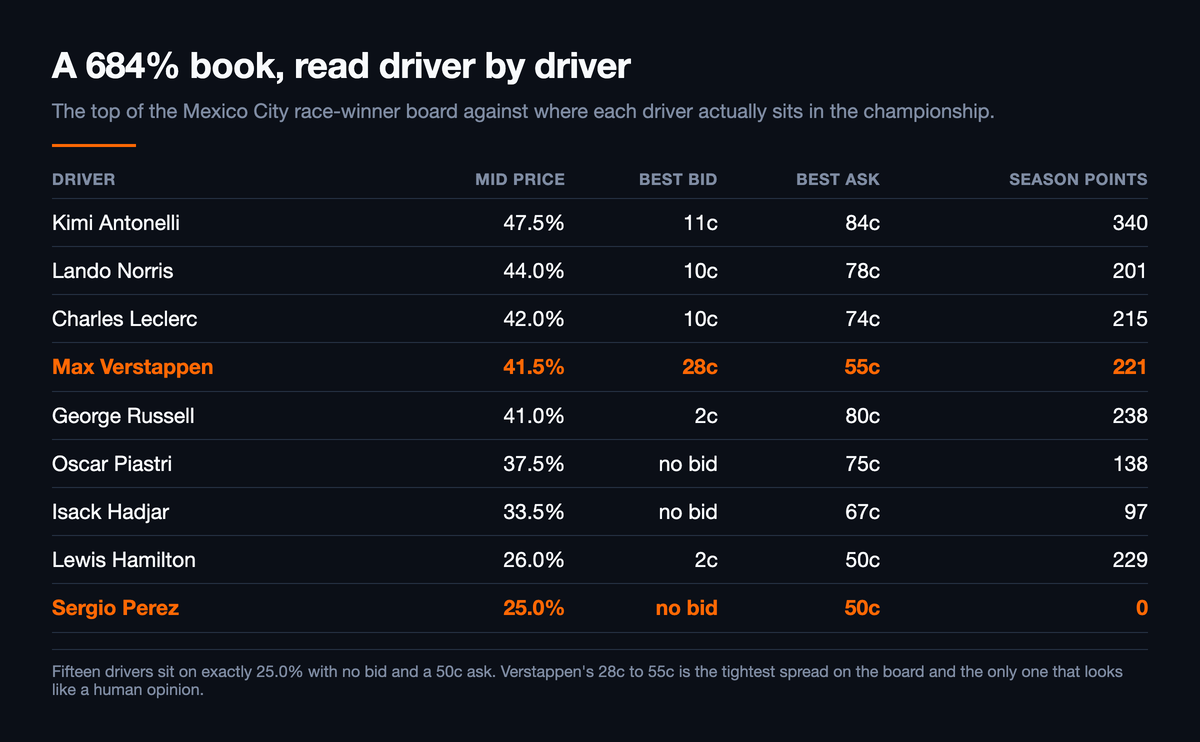
The race-winner market lists 23 drivers plus six empty placeholder slots. Add the yes prices on the 23 real names and you get 684%. Sell every outcome at the quoted price and you would collect $6.84 to pay out $1 — which tells you nobody is standing behind these quotes.
The bid/ask spreads say the same thing more plainly. Here is the top of the winner board against where each driver actually sits in the championship.
| Driver | Mid price | Best bid | Best ask | Season points |
|---|---|---|---|---|
| Kimi Antonelli | 47.5% | 11c | 84c | 340 |
| Lando Norris | 44.0% | 10c | 78c | 201 |
| Charles Leclerc | 42.0% | 10c | 74c | 215 |
| Max Verstappen | 41.5% | 28c | 55c | 221 |
| George Russell | 41.0% | 2c | 80c | 238 |
| Oscar Piastri | 37.5% | no bid | 75c | 138 |
| Isack Hadjar | 33.5% | no bid | 67c | 97 |
| Lewis Hamilton | 26.0% | 2c | 50c | 229 |
| Sergio Pérez | 25.0% | no bid | 50c | 0 |
Look at the bottom row. Sergio Pérez is priced at 25% to win the Mexico City Grand Prix and has scored nothing all season. Fifteen drivers sit on exactly 25.0% with no bid and a 50c ask, which is the signature of a market generated from a template and never touched. Verstappen’s 28c–55c is the tightest spread on the board and the only one that looks like a human opinion.
The useful comparison is the right-hand column. The nominal favourite is Antonelli at 47.5%, who is also the championship leader — but Norris at 44.0% has 201 points and Pérez at 25.0% has zero. A book that cannot separate those two is not ranking anything.
Where the Sportsbooks Have Mexico City Odds
They mostly do not, and the one that appears to is a filing error. Oddschecker’s formula-1/mexican-grand-prix/winner page currently renders United States Grand Prix markets: Verstappen 13/10, Antonelli 13/5, Leclerc 12/1, Russell 11/1. Those are Austin prices on a Mexico City URL. BonusDevil keeps a Mexico City 2026 page alive with the right venue and altitude but no picks and no odds.
What the books do price is the championship, and that is a fair comparison because Polymarket prices it too. Converting Oddschecker’s fractional quotes to implied probability against Polymarket’s mid prices:
| Drivers’ title | Sportsbook price | Implied | Polymarket mid | Difference |
|---|---|---|---|---|
| Kimi Antonelli | 1/100 | 99.01% | 97.15% | −1.86pp |
| Max Verstappen | 55/1 | 1.79% | 1.15% | −0.64pp |
| George Russell | 175/1 | 0.57% | 0.25% | −0.32pp |
| Lewis Hamilton | 175/1 | 0.57% | 0.15% | −0.42pp |
| Sum of these four | — | 101.93% | 98.70% | — |
That last row is the argument for using prediction markets as a reference. The sportsbook needs only four names to clear 100%; Polymarket’s complete 22-driver book sums to 98.9%, under par, because the margin sits in the spread rather than the price. The same page also quotes Verstappen at 40/1 in its “popular bet” module and 55/1 in its grid — a 0.65pp disagreement with itself.
So the hierarchy today: the championship markets are real on both venues and broadly agree, and the Mexico City race markets are real on neither. For a longer treatment of reading the two against each other, see Polymarket vs sportsbook F1 odds.
Mexico City Is Where the Title Can Be Won
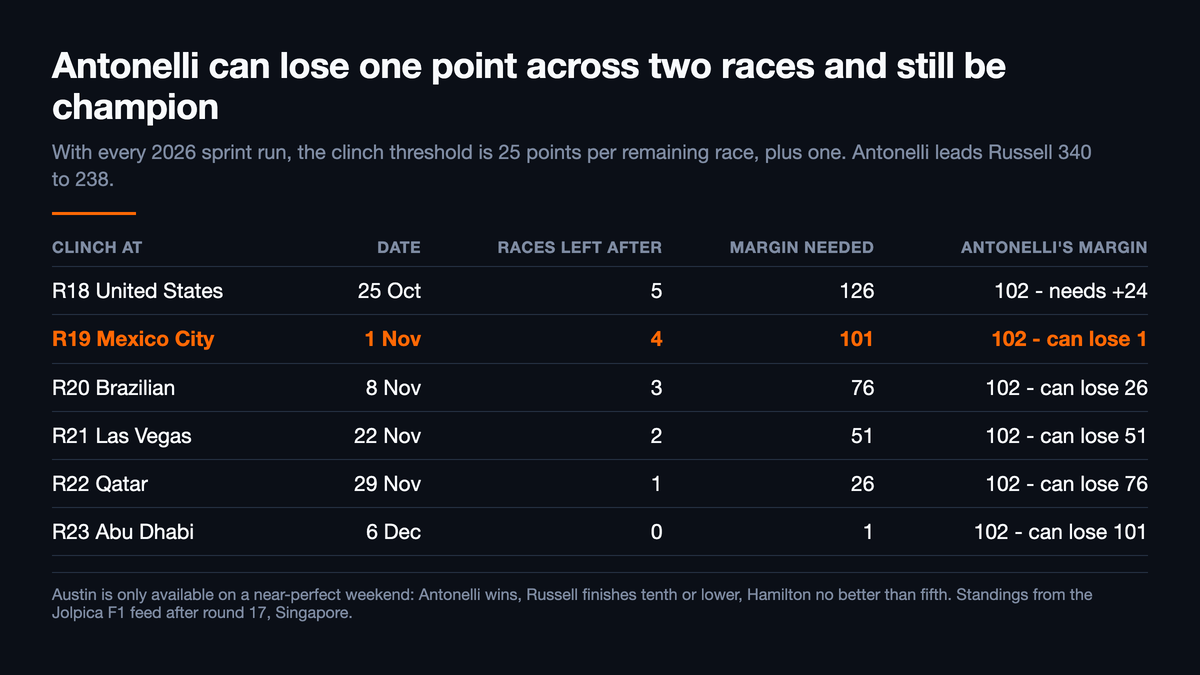
This is the part no competitor has done, and the reason the race matters. After Singapore, Antonelli leads the drivers’ championship 340 to Russell’s 238 — a 102-point margin with six rounds left. All six 2026 sprints have been run, the last at Singapore, so every remaining round is a conventional 25-point race. A rival’s maximum is 25 points per weekend and nothing more.
A title is mathematically settled when the leader’s margin exceeds everything a rival can still score. With no sprints left, that threshold is simply 25 points per remaining race, plus one:
| Clinch at | Date | Races left after | Margin needed | Antonelli’s margin over Russell |
|---|---|---|---|---|
| R18 United States | 25 Oct | 5 | 126 | 102 — needs +24 |
| R19 Mexico City | 1 Nov | 4 | 101 | 102 — can lose 1 |
| R20 Brazilian | 8 Nov | 3 | 76 | 102 — can lose 26 |
| R21 Las Vegas | 22 Nov | 2 | 51 | 102 — can lose 51 |
| R22 Qatar | 29 Nov | 1 | 26 | 102 — can lose 76 |
| R23 Abu Dhabi | 6 Dec | 0 | 1 | 102 — can lose 101 |
Read the Mexico City row again. Antonelli already has 102 points of margin and needs 101 after that race. He can afford to lose exactly one point of it across two Grands Prix and still be champion on 1 November. Our F1 points calculator runs the same arithmetic for any driver pairing you want to test.
What Antonelli Needs Across Austin and Mexico
Russell is the binding constraint, but he is not the only one. Four drivers are still live on paper, and each sets its own requirement. The table shows the net swing Antonelli must achieve against each rival over the two races to be champion at Mexico City — a negative number is a swing he can afford to concede.
| Rival | Points | Current margin | Net needed by 1 Nov | In plain terms |
|---|---|---|---|---|
| George Russell | 238 | 102 | −1 | may lose 1 point net |
| Lewis Hamilton | 229 | 111 | −10 | may lose 10 points net |
| Max Verstappen | 221 | 119 | −18 | may lose 18 points net |
| Charles Leclerc | 215 | 125 | −24 | may lose 24 points net |
| Lando Norris | 201 | 139 | −38 | may lose 38 points net |
In practice Antonelli does not need to win anything. If he and Russell finish in the same order in both races — Antonelli ahead, or even one place behind once — the title is his on 1 November. One retirement for Antonelli while Russell wins is what breaks it: a 25-point swing that cuts the margin to 77 and moves the clinch to Brazil.
The Austin row in the previous table is the one to be careful with. A +24 swing in one race is only available if Antonelli wins and Russell scores a point or less, which means Russell finishing tenth or lower. Hamilton must also finish no better than fifth, because 111 plus 25 minus Hamilton’s score has to clear 126. It is possible. It is not something to price. We walk the branches in more detail in F1 title race scenarios 2026.
Why Mercedes Cannot Seal the Constructors’ Title Here
The constructors’ championship is further gone than the drivers’ and will still take longer to finish. Mercedes has 578 points to Ferrari’s 444, a 134-point margin, and Polymarket prices Mercedes at 99.35%. But a team can score 43 points in a race to a rival’s zero, not 25, so the thresholds are nearly twice as high.
Constructors’ clinch, race by race
- Austin (R18): impossible. The threshold is 216 and Mercedes can gain at most 43 in a weekend, topping out at 177.
- Mexico City (R19): possible but demanding. The threshold is 173, so Mercedes must gain 39 net over two races — effectively two one-two finishes with Ferrari scoring almost nothing.
- Brazil (R20): the realistic date. The threshold drops to 130, below the margin Mercedes already holds, so they can concede 4 points net across three races and still be champions.
So the likely shape is a drivers’ title settled in Mexico City and a constructors’ title settled a week later in São Paulo. If Mercedes sweep and Ferrari stumble, both land on 1 November — the only version of this weekend with real stakes on the minor placings.
2,242 Metres: The Thinnest Air on the Calendar
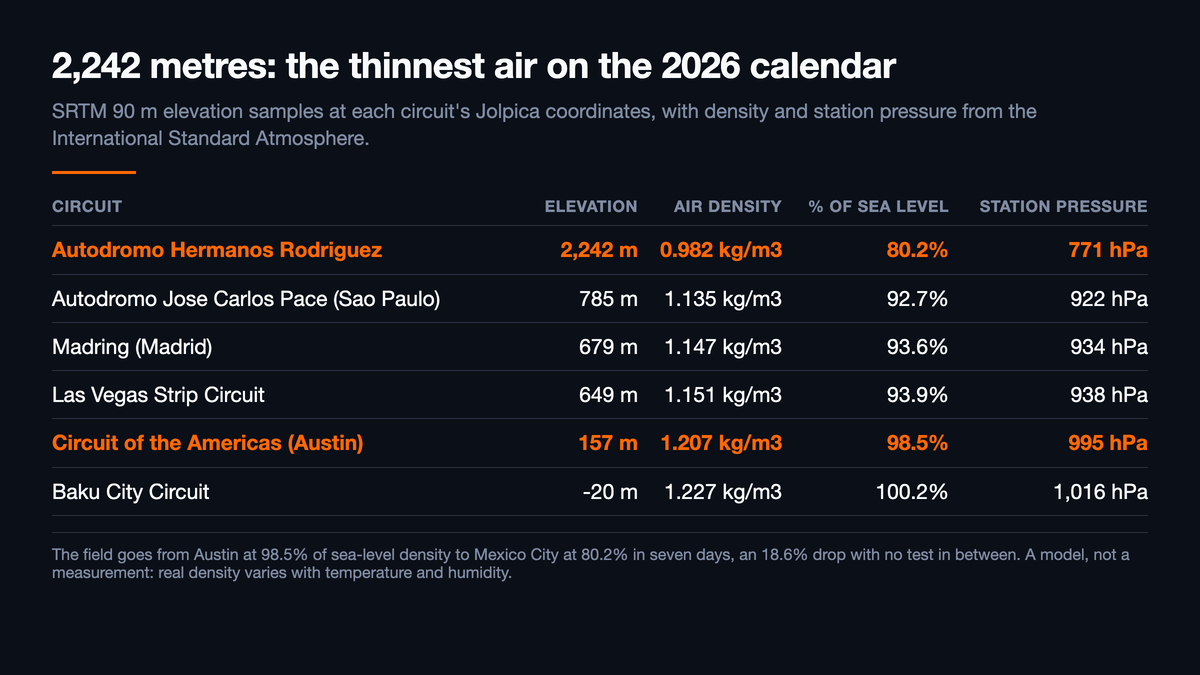
Mexico City is the one venue where the setting changes the car more than the corners do. I sampled SRTM elevation data at the circuit’s own coordinates — 19.4042°N, 99.0907°W, per the Jolpica feed — and ran the standard-atmosphere density formula across the 2026 calendar.
| Circuit | Elevation | Air density | % of sea level | Station pressure |
|---|---|---|---|---|
| Autódromo Hermanos Rodríguez | 2,242 m | 0.982 kg/m³ | 80.2% | 771 hPa |
| Autódromo José Carlos Pace (São Paulo) | 785 m | 1.135 kg/m³ | 92.7% | 922 hPa |
| Madring (Madrid) | 679 m | 1.147 kg/m³ | 93.6% | 934 hPa |
| Las Vegas Strip Circuit | 649 m | 1.151 kg/m³ | 93.9% | 938 hPa |
| Circuit of the Americas (Austin) | 157 m | 1.207 kg/m³ | 98.5% | 995 hPa |
| Baku City Circuit | −20 m | 1.227 kg/m³ | 100.2% | 1,016 hPa |
Hermanos Rodríguez is 2.9 times the elevation of the next-highest circuit on the calendar and 20.0% thinner than the lowest. The number that matters for this particular fortnight is the step between the two: the field goes from Austin at 98.5% of sea-level density to Mexico City at 80.2% in seven days, an 18.6% drop with no test in between.
Thin air does three things at once and they pull against each other. Downforce falls with density, so teams run their highest-downforce wings and still get less grip than the setup suggests. Cooling gets harder, so bodywork is opened up — which costs the downforce the wings were trying to recover. And the turbo works far harder to find the same oxygen, which is a reliability question as much as a performance one. Mercedes’ explainer on what altitude does to an F1 car and the Williams version describe the same trade.
Published figures for this circuit vary — 2,240 m, 2,250 m and 2,285 m all appear in print. My measured 2,242 m sits at the bottom of that range and the density conclusion holds across all of them.
One thing I will not do is give you a race-day forecast. The race is 18 days away, outside the window any weather model can speak to. Early November is the start of the city’s dry season, so rain is historically the less likely story — but anyone quoting you a 1 November precipitation probability today is quoting a climate average with a forecast’s confidence. Our guide to F1 weather and odds covers how much rain moves a race market when there is a real forecast to trade.
Hermanos Rodríguez Form: Ten Races, Five Verstappen Wins
The venue has an unusually concentrated record. Since Mexico returned to the calendar in 2015 there have been ten races there — 2020 was lost — and one driver has won half of them.
| Year | Winner | Team | Started from |
|---|---|---|---|
| 2025 | Lando Norris | McLaren | P1 |
| 2024 | Carlos Sainz | Ferrari | P1 |
| 2023 | Max Verstappen | Red Bull | P3 |
| 2022 | Max Verstappen | Red Bull | P1 |
| 2021 | Max Verstappen | Red Bull | P3 |
| 2019 | Lewis Hamilton | Mercedes | P3 |
| 2018 | Max Verstappen | Red Bull | P2 |
| 2017 | Max Verstappen | Red Bull | P2 |
| 2016 | Lewis Hamilton | Mercedes | P1 |
| 2015 | Nico Rosberg | Mercedes | P1 |
Verstappen five, Hamilton two, and one each for Rosberg, Sainz and Norris. The grid column is the more tradeable fact: five of the ten winners started from pole and five did not, and three won from third. The long run to turn one, at altitude where the slipstream is weaker but braking distances are longer, makes this a track where the front row is worth less than it looks.
What that history cannot tell you is anything about 2026. Verstappen is fourth on 221 points with two wins, and the car that has won eleven races this season is the Mercedes. Venue form is a tiebreaker, not a forecast — and with the race-winner book at 684% there is nothing to tie-break against yet.
How I Would Use These Markets
There is a version of this page that tells you Antonelli is 47.5% to win in Mexico City and stops there. That number is not a probability, and treating it as one is how you lose money to a spread rather than to a race.
What I would actually do between now and 1 November
- Ignore the mid price; read the bid and the ask. A 11c–84c quote on the race favourite is not a 47.5% opinion, it is an empty order book. Verstappen’s 28c–55c is the only spread on the Mexico board worth reading.
- Use the championship market for the title, not the race book. $204.3 million has gone through the drivers’ championship market and it sums to 98.9%. That is a forecast. The $30 race-winner book is not.
- Watch the Austin result, not the Mexico odds. Mexico City’s prices will not mean anything until qualifying on 31 October. The Austin result on 25 October is what determines whether 1 November is a coronation or a formality postponed.
- Expect these books to fill late. The United States Grand Prix winner market has gone from $73.61 to $1,376 of volume in the four days since we last measured it, with the race eleven days out. Mexico City is a week behind that curve.
The sequence, then: check the next race page for session times, watch Austin, and come back to the Mexico City book after Saturday qualifying when there is a grid to price against. Our live odds board tracks the championship markets that are already real, and the safety car odds explainer covers how those neutralisation markets behave once volume arrives.
Sources and Method
All Polymarket figures come from the Gamma API at 16:27Z on 14 October 2026, read from the events endpoint by slug. Book sums add the yes-side prices across the real named outcomes only, excluding the empty “Driver A” to “Driver E” and “Other” placeholder slots — including those would inflate the overround further.
Standings, calendar and venue history are from the Jolpica F1 API after round 17, Singapore. Elevations are SRTM 90 m samples at each circuit’s Jolpica coordinates; density and station pressure come from the International Standard Atmosphere (1.225 kg/m³ at sea level, lapse rate 0.0065 K/m) — a model, not a measurement, so real density varies with temperature and humidity. Sportsbook prices are Oddschecker quotes read on 14 October 2026, converted from fractional odds without removing margin. Session timings are on the Formula 1 race page for Mexico.
Where sources disagree — the altitude, and the round number some calendars give this race — I have said so rather than picked one quietly. Prices move; the timestamp above is what this page was written against.
Related GridOdds analysis
- US Grand Prix odds 2026 — the race before this one, and the earliest clinch date
- Antonelli title clinch 2026 — the clinch scenarios tracked round by round
- F1 drivers’ championship odds — the $204m market, against the standings
- F1 constructors’ title clinch — when Mercedes can finish the job
- F1 schedule 2026 — the remaining six rounds, with times
- F1 on Polymarket — how these markets resolve and settle