Every page ranking for US Grand Prix odds 2026 is quoting the wrong season. I ran the search and fetched the top results: the Formula1.com betting piece is years old, the bet365, Vegas Odds and Covers lines are 2025 numbers, and the one genuine 2026 Austin preview went up on 1 September — five rounds and one wet sprint ago. With the drivers’ title now 89 points wide and the earliest mathematical clinch date falling at the Circuit of the Americas, that gap between the odds on the page and the odds in the market is worth real money.
So this page does the opposite. Every Austin price, bid, ask and dollar of traded volume below was read from the Polymarket Gamma API at 21:22Z on 10 October 2026, the standings from the Jolpica F1 feed plus Saturday’s confirmed sprint result, and the weather normals from the National Weather Service’s own October table for Austin.
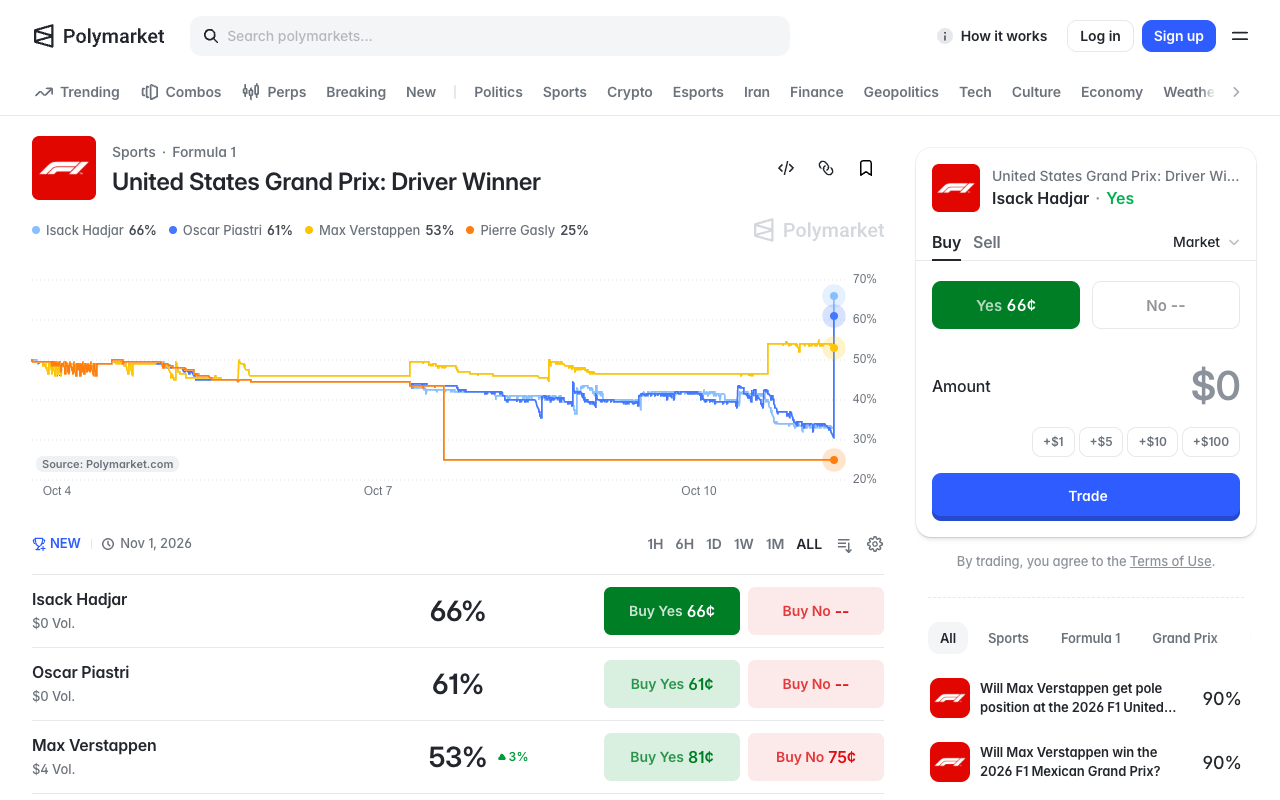
The headline finding is awkward for a betting page: the United States Grand Prix market is open and it is not yet a market. Its 23 outcomes sum to 681% rather than 100%, the favourite is quoted 25c bid against 82c ask, and the whole event has traded $73.61. Singapore’s market, created fifty seconds earlier in the same batch, has traded $243,638. That is not an age gap, it is a proximity gap, and telling the two apart is the whole skill.
Key takeaways
- Polymarket’s Austin race-winner book is unusable as a forecast. 23 outcomes summing to 681%, $73.61 of lifetime volume, and one single trade on the whole event — Max Verstappen at 83c.
- Verstappen is the only name the market has touched, and COTA history agrees with it: he has won four of the last five races here, while Lewis Hamilton holds the outright record with five.
- Austin on 25 October is the earliest date the 2026 drivers’ title can be clinched, and it needs near-perfection: Antonelli must win Singapore and Austin while George Russell scores 13 or fewer across both.
- Mexico City on 1 November is the realistic date. On the per-round margin the two Mercedes drivers have actually shown this season, Antonelli needs to net just 12 points on Russell across three races.
- Kalshi has not opened an Austin market at all. Its only live F1 event is Singapore, and all 22 of those markets show no bid, no ask and no volume on the public API.
The US Grand Prix Odds Board Right Now
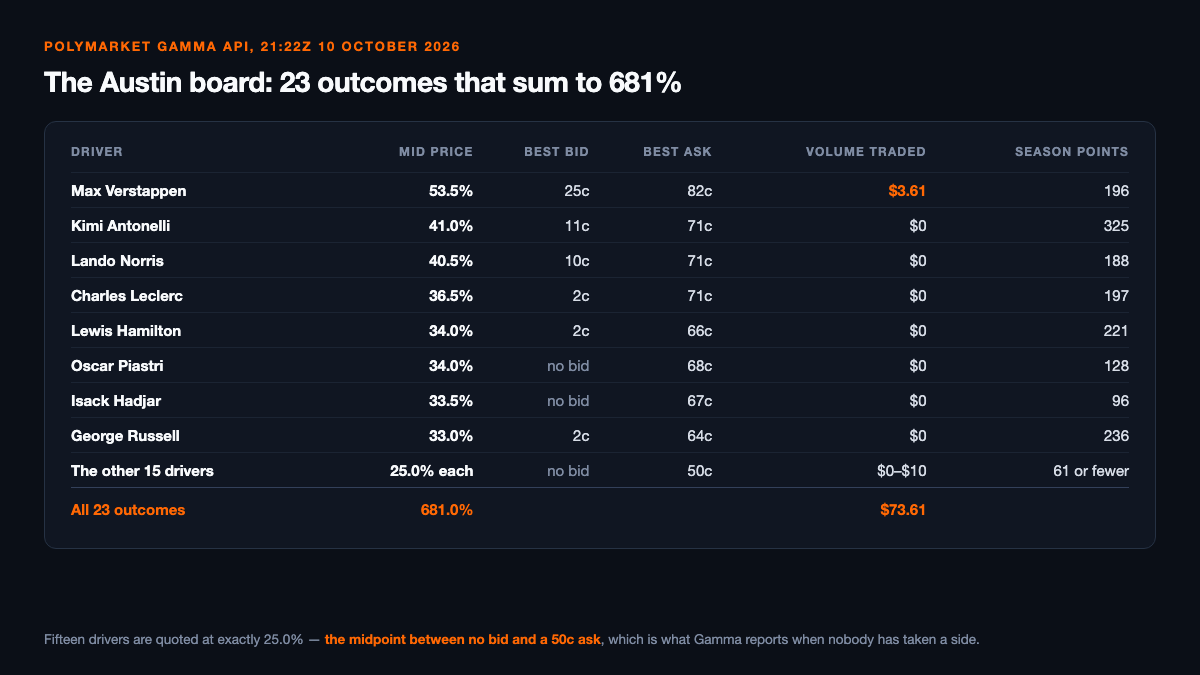
Polymarket opened United States Grand Prix: Driver Winner at 11:30:50Z on 3 October 2026 and it resolves on the race, round 18 of 23, at 20:00Z on Sunday 25 October — 3pm in Austin, 4pm Eastern, 8pm in the UK. Twenty-three drivers have their own yes/no market. Here is the top of that board as it stood at 21:22Z on 10 October, with the bid and the ask alongside the mid price, because on this market those three numbers tell completely different stories.
| Driver | Mid price | Best bid | Best ask | Volume traded | Season points |
|---|---|---|---|---|---|
| Max Verstappen | 53.5% | 25c | 82c | $3.61 | 196 |
| Kimi Antonelli | 41.0% | 11c | 71c | $0 | 325 |
| Lando Norris | 40.5% | 10c | 71c | $0 | 188 |
| Charles Leclerc | 36.5% | 2c | 71c | $0 | 197 |
| Lewis Hamilton | 34.0% | 2c | 66c | $0 | 221 |
| Oscar Piastri | 34.0% | no bid | 68c | $0 | 128 |
| Isack Hadjar | 33.5% | no bid | 67c | $0 | 96 |
| George Russell | 33.0% | 2c | 64c | $0 | 236 |
| The other 15 drivers | 25.0% each | no bid | 50c | $0–$10 | 61 or fewer |
Read the bottom row again. Fifteen of the twenty-three drivers are quoted at exactly 25.0%, including Valtteri Bottas and Sergio Pérez, who have not scored a point all season. That is not a market’s opinion of their chances. It is the midpoint between no bid at all and a 50c ask, which is what Gamma reports when nobody has taken a side.
The one number here with a human behind it is Verstappen’s. His market carries the event’s only trade, $3.61 at 83c, which is both the single most informative data point on the board and far too small to lean on. Everything else is the shape of an empty order book, so the next question is what that shape does to the arithmetic.
What a 681% Book Means in Practice
A prediction market that works adds up. One of these drivers wins in Austin, so the twenty-three prices should total roughly 100%, plus a little slack for the spread. Add up the Austin board and you get 681.0%. There is 581 percentage points of air in it.
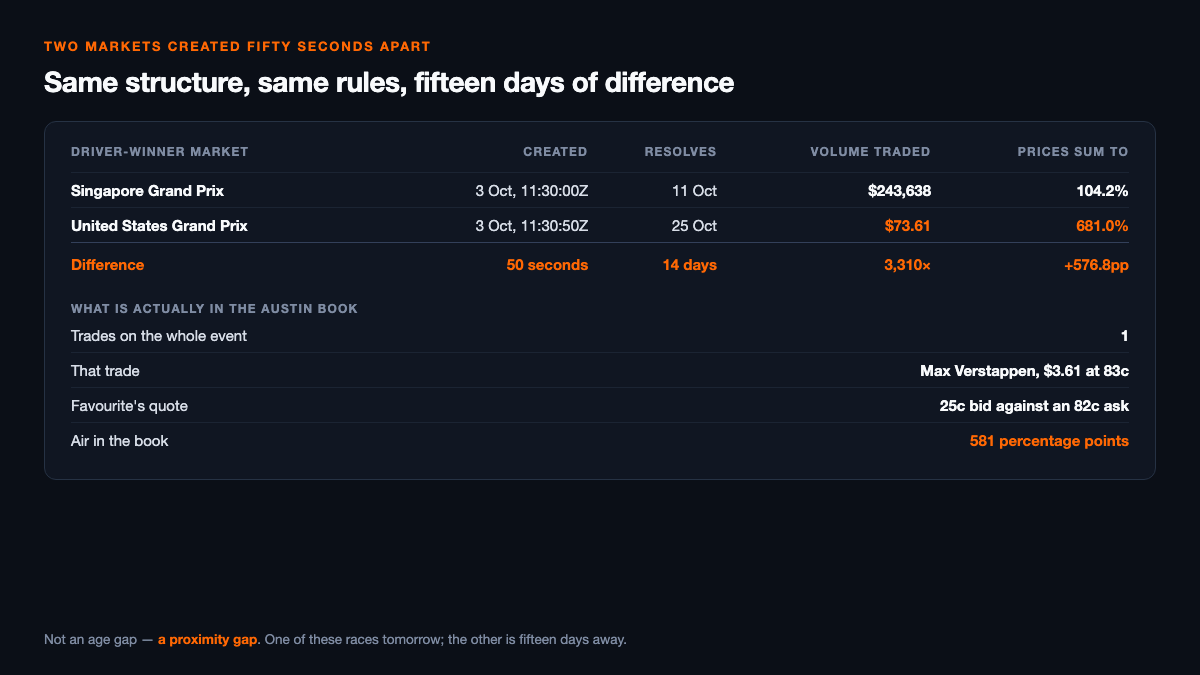
The honest comparison is the same weekend’s sibling. Polymarket created the Singapore and Austin markets fifty seconds apart — 11:30:00Z and 11:30:50Z on 3 October — with the same 23-driver structure and the same resolution rules. One of them races tomorrow. The other races in fifteen days. Look at what that alone has done:
| Market | Created | Resolves | Volume traded | Prices sum to | Favourite’s spread |
|---|---|---|---|---|---|
| US GP: driver winner | 3 Oct, 11:30:50Z | 25 Oct | $73.61 | 681.0% | 25c / 82c (57c wide) |
| Singapore GP: driver winner | 3 Oct, 11:30:00Z | 11 Oct | $243,638.62 | 104.2% | 64c / 65c (1c) |
| 2026 drivers’ champion | pre-season | season end | $203,997,069 | 99.3% | 95.6c / 96.0c (0.4c) |
The deepest book is tighter than most sportsbooks: the $204m championship market sums to 99.3%, a rounding artefact of a book where the favourite trades at 95.8% and five rivals are priced in tenths of a cent. Singapore sums to 104.2%, about what a decent bookmaker charges. Austin sums to 681% because nobody has shown up.
So the rule I use, and it has never let me down on this site: check the sum before you read any single price. If the outcomes do not total something near 100, the number you are looking at is not a probability, however confidently it is displayed. That test takes one minute and it is more useful than any tipster’s pick.
Where the Sportsbooks Have US Grand Prix Odds
If the exchange is empty, the fixed-odds books are the fallback — with a date attached, because that turns out to be the thing that matters. The most substantial 2026 Austin preview I could find is Motorsport Week’s betting guide, published on 1 September 2026. Its prices, converted to implied probability, look like this.
| Driver | Quoted price | Implied probability | Priced on | Where that driver is now |
|---|---|---|---|---|
| Kimi Antonelli | +150 | 40.0% | 1 Sep 2026 | 95.8% for the title, 8.5% for Singapore |
| Max Verstappen | +450 | 18.2% | 1 Sep 2026 | 64.5% favourite for Singapore |
| Lewis Hamilton | +650 | 13.3% | 1 Sep 2026 | 12.5% for Singapore, 2nd in the sprint |
Those three total 71.5% between them with twenty drivers left unpriced, which tells you the book expects a front-three result and is charging accordingly. But the date is the problem. On 1 September, Verstappen had not yet won the Singapore sprint from pole in the rain, Russell had not crashed out of the lead of it, and the title gap was not 89 points.
The direction of travel since is clear in the one market that is liquid. Verstappen has gone from a +450 outsider in early September to the 64.5% favourite for tomorrow. Antonelli, the +150 Austin favourite on that page, is 8.5% for Singapore — because the market has correctly separated ’will win the championship’ from ’will win this particular race’, something a six-week-old outright price cannot do. More on how to run that comparison properly in Polymarket vs sportsbook F1 odds.
Kalshi Has Not Opened Austin At All
The obvious next move is to cross-check a second venue, so I queried Kalshi’s public API for its F1 race series. There is exactly one open event: KXF1RACE-SIN26, the Singapore Grand Prix main-race winner. There is no Austin event, no COTA event and no United States Grand Prix event on Kalshi as of 10 October.
Nor is the Singapore one usable. All 22 of its driver markets return null for yes bid, yes ask, last price, volume and open interest — listed and active, with nothing quoted against them. The rules text is precise and correct — ’If Max Verstappen finishes in first in the main race originally scheduled for October 11, 2026’ — but a market with no book is a contract, not a forecast.
What this means for a cross-venue check: for the United States Grand Prix specifically, there is no second venue to check yet. Polymarket is the only exchange with an Austin market, that market has traded $73.61, and the nearest thing to a consensus is a fixed-odds price from early September. Anyone publishing a confident Austin number this week is making it up.
COTA Form: 13 Races, and What Actually Wins
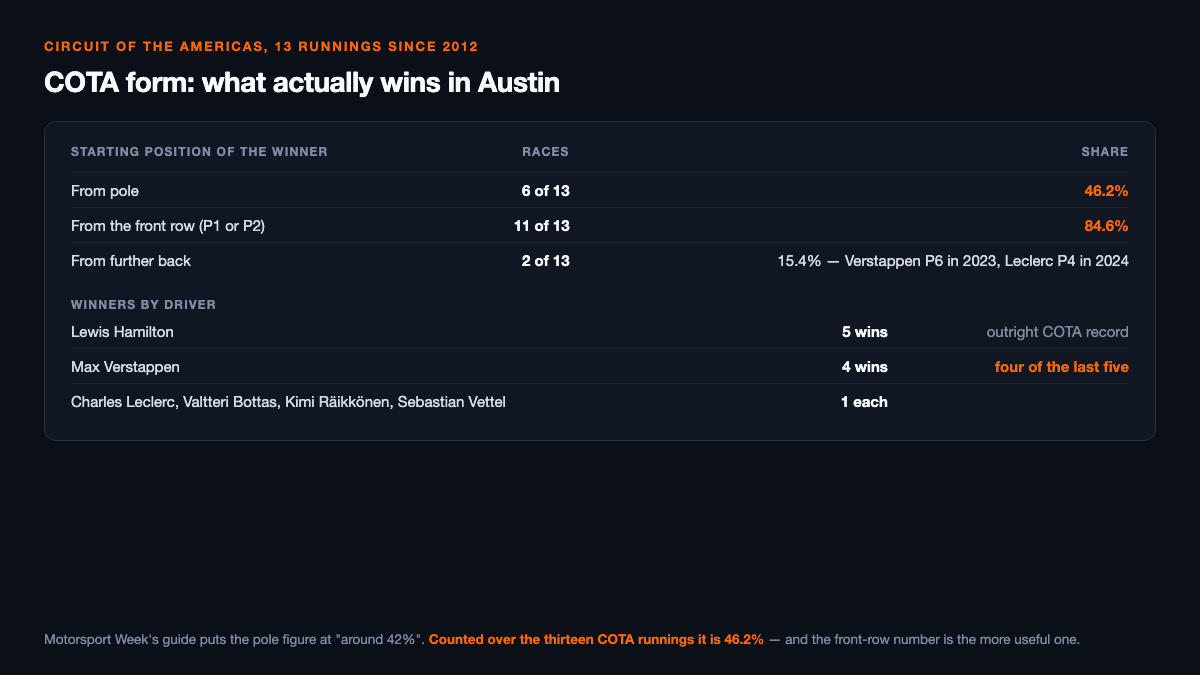
With no usable market, history earns more weight than it usually deserves. The United States Grand Prix has run at the Circuit of the Americas thirteen times since 2012 — every year except 2020 — always over 56 laps. I pulled all thirteen results, with the winner’s starting position, rather than trusting anybody’s summary of them.
| Year | Winner | Team | Started |
|---|---|---|---|
| 2025 | Max Verstappen | Red Bull | P1 |
| 2024 | Charles Leclerc | Ferrari | P4 |
| 2023 | Max Verstappen | Red Bull | P6 |
| 2022 | Max Verstappen | Red Bull | P2 |
| 2021 | Max Verstappen | Red Bull | P1 |
| 2019 | Valtteri Bottas | Mercedes | P1 |
| 2018 | Kimi Räikkönen | Ferrari | P2 |
| 2017 | Lewis Hamilton | Mercedes | P1 |
| 2016 | Lewis Hamilton | Mercedes | P1 |
| 2015 | Lewis Hamilton | Mercedes | P2 |
| 2014 | Lewis Hamilton | Mercedes | P2 |
| 2013 | Sebastian Vettel | Red Bull | P1 |
| 2012 | Lewis Hamilton | McLaren | P2 |
Two patterns fall straight out of that column, and one of them contradicts the figure the betting previews use. Pole has won 6 of 13 Austin races, 46.2%, and the front row has won 11 of 13, 84.6%. Motorsport Week’s guide puts the pole figure at ’around 42%’; counted over the thirteen COTA runnings it is 46.2%, and the more useful number is the front-row one, because only twice has this race been won from further back — Verstappen from P6 in 2023 and Leclerc from P4 in 2024.
The driver column is blunter. Hamilton has five Austin wins, the outright record, and all five came between 2012 and 2017. Verstappen has four, and they came in 2021, 2022, 2023 and 2025 — four of the last five runnings. Whatever the mid prices say, a market pricing Verstappen as its only traded name is pricing the right driver; it simply has not decided how much.
The Title Maths That Make Austin Matter
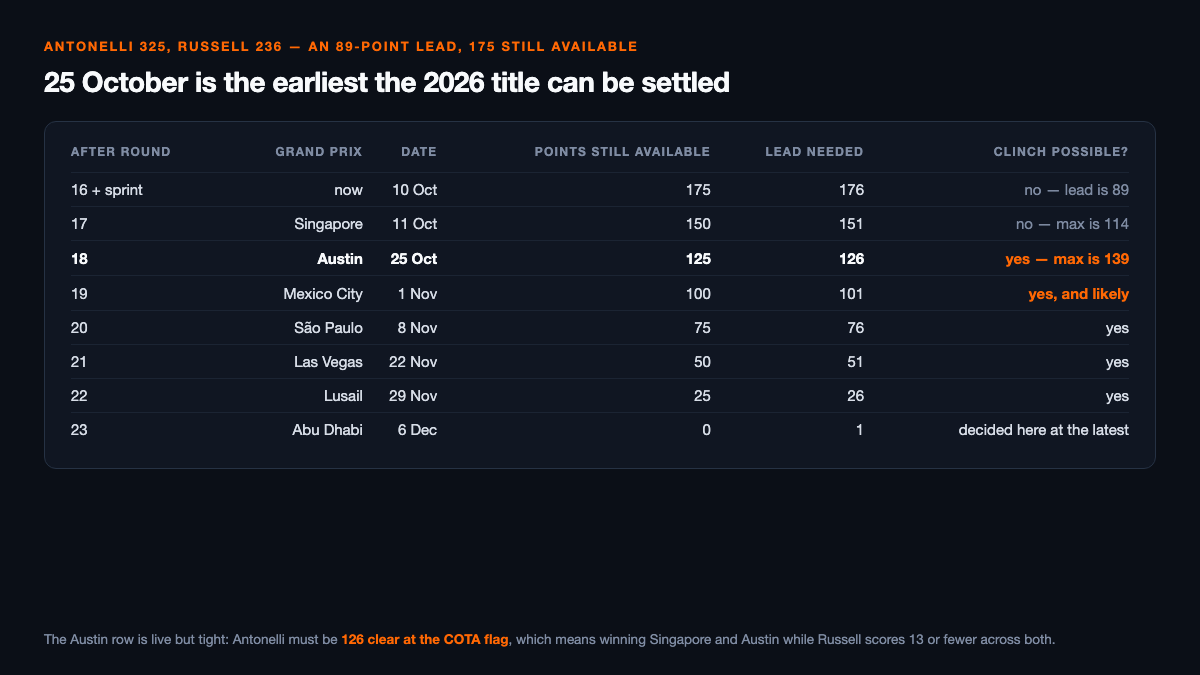
Austin is on this calendar for a bigger reason than a race-winner market, and it is the reason to care about the date at all. 25 October is the earliest Sunday on which the 2026 drivers’ championship can be mathematically settled.
Start from where the season is. The Jolpica feed’s round-16 standings plus Saturday’s sprint — Verstappen won from pole in the wet, Hamilton second, Leclerc third, Antonelli fourth, Russell out on lap one from the lead — put Antonelli on 325 points to George Russell’s 236. That is an 89-point lead with seven grands prix and no sprints left, so 175 points remain. A title is won when the leader’s margin over every rival exceeds what those rivals can still score.
| After round | Grand Prix | Date | Points still available | Lead needed to be champion | Possible? |
|---|---|---|---|---|---|
| 16 + sprint | now | 10 Oct | 175 | 176 | no (lead is 89) |
| 17 | Singapore | 11 Oct | 150 | 151 | no (max is 114) |
| 18 | Austin | 25 Oct | 125 | 126 | yes (max is 139) |
| 19 | Mexico City | 1 Nov | 100 | 101 | yes, and likely |
| 20 | São Paulo | 8 Nov | 75 | 76 | yes |
| 21 | Las Vegas | 22 Nov | 50 | 51 | yes |
| 22 | Lusail | 29 Nov | 25 | 26 | yes |
| 23 | Abu Dhabi | 6 Dec | 0 | 1 | decided here at the latest |
The Austin row is live but tight. Antonelli has to be 126 clear at the COTA flag, and the most he can gain over two races is 50. Winning both puts him on 375, so every rival has to finish on 249 or less. Here is what that asks of each.
| Rival | Points now | Gap to Antonelli | Max they can score at Singapore + Austin | In practice |
|---|---|---|---|---|
| George Russell | 236 | 89 | 13 | P4 then P10, and nothing better |
| Lewis Hamilton | 221 | 104 | 28 | two podiums is already too many |
| Charles Leclerc | 197 | 128 | 52 | cannot reach it even with two wins |
| Max Verstappen | 196 | 129 | 53 | cannot reach it even with two wins |
| Lando Norris | 188 | 137 | 61 | out of it on this path already |
That is the honest version of a claim you will see written loosely this fortnight: a 25 October clinch needs two straight Antonelli wins and Russell on 13 or fewer and Hamilton off two podiums. I would not price it above single digits.
Mexico City on 1 November is the realistic date. With 100 points left he needs a lead over 100, which means netting just 12 on Russell across three races — and over sixteen rounds the two Mercedes drivers have averaged 20.3 a round against 14.75, about 17 over three. The constructors’ title points the same way: Mercedes lead Ferrari 561 to 418, and with 129 team points left after São Paulo that 143-point gap only has to hold to settle it on 8 November. Run your own permutations in the 2026 points calculator.
Austin on 25 October, From the Climate Record
Fifteen days out, no forecast is worth printing — and the Austin race weekend has twice been decided by water, so ’heat and storms’ as a one-liner is not good enough either. What you can use now is the climate record, and the National Weather Service publishes a daily October table for the city: normals over 1991—2020, records back to 1891.
| Session day | Normal high | Normal low | Normal rain | Record high | Record low | Wettest on record |
|---|---|---|---|---|---|---|
| Fri 23 Oct (practice) | 80°F | 58°F | 0.15 in | 94°F (2003) | 36°F (1923) | 4.12 in (1953) |
| Sat 24 Oct (qualifying) | 80°F | 58°F | 0.14 in | 94°F (1933) | 33°F (1924) | 4.79 in (2015) |
| Sun 25 Oct (race) | 79°F | 58°F | 0.14 in | 91°F (2024) | 33°F (1924) | 2.13 in (1975) |
| October, whole month | 82.5°F | 60.8°F | 3.91 in total | 101°F (2024) | 30°F (1917) | 7.39 in (1923) |
Two things to take from it. Race day in late October is warm rather than hot — a 79°F normal high, eight degrees down on the start of the month — so the tyre-and-track-temperature story that drives a Texas summer race is milder than people assume. And the normal daily rainfall is 0.14 of an inch, which is close to nothing, against a wettest-ever 25 October of 2.13 inches.
In other words the base rate for a dry Austin race is high, and the distribution has a fat tail. That combination is exactly what a thin market misprices, and it is why I would wait for the Friday before touching a weather-sensitive position. Our next-race page carries the live forecast once it is inside range, and F1 weather odds covers how rain reprices a grid.
How I Would Use the Austin Market
None of the above adds up to ’back this driver’, and that is the point. Here is the sequence I would actually follow between now and 25 October.
- Ignore every mid price until the sum comes down. At 681% the number beside a driver is an artefact. Re-check after Singapore resolves, when the people who traded $243,638 on tomorrow go looking for the next race.
- Watch the bid, not the mid. Verstappen bid 25c is a real person willing to pay 25c. Verstappen mid 53.5% is arithmetic. On a market this thin the bid side is the only honest signal.
- Use the championship market for championship questions. It has traded $204m and sums to 99.3%, so it answers ’is this title done’ — 95.8% — better than any Austin price will for a week.
- Price the clinch separately from the race. Verstappen can win Austin and it can still be the race Antonelli seals the title in. Most of the fortnight’s writing will conflate the two.
- Wait for Saturday. Pole has converted 46.2% of the time at COTA and the front row 84.6%, so the qualifying result moves this market more than two weeks of speculation will.
Our board refetches Polymarket every ten minutes, so the sum-of-prices test is one click away on the drivers’ championship page and the live board. When Austin fills, it shows there before it shows in a preview.
Sources and Method
Prices, bids, asks, volumes and creation timestamps were read from the Polymarket Gamma API at 21:22Z on 10 October 2026 for f1-united-states-grand-prix-winner-2026-10-25, f1-singapore-grand-prix-winner-2026-10-11 and 2026-f1-drivers-champion. The Kalshi figures are its public trade-api/v2 endpoints for the KXF1RACE series, same timestamp. The calendar, round numbers, standings and the thirteen COTA winners with their grid slots come from the Jolpica Ergast-compatible F1 feed.
Saturday’s sprint result is Formula1.com’s report, corroborated by Sky Sports; the 89-point gap is also the figure in RacingNews365’s clinch piece of 10 October, whose Austin requirement of ’11 points’ I could not reconcile and have recomputed above. The fixed-odds prices and the ’around 42%’ pole figure are from Motorsport Week’s Austin betting guide of 1 September 2026. Austin normals and records are the National Weather Service’s October daily climate table for the city (Camp Mabry/Mueller/Austin Downtown, normals 1991—2020, records from 1891).
Prediction-market prices move, and a market this thin can move a long way on one trade. Everything above is a reading at a moment, not a tip, and nothing here is betting advice.