Every page currently ranking for Singapore Grand Prix odds 2026 is a sportsbook preview that hands you one number for Sunday and calls it a forecast. That is a problem this weekend specifically, because Marina Bay is a sprint round for the first time in its history and Polymarket has opened five separate markets on it — and four of the five are so thinly traded that their prices sum to between 123% and 163% instead of 100%.
So this piece does the thing the tipster pages do not: it gives you the live board and then tells you which parts of it to ignore. I pulled all five Singapore markets out of the Polymarket Gamma API, added up every outcome in each one, and matched the totals against each market’s traded volume and resting liquidity. The pattern is clean enough to use as a rule.
The headline case: the sprint market currently has Lance Stroll as its favourite at 24.0% on ten dollars of lifetime volume. The same weekend’s race market, which has traded $17,727, prices Stroll at 0.5%. Stroll has scored zero championship points all season. Every price, volume and timestamp below was read from the Polymarket Gamma and CLOB APIs, the Jolpica F1 feed and this site’s own snapshot history on 7 October 2026, three days before the sprint.
Key takeaways
- Max Verstappen is the 29.0% favourite for Sunday at Marina Bay — the one circuit on the current calendar he has never won. Kimi Antonelli is second at 23.5%, Lando Norris and Lewis Hamilton share third on 13.0%.
- Singapore 2026 has five Polymarket markets, not one, because it is the sixth and final sprint round of the season: race winner, podium finish, race pole, sprint winner and sprint-qualifying pole.
- Only the race-winner market is deep enough to read as a forecast. It has traded $17,727 and its 23 outcomes sum to 114.8%. The sprint-winner market has traded $176 and sums to 162.8% — 63 percentage points of pure slack.
- The market cut George Russell roughly 23 hours before the news broke. He was marked down from 9.5% to 5.0% at 11:00Z on 6 October; the BBC confirmed his back-of-grid power-unit penalty at 10:01Z on 7 October. He is 2.4% now.
- Antonelli cannot win the title in Singapore. Even taking all 33 points on offer while Russell scores none, he finishes the weekend 33 points short of the clinch. The earliest mathematical date is Austin on 25 October.
The Singapore Grand Prix Odds Board Right Now
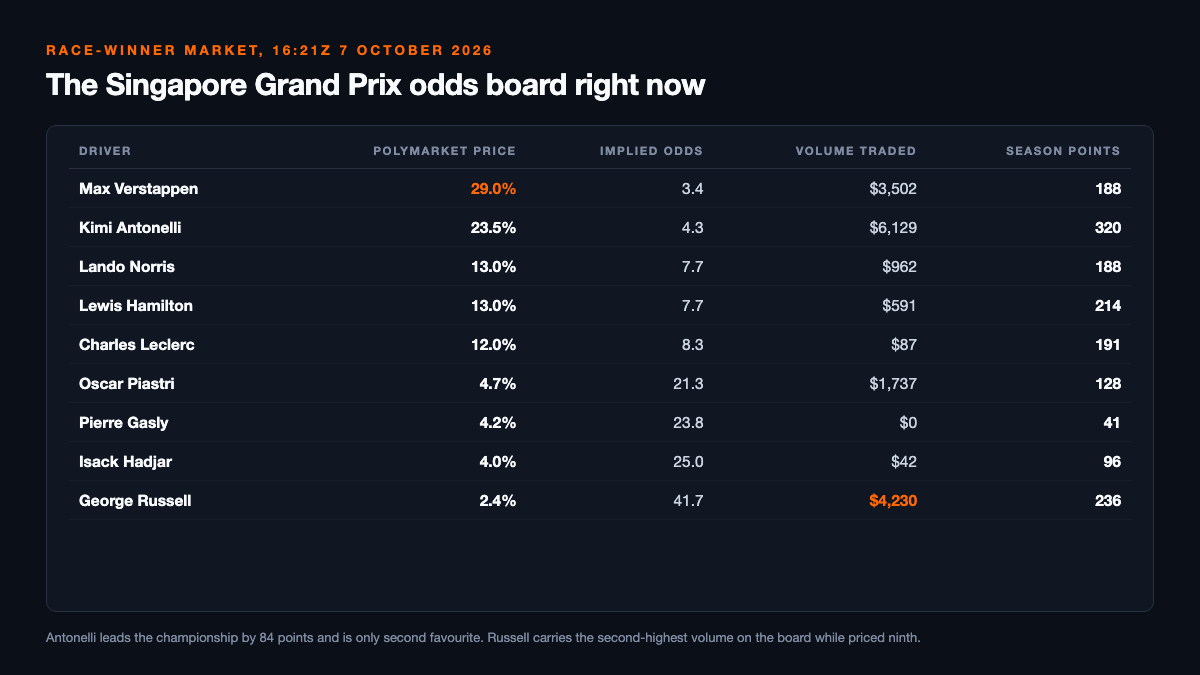
Here is the race-winner market as it stood at 16:21Z on 7 October 2026. I have put traded volume next to each price on purpose, because on this board the two columns disagree in a way that matters.
| Driver | Polymarket price | Implied odds | Volume traded | Season points |
|---|---|---|---|---|
| Max Verstappen | 29.0% | 3.4 | $3,502 | 188 |
| Kimi Antonelli | 23.5% | 4.3 | $6,129 | 320 |
| Lando Norris | 13.0% | 7.7 | $962 | 188 |
| Lewis Hamilton | 13.0% | 7.7 | $591 | 214 |
| Charles Leclerc | 12.0% | 8.3 | $87 | 191 |
| Oscar Piastri | 4.7% | 21.3 | $1,737 | 128 |
| Pierre Gasly | 4.2% | 23.8 | $0 | 41 |
| Isack Hadjar | 4.0% | 25.0 | $42 | 96 |
| George Russell | 2.4% | 41.7 | $4,230 | 236 |
Two rows are worth staring at. Antonelli leads the championship by 84 points and is only the second favourite for Sunday, which is the market separating season-long pace from a single street race. And Russell carries the second-highest volume on the board at $4,230 while priced ninth at 2.4% — that is not a sleepy outcome, that is an outcome a lot of money has actively moved. The reason is a grid penalty, and I come back to it below.
If you want the championship picture behind these race prices rather than the weekend one, our drivers’ championship page carries the live title market against the actual points table, and the live page shows what has moved in the last day.
Five Markets, Because This Is a Sprint Round
Singapore is round 17 of 23 and the sixth and final sprint event of 2026, the first ever held at Marina Bay. A sprint weekend splits the schedule into four competitive sessions instead of two, and Polymarket opens a market on most of them. That is why searching for one Singapore number gets you five.
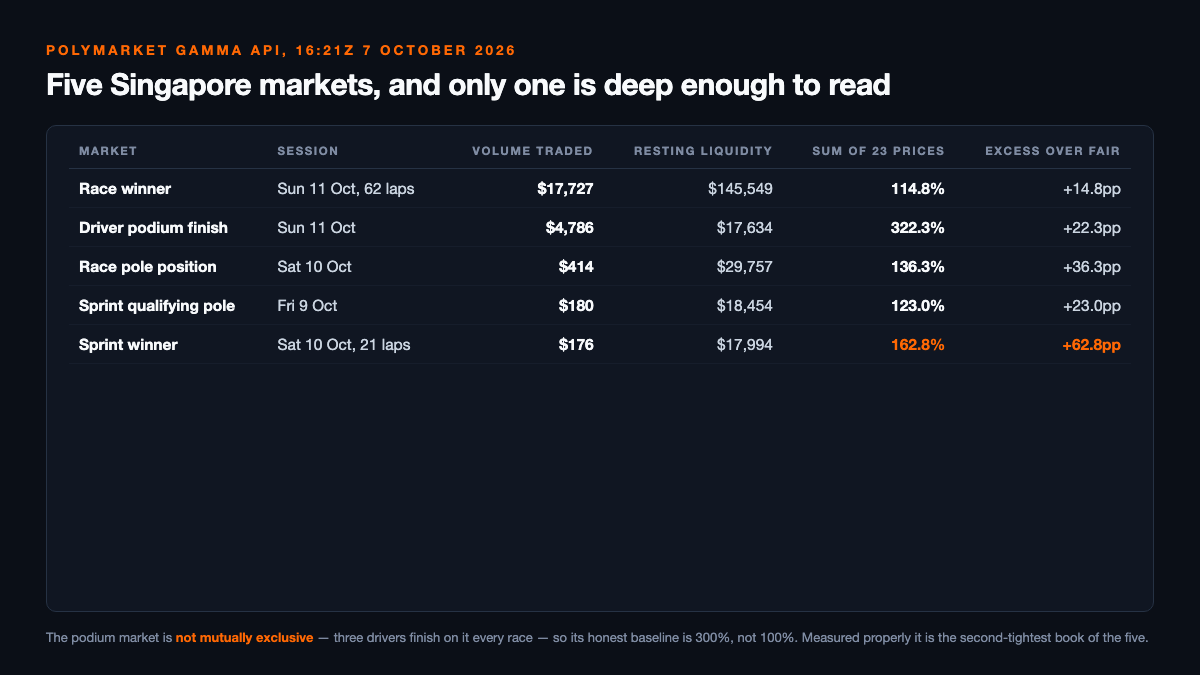
The table below is the whole weekend, with the figure that actually tells you how much to trust each market: the sum of all 23 driver prices. A market where every outcome is mutually exclusive should sum to 100%. Anything above that is slack — the spread between bid and ask, multiplied across an untraded book.
| Market | Session | Volume traded | Resting liquidity | Sum of 23 prices | Excess over fair |
|---|---|---|---|---|---|
| Race winner | Sun 11 Oct, 62 laps | $17,727 | $145,549 | 114.8% | +14.8pp |
| Driver podium finish | Sun 11 Oct | $4,786 | $17,634 | 322.3% (three podium places, so 300% is fair) | +22.3pp |
| Race pole position | Sat 10 Oct | $414 | $29,757 | 136.3% | +36.3pp |
| Sprint qualifying pole | Fri 9 Oct | $180 | $18,454 | 123.0% | +23.0pp |
| Sprint winner | Sat 10 Oct, 21 laps | $176 | $17,994 | 162.8% | +62.8pp |
Note the podium row before anything else, because it is the one every aggregator gets wrong. A podium market is not mutually exclusive — three drivers finish on it every race — so its honest baseline is 300%, not 100%. Reported as a 322% market it looks catastrophic; measured properly it is the second-tightest book of the five. If you see a page describing that market as 222% overpriced, it has not understood what it is reading.
With that correction made, the ordering is hard to miss: the deepest market is the tightest and the thinnest market is the loosest, with a factor of four between them.
Why the Sprint Market Is Noise, in One Number
The sprint-winner market has traded $176 in its entire life. Its 23 prices sum to 162.8%. That means if you bought every driver at the asking price you would pay $1.63 to guarantee yourself $1.00 — a 39% guaranteed loss, which is another way of saying the quoted prices are not probabilities at all.
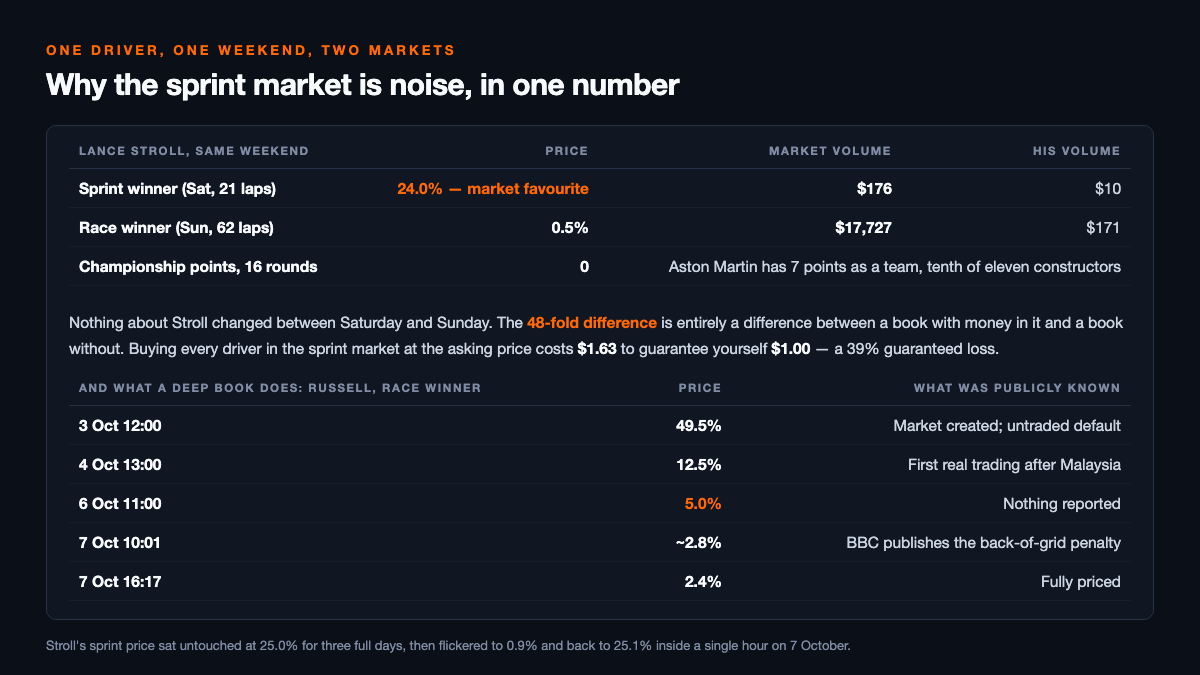
Here is what that looks like at the level of one driver, and it is the cleanest example of market thinness I have seen on this site.
| Lance Stroll, same weekend | Price | Market volume | His volume |
|---|---|---|---|
| Sprint winner (Sat, 21 laps) | 24.0% — market favourite | $176 | $10 |
| Race winner (Sun, 62 laps) | 0.5% | $17,727 | $171 |
| Championship points, 16 rounds | 0 — Aston Martin has 7 points as a team, placing it tenth of eleven constructors | ||
Nothing about Stroll changed between Saturday and Sunday. The 48-fold difference is entirely a difference between a book with money in it and a book without. And the CLOB price history shows the mechanism directly: Stroll’s sprint price sat untouched at 25.0% from 11:00Z on 4 October for three full days, then flickered to 0.9% and back to 25.1% inside a single hour on 7 October. That is not information arriving. That is a midpoint wobbling between a bid and an ask with nothing in between.
The rule I now use. Before reading any price, read the volume. Under roughly $1,000 of lifetime volume, a Polymarket outcome price is a quote, not a forecast — it tells you where a market maker is willing to stand, not what traders believe. The four Singapore side markets are all under $5,000. Only the race-winner market clears the bar.
Russell’s Price Fell 23 Hours Before the Headline
The deep market earns its keep in moments like this one. George Russell won this race in 2025 and took pole at the last round in Baku. He will start Sunday’s race from the back of the grid after a power-unit penalty carried over from the Bahrain Grand Prix in Malaysia. Here is the order in which that became public and the order in which it became priced.
| Timestamp (UTC) | Russell, race-winner price | What was publicly known |
|---|---|---|
| 3 Oct 12:00 | 49.5% | Market created; every driver sits at the untraded default |
| 4 Oct 13:00 | 12.5% | First real trading after the Malaysia race |
| 5 Oct 09:00 | 10.0% | Nothing reported |
| 6 Oct 11:00 | 5.0% | Nothing reported |
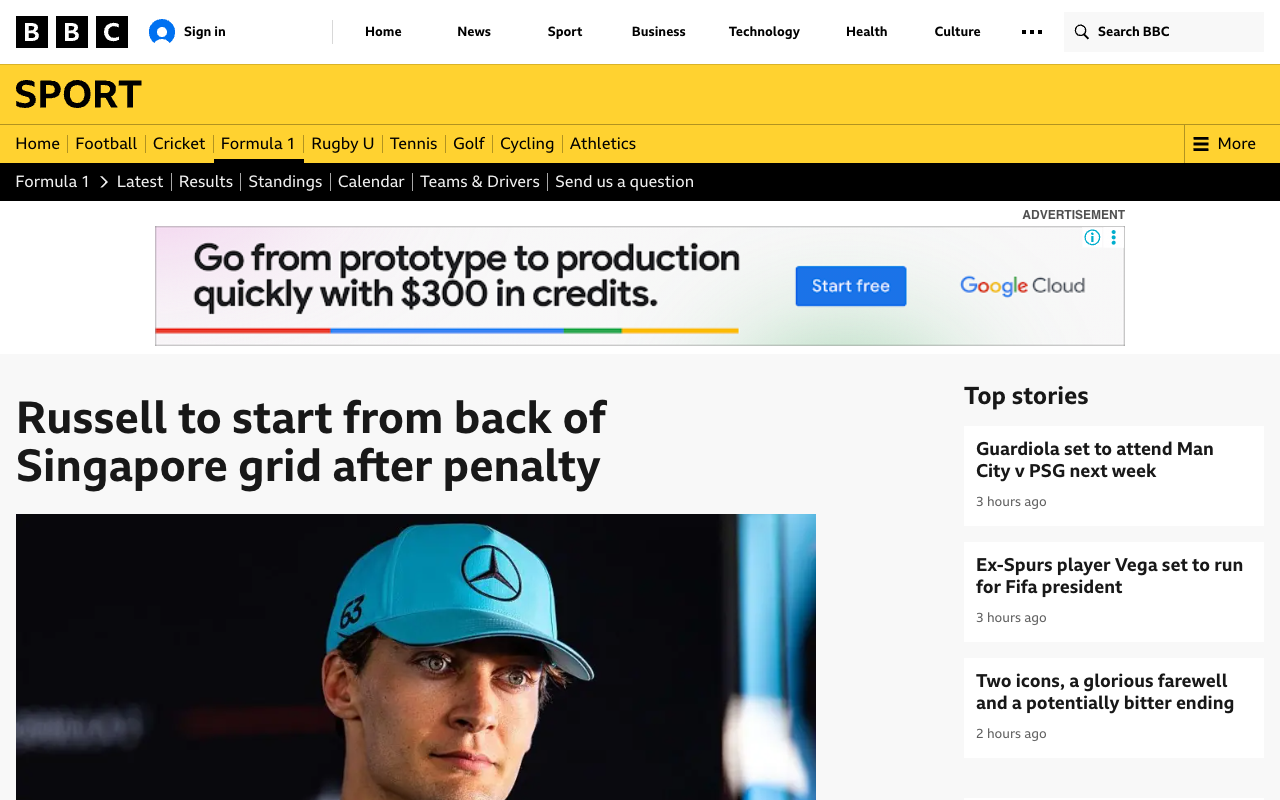
| 7 Oct 10:01 | ~2.8% | BBC publishes “Russell to start from back of Singapore grid after penalty” |
| 7 Oct 16:17 | 2.4% | Fully priced |
The market halved him 23 hours before the confirmation was published. I want to be careful about what that does and does not prove: Mercedes had signalled a penalty was coming before the BBC confirmed its severity, and the Formula1.com piece announcing it carries no timestamp in our news feed, so I cannot claim the market moved before any public word. What the timestamps do establish is that the price was already at 5.0% a full day before the number most readers saw.
That is the practical argument for prediction markets over a static odds table, and it is the same effect we tracked through qualifying in F1 qualifying odds: a book with $17,727 in it reprices on rumour, and a tipster page published on Tuesday does not.
The Favourite Has Never Won Here
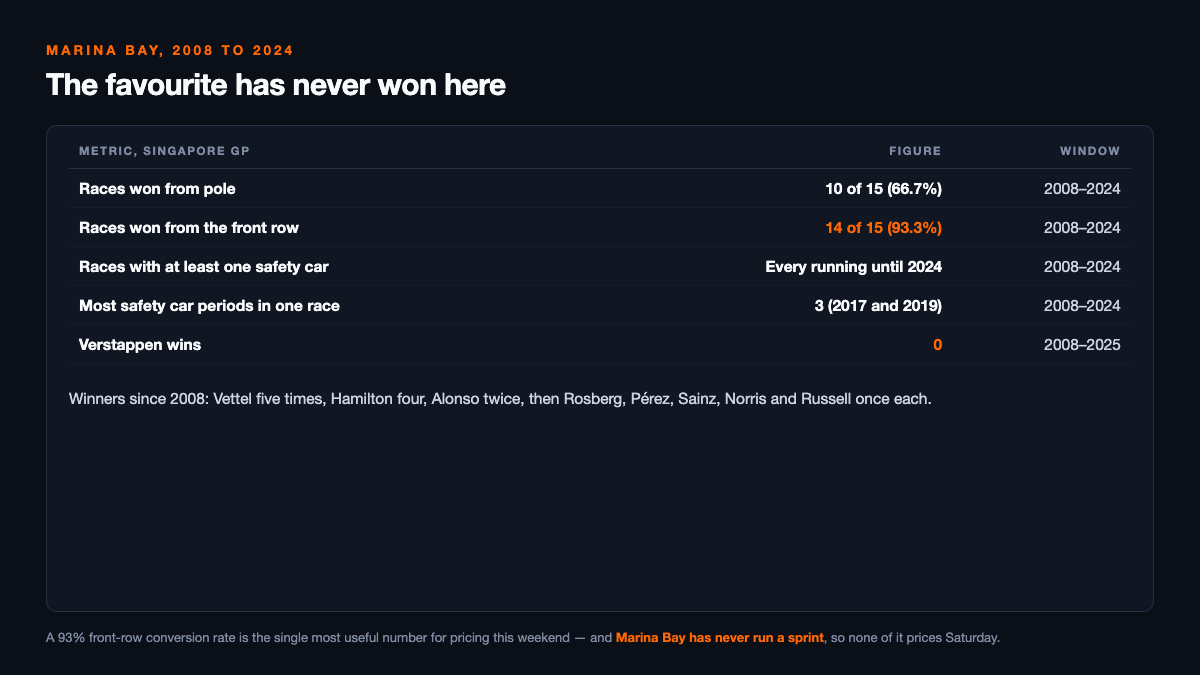
Verstappen at 29.0% is the most interesting price on the board, because Marina Bay is the one circuit on the 2026 calendar where he has never stood on the top step. Run down the winners since the race joined the championship in 2008 and his name is absent: Vettel five times, Hamilton four, Alonso twice, then Rosberg, Pérez, Sainz, Norris and Russell once each.
He also arrives in form — pole and the win at the last round, Red Bull’s first of a difficult season, from a car sitting fourth in the constructors’ table on 298 points. So the market is pricing recent pace against a circuit record, and reasonable people can disagree about the balance. What is not in dispute is the context:
| Metric, Singapore GP | Figure | Window |
|---|---|---|
| Races won from pole | 10 of 15 (66.7%) | 2008–2024 |
| Races won from the front row | 14 of 15 (93.3%) | 2008–2024 |
| Races with at least one safety car | Every running until 2024, the first without one | 2008–2024 |
| Most safety car periods in one race | 3 (2017 and 2019) | 2008–2024 |
| Verstappen wins | 0 | 2008–2025 |
A 93% front-row conversion rate is the single most useful number for pricing this weekend, and it is why Saturday’s qualifying market deserves more attention than its $414 of volume suggests it is getting.
What Marina Bay History Can and Cannot Tell You
The figures above are a genuine edge for Sunday and worth almost nothing for Saturday, and that distinction is the part no preview page makes. Marina Bay has never run a sprint. There is no pole-to-sprint-win conversion rate for this circuit, no safety car rate over 21 laps here, no precedent for how a street track with 19 turns and essentially no overtaking behaves when the field has one short race to sort itself out.
That matters because the two things everyone knows about Singapore pull in opposite directions over a sprint distance. Overtaking is famously hard, which argues the grid order holds and the sprint pole-sitter converts at a rate even higher than Sunday’s 67%. But a safety car in a 21-lap race is proportionally three times the disruption it is in a 62-lap race, and Singapore has produced one in all but one of its runnings. We unpacked that trade-off in general terms in F1 safety car odds; here, nobody has data for it.
So the honest summary of the sprint markets is that they are badly priced and genuinely hard to price. Those are not the same claim, and only the first one is a reason to think you can beat them.
The weekend’s own structure is the last piece of context:
| Session | Date | Laps | Points on offer |
|---|---|---|---|
| Sprint qualifying | Fri 9 Oct | — | 0 |
| Sprint | Sat 10 Oct | 21 | 8 on the 8-7-6-5-4-3-2-1 scale, top eight only |
| Qualifying | Sat 10 Oct | — | 0 |
| Grand Prix | Sun 11 Oct | 62 | 25 on the 25-18-15-12-10-8-6-4-2-1 scale |
What Singapore Can and Cannot Settle
The title market has Antonelli at 96.6% and Mercedes at 98.9%, so the obvious question is whether this weekend ends it. It does not, and the arithmetic is not close.
Antonelli has 320 points, Russell 236, a gap of 84. Singapore puts 33 points on the table — 25 for the race, 8 for the sprint. Six races follow it, all without sprints, so 150 points remain after Sunday. A champion is confirmed when his total exceeds every rival’s best possible finish.
| After round | Date | Antonelli, best case | Russell’s ceiling | Title confirmed? |
|---|---|---|---|---|
| Singapore (17) | 11 Oct | 353 | 386 | No |
| United States (18) | 25 Oct | 378 | 361 | Yes |
| Mexico City (19) | 1 Nov | 403 | 336 | Yes |
| Brazil (20) | 8 Nov | 428 | 311 | Yes |
Read the first row carefully: even in the maximum case — Antonelli wins the sprint and the race, Russell scores nothing from the back of the grid — Antonelli ends Sunday on 353 against a Russell ceiling of 386. He is 33 points short, which is exactly the number Singapore is worth. The earliest the 2026 title can be mathematically settled is the United States Grand Prix on 25 October, and only on that perfect sequence.
For the full branch of scenarios rather than the best case, we keep the Antonelli clinch scenarios and the 2026 points calculator updated against the live table.
How to Read All Five Markets Without Being Fooled
Condensed into the order I actually work in, applied to this weekend:
- Read volume before price. $17,727 on the race means the number is doing work. $176 on the sprint means it is not. This single step would have stopped you taking Stroll at 24.0%.
- Add the column up. If the outcomes sum to 115% you are looking at a normal spread; 163% means the book is empty. Correct the baseline first for markets that are not mutually exclusive — 300% for a three-place podium.
- Check the price history, not the price. A number that has not moved in three days and then jumps 24 points in an hour is a quote, not a belief. A number that slides from 10% to 5% a day before the news is the opposite.
- Separate the weekend from the season. Antonelli is 96.6% for the title and 23.5% for Sunday. Both can be right.
- Price the structure, not just the driver. A 93% front-row conversion over 15 runnings is a stronger input here than any individual’s form, and there is no equivalent number for a Marina Bay sprint because this is the first one.
The broader comparison between market-implied prices and fixed sportsbook lines is in Polymarket vs sportsbook F1 odds, and the sprint-specific mechanics are in F1 sprint weekend odds. Live prices for every market above refresh on the next race page.
Sources and method
Prices, volume and liquidity for all five markets were read from the Polymarket Gamma and CLOB APIs at 16:21Z on 7 October 2026; the price histories quoted are from the CLOB prices-history endpoint at 60-minute resolution. The 2026 calendar, round number and sprint designation come from the Jolpica Ergast-compatible F1 feed, and the session times and circuit figures from Formula1.com’s Singapore race page. The Russell penalty timestamp is the publication time of the BBC’s report, 10:01Z on 7 October 2026. Historical pole conversion and safety car counts cover the 15 runnings from 2008 to 2024 and come from Lights Out’s Marina Bay track stats; the list of race winners through 2025 is from Wikipedia’s Singapore Grand Prix page. Championship points are this site’s own snapshot of 7 October 2026, 14:08Z.
Prediction-market prices move. Everything above is a reading at a moment, not a tip, and nothing here is betting advice.