
Search for F1 2027 championship odds today and every result you get is a 2026 page. Not a stale 2027 page — there is no 2027 page. The books have not posted the market, Polymarket has not created the event, and Kalshi has one open F1 series and it expires in December.
That matters more than it sounds, because the gap is about to close. The last time Polymarket opened a next-season F1 title market it did so 90 days before round one, which puts the 2027 event in the middle of December — roughly eleven weeks from now — and the number it opens at will be quoted by every aggregator for the following three months.
So rather than guess at it, I pulled the full daily price history of the 2026 drivers' market out of Polymarket's order book, back to the day it was created, and lined the opening board up against the standings it produced. The day-one favourite is now trading at 0.30%. The driver who was sixth at 5.1% leads the championship by 66 points. Every price and date below was read from the Polymarket Gamma and CLOB APIs, the Kalshi public API and the Jolpica F1 feed on 26 September 2026, after round 15 in Baku.
Key takeaways
- There is no 2027 F1 championship market anywhere yet. We queried the Polymarket Gamma API and the Kalshi public API on 26 September 2026: Polymarket's only F1 title events are the 2026 drivers' and constructors' markets, and Kalshi has exactly one open F1 event,
KXF1-26. The sportsbooks are also still on 2026. - Expect the Polymarket market around mid-December 2026. The 2026 drivers' market was created on 8 December 2025, 90 days before round one. Apply the same lead time to the 2027 opener in Bahrain on 14 March and you get 14 December 2026 — 79 days from today.
- Opening prices on a new-rules grid were close to worthless. On day one of the 2026 market Verstappen was favourite at 27.5%; he is now 0.30%. Antonelli was sixth at 5.1%; he is now 91.4% and 66 points clear.
- 2027 hands out 680 points, not 623. Twenty-four rounds and 10 sprint races instead of 23 and six, with Monaco holding a sprint for the first time. Sprint weekends go from 7.7% of the points pool to 11.8%.
- The 2027 grid is being confirmed now, and that is what moves an opening price. Red Bull retained Isack Hadjar for 2027 on 23 September; Verstappen is contracted to the end of 2030.
Where F1 2027 Championship Odds Stand Today
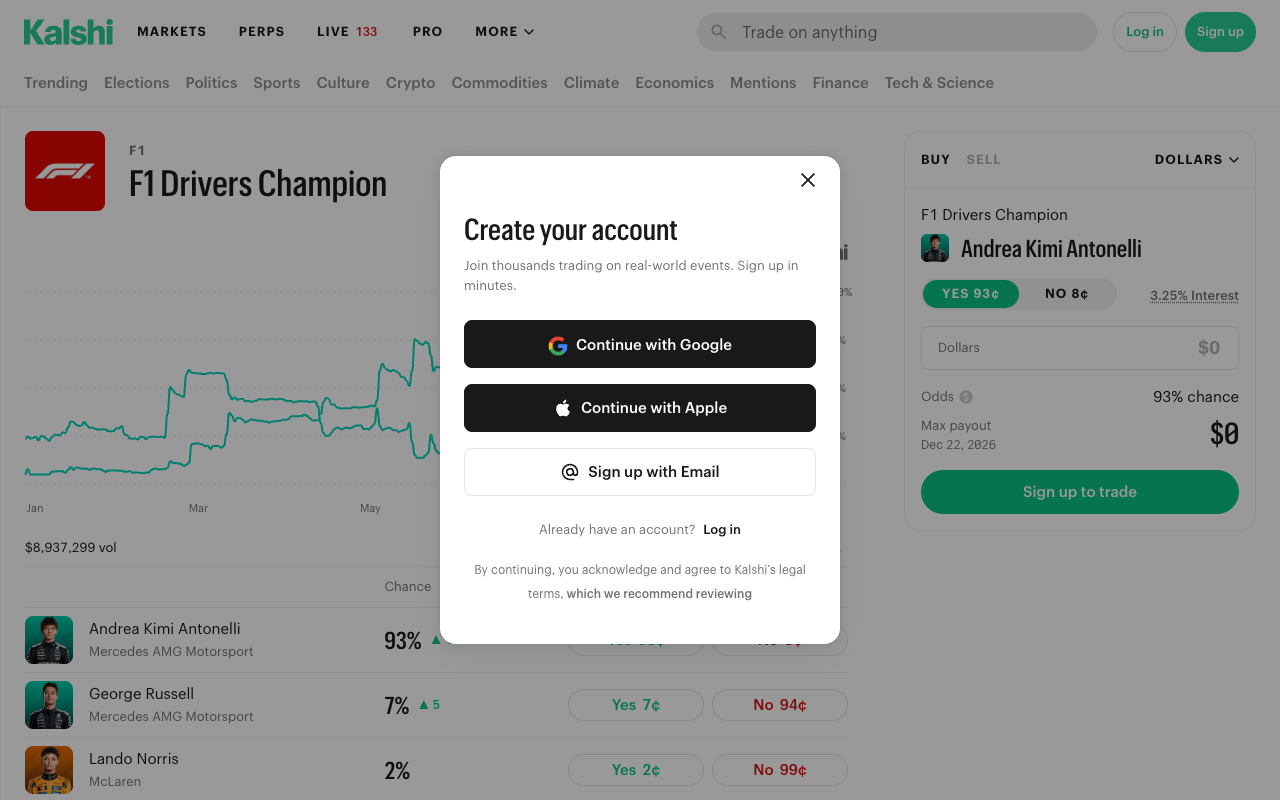
I checked all three venues directly rather than reading someone's odds table. Polymarket's public search returns two open F1 title events, F1 Drivers' Champion and F1 Constructors' Champion, and both resolve on the 2026 season. Kalshi's KXF1 series has a single open event, KXF1-26, which closes on 22 December 2026. The sportsbook futures boards are all still headed 2026.
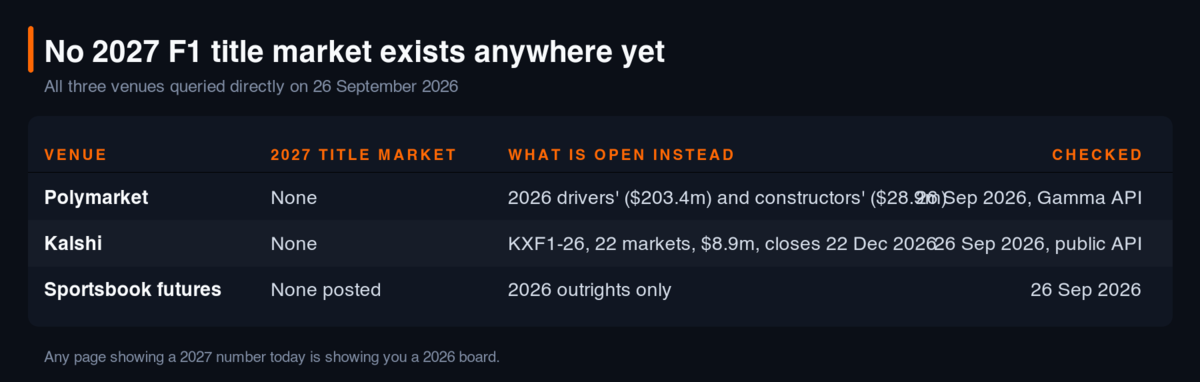
| Venue | 2027 title market | What is open instead | Checked |
|---|---|---|---|
| Polymarket | None | 2026 drivers' ($203.4m volume) and constructors' ($28.9m) | 26 Sep 2026, Gamma API |
| Kalshi | None | KXF1-26, 22 markets, $8.9m volume, closes 22 Dec 2026 | 26 Sep 2026, public API |
| Sportsbook futures | None posted | 2026 outrights only | 26 Sep 2026 |
A word on why that is the correct answer rather than an unhelpful one. Every page currently ranking for this question quietly substitutes the 2026 board and hopes you do not notice the year. A 2026 price is not a 2027 price, and on this grid the difference is enormous: the 2026 market is 91.4% settled on one driver, which tells you nothing about a season that starts with a fresh points total. If you want the live 2026 numbers, they are on our drivers' championship page; if you want to know what a 2027 line will be worth when it appears, keep reading.
The two questions worth answering now are when the market opens and what its first number will be worth. Both have evidence behind them.
When the 2027 Market Will Actually Open
Creation timestamps are public on both exchanges, so this is measurable rather than a guess. The 2026 Polymarket drivers' market was created on 8 December 2025 and went live the following day. Round one of 2026 was the Australian Grand Prix on 8 March, which is a lead time of 90 days. Kalshi came later, opening KXF1-26 on 12 January 2026, 55 days out.
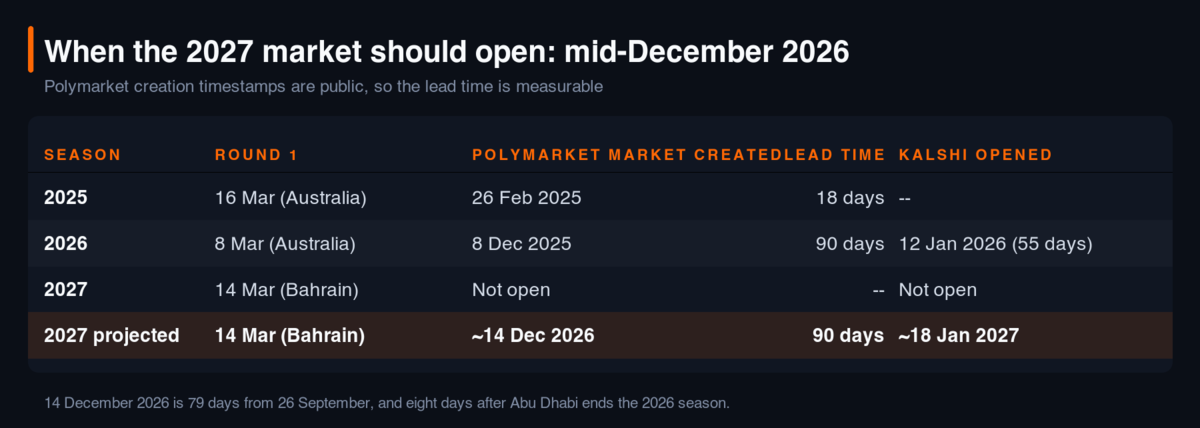
The season before, Polymarket was much slower: the 2025 drivers' market was created on 26 February 2025, only 18 days before the Melbourne opener. The trend across two seasons is sharply earlier, not later.
| Season | Round 1 | Polymarket market created | Lead time | Kalshi opened |
|---|---|---|---|---|
| 2025 | 16 Mar (Australia) | 26 Feb 2025 | 18 days | — |
| 2026 | 8 Mar (Australia) | 8 Dec 2025 | 90 days | 12 Jan 2026 (55 days) |
| 2027 | 14 Mar (Bahrain) | Not open | — | Not open |
| 2027 projected | 14 Mar (Bahrain) | ~14 Dec 2026 | 90 days | ~18 Jan 2027 |
The 2027 calendar is confirmed: Formula 1 has published 24 rounds opening with Bahrain on 12–14 March and Saudi Arabia a week later. Carry the 2026 lead time across and the Polymarket event should appear around 14 December 2026, which is 79 days from today and eight days after the 2026 season ends in Abu Dhabi on 6 December.
That ordering is the useful part. The 2027 market will almost certainly open after the 2026 title is settled and after the silly season has resolved most seats, which is a very different information environment from the one that produced 2026's opening board. It is worth knowing how badly that board aged.
What 2026's Opening Prices Got Wrong
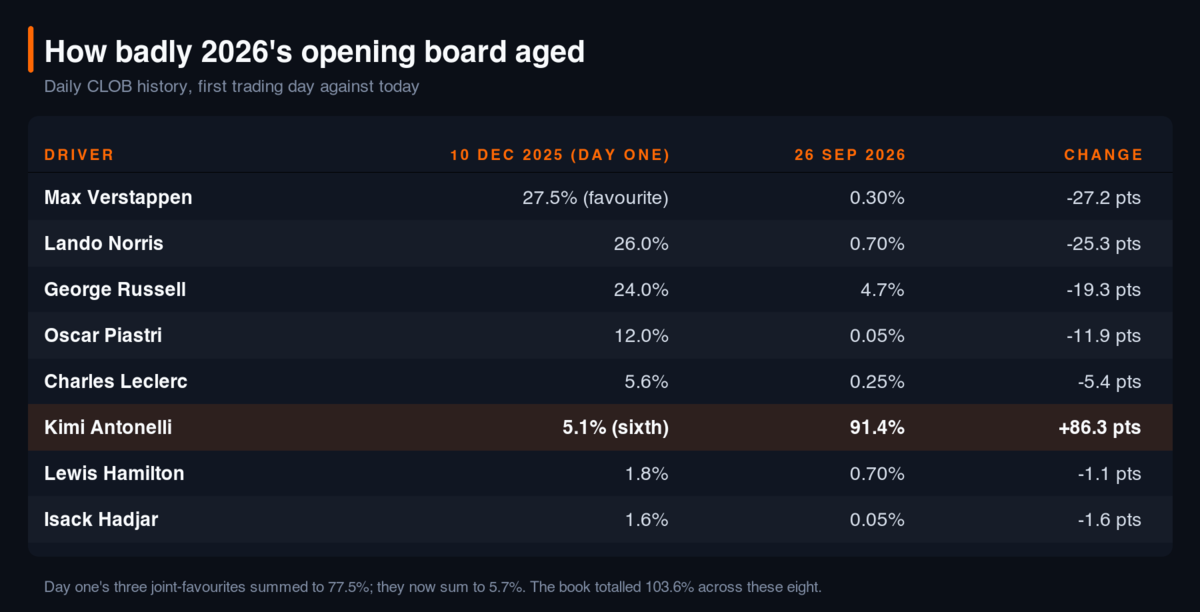
This is the part no odds page will tell you, because it requires pulling a full price history rather than a live quote. I fetched the daily series for eight drivers from the CLOB endpoint at maximum interval, which reaches back to 10 December 2025, the market's first trading day, and put the opening board next to today's.
| Driver | 10 Dec 2025 (day one) | 26 Sep 2026 | Change |
|---|---|---|---|
| Max Verstappen | 27.5% (favourite) | 0.30% | −27.2 pts |
| Lando Norris | 26.0% | 0.70% | −25.3 pts |
| George Russell | 24.0% | 4.7% | −19.3 pts |
| Oscar Piastri | 12.0% | 0.05% | −11.9 pts |
| Charles Leclerc | 5.6% | 0.25% | −5.4 pts |
| Kimi Antonelli | 5.1% (sixth) | 91.4% | +86.3 pts |
| Lewis Hamilton | 1.8% | 0.70% | −1.1 pts |
| Isack Hadjar | 1.6% | 0.05% | −1.6 pts |
Read the top and bottom of that table together. The three drivers the market made joint-favourites on day one, at a combined 77.5%, now sum to 5.7%. The driver it had sixth, behind his own team-mate by nineteen points of probability, is 91.4% and leads by 66 points with eight rounds left.
In money: $100 on Antonelli at 5.1 cents bought about 1,961 shares, which are worth roughly $1,792 at today's 91.4 cents. Call it eighteen times your stake for holding a pre-season position through nine months. The same $100 on the favourite is worth about $1.10.
I want to be careful about the lesson here, because "the market was wrong" is the lazy version. The market was uninformed, which is different and more useful. December 2025 was before a single lap of the new regulations had been run in anger; nobody knew Mercedes had the power unit, so the board defaulted to reputation — the reigning champion, the previous year's title contenders, the established names. It priced the past because the present did not exist yet. That is also why the day-one prices summed to 103.6% across just those eight drivers: a wide, low-conviction book with plenty of overround to go round.
The practical takeaway for December 2026 is narrow and worth holding onto: an opening price on a grid whose competitive order is genuinely unknown is a reputation ranking, not a forecast. The difference in 2027 is that the order will not be unknown. One full season of the current rules will be on the record.
The 2026 Title Is Not Mathematically Over
Before 2027 pricing can anchor on anything, 2026 has to finish, and the market has effectively called it. Antonelli is 91.4% for the drivers' title and Mercedes 96.5% for the constructors'. The arithmetic is less emphatic than the prices.
Fifteen of 23 rounds are complete after Baku, where Russell won and Antonelli put his car in the wall in qualifying. Eight rounds remain, so 200 race points are still available to any driver. Every one of the top six is mathematically alive, which is exactly the kind of gap between price and arithmetic our title race scenarios page exists to measure.
| Driver | Points | Gap to Antonelli | Needed per race | Share of points scored | Polymarket | Market edge |
|---|---|---|---|---|---|---|
| Kimi Antonelli | 302 | — | — | 17.8% | 91.4% | +73.6 |
| George Russell | 236 | 66 | 8.3 | 13.9% | 4.7% | −9.2 |
| Lewis Hamilton | 199 | 103 | 12.9 | 11.7% | 0.70% | −11.0 |
| Lando Norris | 186 | 116 | 14.5 | 11.0% | 0.70% | −10.3 |
| Charles Leclerc | 179 | 123 | 15.4 | 10.6% | 0.25% | −10.3 |
| Max Verstappen | 163 | 139 | 17.4 | 9.6% | 0.30% | −9.3 |
"Needed per race" is the average margin by which a driver must out-score Antonelli over the remaining eight rounds, and it is the column that explains the prices. Russell needs to beat his own team-mate by 8.3 points a weekend for eight straight weekends in equal machinery. Verstappen needs 17.4, which is most of a race win every time out, in a car that has not won all year.
Sprint points are excluded from that column, as they are everywhere on this site, because sprint scoring is a smaller and less predictable pool. Include them and the required margins fall slightly; they do not change the ranking. The constructors' picture is the same shape: Mercedes lead Ferrari by 160 with 344 team race points still on the table, which is alive on paper and 1.4% in the market. The full board is on the constructors' championship page.
Ten Sprint Races Change the 2027 Maths
Here is the structural change to 2027 that no odds page has priced, because no odds page covers 2027 at all. F1 has increased sprint races from six to 10 for 2027, and confirmed the venues alongside the calendar. Bahrain, Australia, Japan, Monaco and Abu Dhabi hold sprints for the first time; Canada, Britain, Italy, Brazil and Qatar keep theirs. Six had been the maximum in any season.
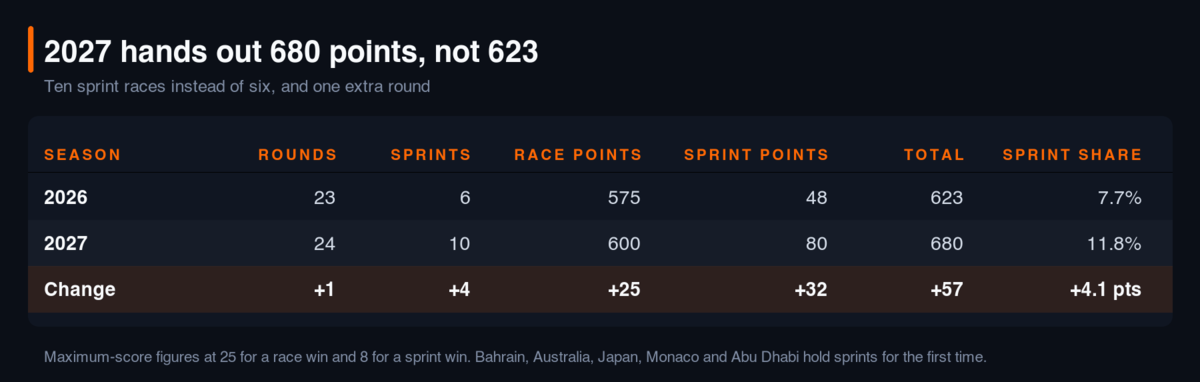
That changes the size and the shape of the points pool a title is won from.
| Season | Rounds | Sprints | Race points available | Sprint points available | Total | Sprint share |
|---|---|---|---|---|---|---|
| 2026 | 23 | 6 | 575 | 48 | 623 | 7.7% |
| 2027 | 24 | 10 | 600 | 80 | 680 | 11.8% |
Maximum-score figures, using 25 for a race win and 8 for a sprint win. Two things follow. The first is mechanical: a 2027 champion can score 57 more points than a 2026 one, so raw point totals will not be comparable across the two seasons and any "record points haul" framing next year should be discounted accordingly.
The second is about variance, and it cuts against the favourite. Sprints are short, run on Saturday off a single extra qualifying session, with less time for a fast car to recover from a bad first lap. Quadrupling the number of them at circuits like Monaco — where the sprint exists mainly to give the weekend a second qualifying session, since overtaking is close to impossible — adds 32 points of genuinely scrappy scoring to the season. More sprints means more small, semi-random point swings, which is a mild argument against any heavy pre-season favourite and a reason 2027's opening prices should sit flatter than they otherwise would. We wrote up how the sprint format distorts weekend pricing in F1 sprint weekend odds.
One caveat the BBC report is explicit about, and it belongs in any 2027 forecast: the Bahrain and Saudi Arabian rounds that open the season are in doubt while the conflict in the Middle East continues, and F1 is working on contingency plans for the end of 2026 as well.
The 2027 Grid Is Already Filling In
An opening price is mostly a bet on a car, but seat confirmations are what let the market attach that car to a name, and they are landing now. On 23 September, Red Bull confirmed Isack Hadjar for 2027 alongside Verstappen, with team principal Laurent Mekies calling it "an easy decision".
The detail worth keeping is the pace comparison. Over the first half of this season Hadjar was 0.239 seconds off Verstappen on average in qualifying and out-qualified him three times, in Australia, Japan and Britain. That is the closest any Verstappen team-mate has run since Ricciardo in 2018, in only Hadjar's second F1 season, and his best result is third at Monaco. He is 1.6% to 0.05% on the 2026 board, which is a car verdict rather than a driver one.
The other confirmed 2027 fixture is at the top of the same garage: Verstappen signed a two-year extension in August that runs to the end of 2030. That extension is what collapsed his retirement market from a 25.0% peak in April to 1.4%, which we traced day by day in Max Verstappen retirement odds 2026. For 2027 pricing purposes the point is simply that the market no longer has to discount him leaving.
What is not settled is whether Mercedes' advantage carries, and that is the whole question a December opening price will try to answer with one number.
Where a 2027 Edge Actually Comes From
If you are going to look at a 2027 line in December, these are the four things I would weigh, in this order.
Year two of a rule set usually rewards the year-one winner. The 2026 regulations were the reset; 2027 runs to the same rules. Development advantages built into a concept that works tend to persist into the following season more often than they evaporate, which is an argument for Mercedes opening short. It is an argument, not a law — the counter-case is that rivals get a full season of data on what the winning package looks like and a winter to copy it, and that convergence is the normal pattern late in a regulation cycle.
The team-mate split is the live question, not the constructor. Mercedes are 96.5% for this year's constructors' title, so a bet on the car in 2027 is mostly a bet on which side of the garage takes it. That was precisely the mistake the 2026 opening board made in reverse: it had Russell at 24.0% and Antonelli at 5.1%, and the split went the other way. Nine months of head-to-head data now exists where none did then.
Discount the opening number, then wait for testing. The 2026 history says the first price is a reputation ranking. It also says the repricing was not gradual: Antonelli went from 10.1% on 9 March to 31.6% by 1 May, once the cars had actually raced. If you want a position at a good price, the window is between the market opening and the first competitive laps, and the risk is that the window is exactly where you have no information either.
Check the overround before you treat a price as a probability. Day-one 2026 summed to 103.6% across eight drivers alone; the full 32-runner book was wider still. A sportsbook 2027 outright will be wider again. The mechanics of that comparison, and why the prediction-market number is usually the cleaner one, are in Polymarket versus the sportsbooks.
How to Track F1 2027 Odds When They Open
There is nothing to track yet, and I would rather say that than pad this page with a 2026 table wearing a 2027 headline. What I can give you is the checklist for December.
- Watch for the Polymarket event first. On the 2026 precedent it appears roughly 90 days before round one, so mid-December 2026, and it will carry a name in the form of a 2027 drivers' champion event. Kalshi historically follows about five weeks later.
- Read the resolution rules before the price. Both exchanges settle on the official FIA classification, and the 2026 events do not close until 1 April 2027 for exactly that reason. The mechanics are in F1 on Polymarket.
- Expect the 2026 markets to resolve first. Abu Dhabi is 6 December; Kalshi's 2026 event closes 22 December. Liquidity tends to rotate into the new season market as the old one settles.
- Treat the Middle East calendar risk as real. Rounds one and two of 2027 are both in doubt, and a reshuffled opening schedule changes which circuits set the early narrative.
Our live odds board tracks every F1 market we can read from Polymarket and picks up new events automatically, so the 2027 championship will appear there as soon as it exists. Until then the next race page carries the weekend markets, and the drivers' and constructors' pages carry the title boards that are actually trading.
I will update this page with the real opening prices the day the market appears. If the projection above is right, that is around 14 December 2026.
Prices and creation timestamps quoted here were read from the Polymarket Gamma and CLOB APIs, the Kalshi public API and the Jolpica F1 feed on 26 September 2026, and move continuously. GridOdds earns a referral commission if you open a Polymarket account through links on this site; it costs you nothing and does not change what we write.
Related Analysis
- Antonelli Title Clinch 2026: The Earliest Date Is Singapore — when the 91.4% becomes a certainty.
- F1 Drivers' Championship Odds 2026: Polymarket vs the Standings — the live board, points against prices.
- F1 Constructors' Championship Odds & Standings 2026 — where Mercedes' 96.5% comes from.
- F1 Title Race Scenarios 2026 — the eight-round arithmetic in full.
- F1 on Polymarket: How to Read and Trade the Championship Markets — resolution rules, tick sizes and book sums.
- F1 Sprint Weekend Odds — why the format that quadruples in 2027 distorts pricing.