
Key takeaways
- Polymarket prices 22 drivers for the 2026 F1 Action of the Year; the FIA ballot holds three. Last year the F1 shortlist was Verstappen, Norris and Bearman — three names chosen by the FIA, then a one-day fan vote. Nineteen of the lines quoted tonight are bets on making the ballot, not on winning it.
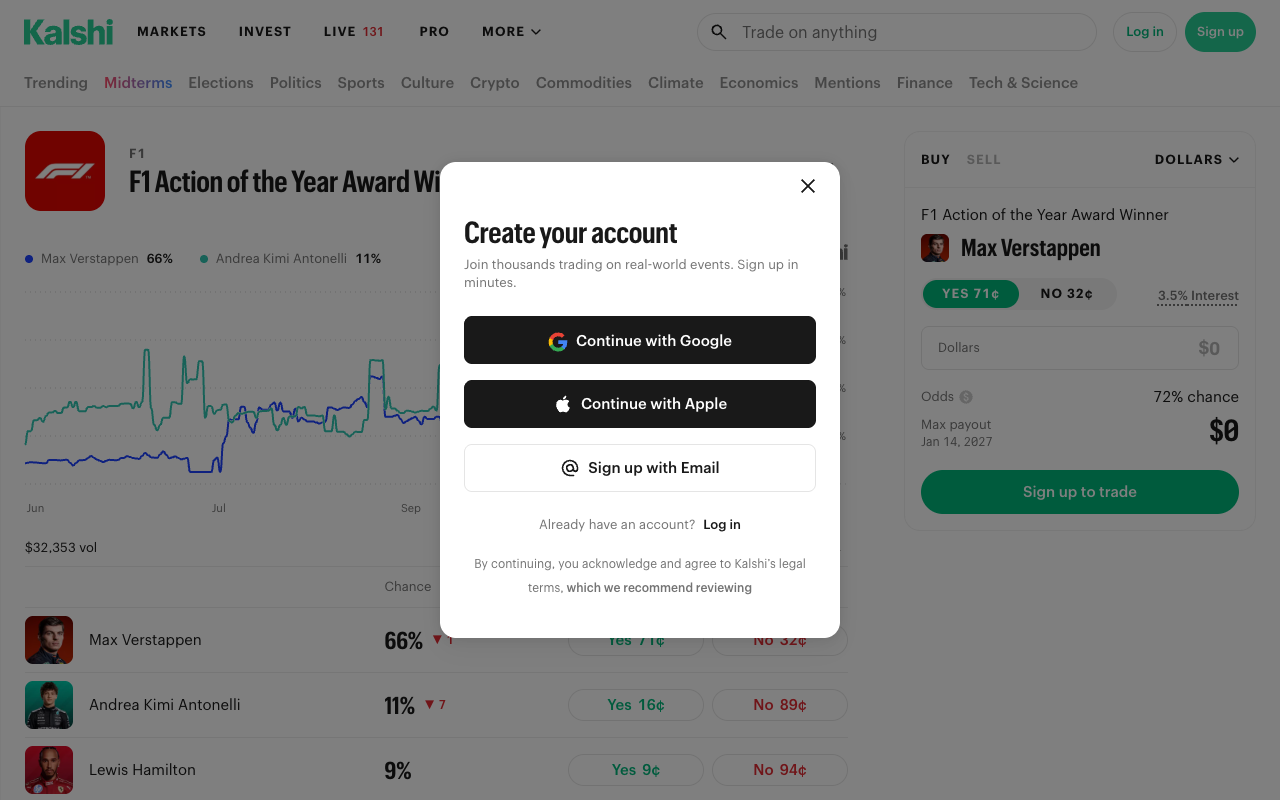
- Max Verstappen is 70.2¢ on Polymarket and 66¢ on Kalshi — two books, 4.2 points apart on the favourite, read at 21:10 UTC on 14 November 2026. Kimi Antonelli, who clinched the title at Mexico City, is 13.5¢.
- The award has gone to the season’s world champion in none of its nine Formula 1 editions. 2015 through 2025: nine F1 winners, nine different years, and not once the driver who won that year’s title.
- $167,912 of the book’s $204,984 sits on lines priced at a cent or less — and only $109 of it is anyone buying. Across those 16 lines the trade record shows $159,268 of No against $109 of Yes. Valtteri Bottas alone carries $43,718 at 0.2¢, of which $42,955 is No.
- Verstappen’s price did not move at Interlagos; it moved at Mexico City. He gained 14.8 points in one day on 3 November, from 56.0¢ to 70.8¢. Lewis Hamilton’s doubled over the São Paulo weekend instead, 4.9¢ to 9.8¢.
- What the Action of the Year actually awards
- The Polymarket book, line by line
- One award, two books: Polymarket vs Kalshi
- $167,912 of volume and $109 of buying
- Nine editions, nine non-champions
- How the price got here: Mexico City, not Interlagos
- The three-name Action of the Year ballot
- Sources and method
If you are reading F1 Action of the Year odds for 2026, you are looking at a 22-name book for a prize that goes to a three-name ballot — and that mismatch is the whole trade. The FIA hands this award out on Saturday 12 December in Shanghai, six days after the season ends, and it hands it out on a fan vote taken from a shortlist the FIA picks. Last year that shortlist was three drivers. So I pulled both books that quote it, read the trade record line by line, and checked eleven years of winners to see what the vote actually rewards.
What comes back is a market that agrees with itself on the favourite and disagrees with itself about everything else. Verstappen is 70.2¢ on Polymarket and 66¢ on Kalshi, inside a book that sums to 105% on one venue and 122% on the other. Below the top three, eighty-two per cent of Polymarket’s reported volume sits on lines nobody has bought. Here is the book, the vote that settles it, and the one number I would not pay.
What the Action of the Year actually awards
This is not a championship market wearing a different hat. The Action of the Year goes to a single on-track moment — Kalshi’s own rules call it the most spectacular, thrilling, or skillful on-track maneuver — and the FIA describes the contest as letting fans choose their defining event of the sporting year. Fans vote. No panel, no points, no countback.
Two mechanics matter before any price does. From 2024 the award split into seven championship categories, so Formula 1 now has its own winner rather than competing with the World Rally Championship for one trophy — which is why 2017 and 2018 went to Esapekka Lappi and Teemu Suninen and no F1 driver appears at all. And the vote runs off a shortlist: in 2025 the FIA opened it on 26 November, ran one championship a day across its social channels, and gave F1 exactly three candidates.
Here is every Formula 1 edition since the award began, with what won it.
| Year | Winner | The moment | Type |
|---|---|---|---|
| 2015 | Max Verstappen | Overtaking Felipe Nasr at the Belgian GP | Overtake |
| 2016 | Max Verstappen | Overtaking Nico Rosberg at the Brazilian GP | Overtake |
| 2019 | Max Verstappen | Overtaking Charles Leclerc at the British GP | Overtake |
| 2020 | Kimi Räikkönen | Opening lap at the Portuguese GP | Opening lap |
| 2021 | Fernando Alonso | Defending against Lewis Hamilton at the Hungarian GP | Defence |
| 2022 | Lewis Hamilton | Overtaking Leclerc and Pérez at the British GP | Overtake |
| 2023 | Fernando Alonso | Last-lap pass on Sergio Pérez at the São Paulo GP | Overtake |
| 2024 | Sergio Pérez | Passing Sainz and Alonso in the Chinese GP sprint | Overtake |
| 2025 | Max Verstappen | Overtaking Oscar Piastri at the Emilia Romagna GP | Overtake |
Nine F1 editions, and seven went to an overtake. One went to a defensive move and one to an opening lap. Verstappen has four of the nine, plus the 2014 award for a Formula 3 pass at Imola. That record is the single best argument for his price — and, as the base rates below show, it is also the only one.
The Polymarket book, line by line
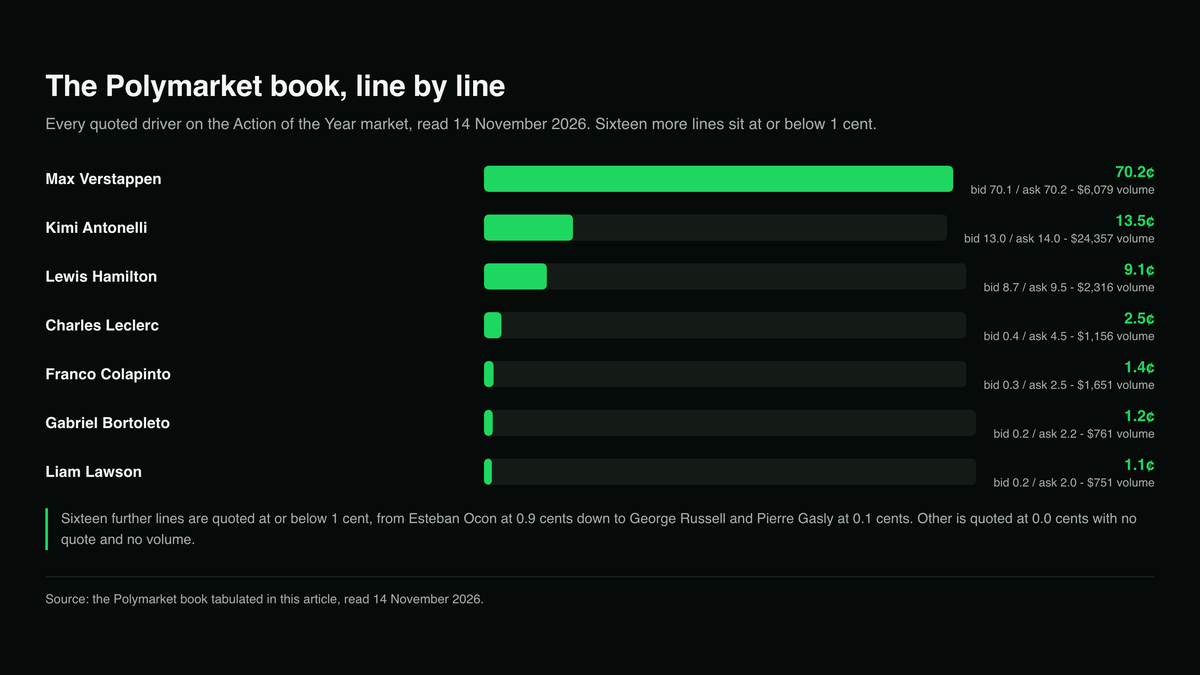
Polymarket’s event opened on 10 March 2026 and has traded $204,984 with $39,093 of resting liquidity. It lists 33 markets, but ten are unnamed placeholders and one is “Other”, so 22 drivers carry a real price. Everything below was read from the Gamma API at 21:10 UTC on 14 November 2026.
| Driver | Price | Bid / ask | Volume |
|---|---|---|---|
| Max Verstappen | 70.2¢ | 70.1¢ / 70.2¢ | $6,079 |
| Kimi Antonelli | 13.5¢ | 13.0¢ / 14.0¢ | $24,357 |
| Lewis Hamilton | 9.1¢ | 8.7¢ / 9.5¢ | $2,316 |
| Charles Leclerc | 2.5¢ | 0.4¢ / 4.5¢ | $1,156 |
| Franco Colapinto | 1.4¢ | 0.3¢ / 2.5¢ | $1,651 |
| Gabriel Bortoleto | 1.2¢ | 0.2¢ / 2.2¢ | $761 |
| Liam Lawson | 1.1¢ | 0.2¢ / 2.0¢ | $751 |
| Esteban Ocon | 0.9¢ | 0.3¢ / 1.4¢ | $833 |
| Lando Norris | 0.7¢ | 0.5¢ / 0.8¢ | $1,018 |
| Oliver Bearman | 0.6¢ | 0.3¢ / 0.9¢ | $29,909 |
| Isack Hadjar | 0.6¢ | 0.3¢ / 0.9¢ | $991 |
| Oscar Piastri | 0.5¢ | 0.4¢ / 0.7¢ | $1,124 |
| Sergio Pérez | 0.5¢ | 0.1¢ / 0.9¢ | $27,534 |
| Carlos Sainz | 0.4¢ | 0.2¢ / 0.7¢ | $4,562 |
| Lance Stroll | 0.4¢ | 0.2¢ / 0.6¢ | $982 |
| Alexander Albon | 0.2¢ | 0.1¢ / 0.4¢ | $3,643 |
| Fernando Alonso | 0.2¢ | 0.2¢ / 0.3¢ | $23,843 |
| Valtteri Bottas | 0.2¢ | 0.2¢ / 0.3¢ | $43,718 |
| Nico Hülkenberg | 0.2¢ | 0.1¢ / 0.4¢ | $926 |
| Arvid Lindblad | 0.2¢ | 0.1¢ / 0.3¢ | $811 |
| George Russell | 0.1¢ | 0.1¢ / 0.2¢ | $1,098 |
| Pierre Gasly | 0.1¢ | 0.1¢ / 0.2¢ | $26,920 |
| Other | 0.0¢ | no quote | $0 |
Two things jump out of that table before any opinion does. The prices sum to 105.0%, so the book carries five points of overround — tight for a 22-runner field, and tighter than the sportsbook version of any F1 market I have compared on the Polymarket versus sportsbook page. And the volume column is upside down: the 70¢ favourite has traded $6,079, three per cent of the book, while four drivers priced under a cent have traded more than $23,000 each. That is not a mistake in the data. It is the shape of the flow, and it is worth its own section.
The spreads deserve a note too. Verstappen is quoted 0.1¢ wide. Leclerc is quoted 0.4¢ bid against 4.5¢ offered — a 4.1-point spread on a 2.5¢ line, which is to say there is no price on Leclerc at all, only two numbers with a canyon between them.
One award, two books: Polymarket vs Kalshi
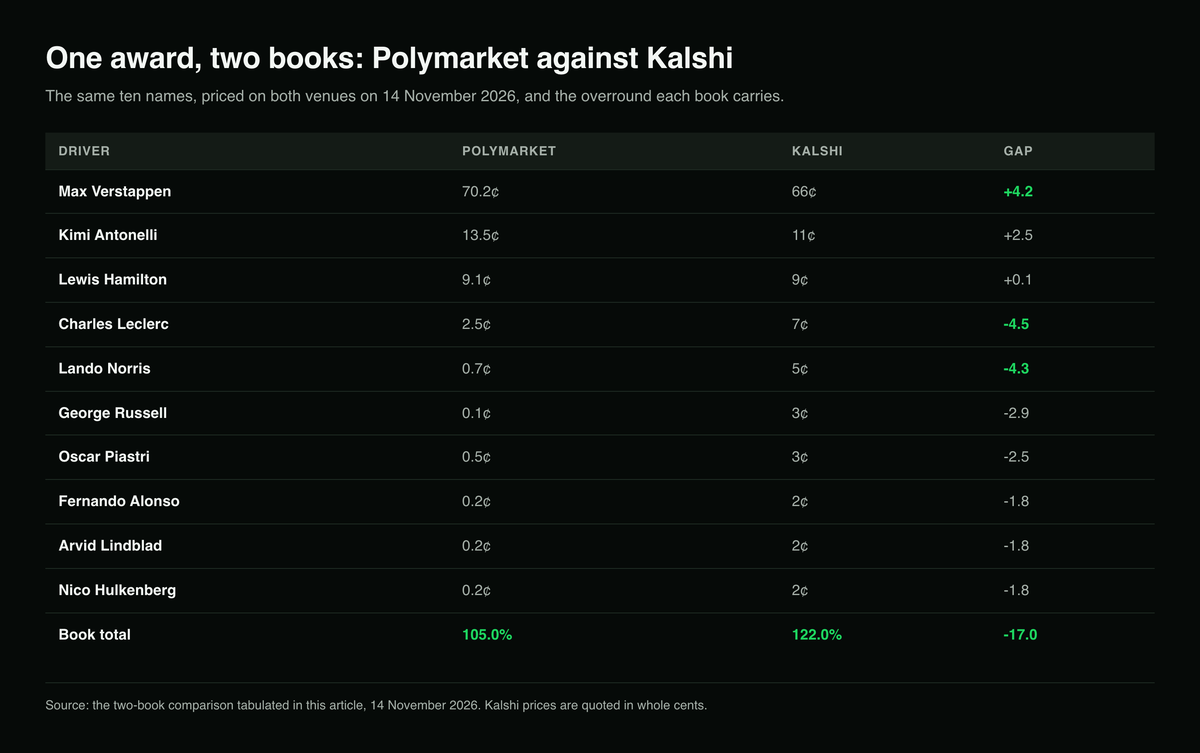
Kalshi lists the same award as KXF1ACTION-2026, opened on 17 June 2026, and it is the cleanest cross-venue check available in F1 right now: same event, same resolution source, two independent order books. It has traded 32,353 contracts with 18,174 still open. Kalshi prices are last traded, in cents.
| Driver | Polymarket | Kalshi | Gap |
|---|---|---|---|
| Max Verstappen | 70.2¢ | 66¢ | +4.2 |
| Kimi Antonelli | 13.5¢ | 11¢ | +2.5 |
| Lewis Hamilton | 9.1¢ | 9¢ | +0.1 |
| Charles Leclerc | 2.5¢ | 7¢ | −4.5 |
| Lando Norris | 0.7¢ | 5¢ | −4.3 |
| George Russell | 0.1¢ | 3¢ | −2.9 |
| Oscar Piastri | 0.5¢ | 3¢ | −2.5 |
| Fernando Alonso | 0.2¢ | 2¢ | −1.8 |
| Arvid Lindblad | 0.2¢ | 2¢ | −1.8 |
| Nico Hülkenberg | 0.2¢ | 2¢ | −1.8 |
| Book total | 105.0% | 122.0% | −17.0 |
The top of the book is a genuine agreement. Two sets of traders, two fee structures, two user bases, and they land within 4.2 points on Verstappen and 0.1 of a point on Hamilton. When independent books converge like that, the number is usually worth taking seriously.
The tail is a genuine disagreement, and it runs one way: Kalshi’s longshots are fatter on every single line. Norris is 0.7¢ on Polymarket and 5¢ on Kalshi — seven times the price. Russell is 0.1¢ against 3¢, a thirty-fold gap. Sum the two books and Kalshi reads 122% against Polymarket’s 105%, so seventeen of those points are simply a wider book rather than a different opinion about any driver. Kalshi quotes in whole cents, which floors a true 0.2¢ chance at 1¢, and 22 lines rounded up to a penny is most of the gap on its own.
One real structural difference sits underneath the prices. Kalshi carries an explicit “Tie / Co-Winners” line at 1¢. Polymarket does not — its rules resolve a shared award to whichever winner’s surname comes first alphabetically. If the FIA names two drivers, Kalshi pays the Tie line and Polymarket pays an alphabet. The other difference is the clock: Polymarket closes 1 January 2027 and Kalshi 14 January 2027, both weeks after the 12 December ceremony has already settled the question.
$167,912 of volume and $109 of buying
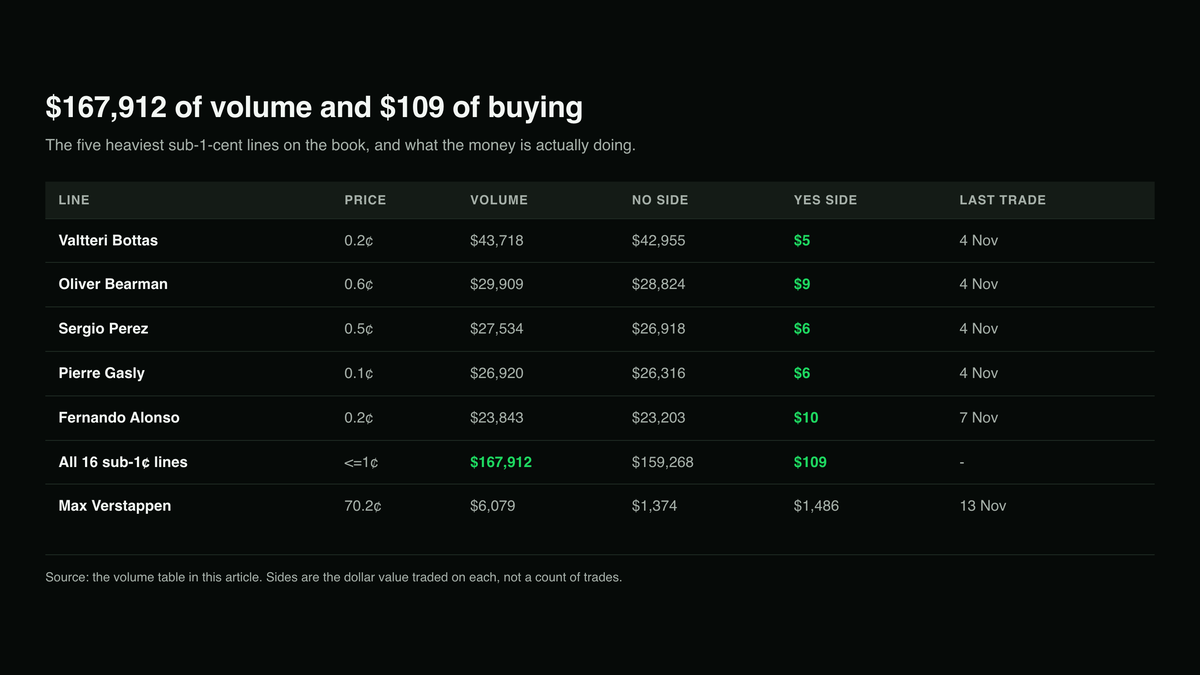
Sixteen of the 22 priced drivers sit at a cent or less, and between them they carry $167,912 — 81.9% of everything this book has traded. Read as a sentence that sounds absurd: four-fifths of the money has gone on drivers the market gives less than a one-in-a-hundred chance. So I pulled the trade record for every line from Polymarket’s data API, keyed by condition ID, and split each trade by which side of the contract it touched.
| Line | Price | Volume | No side | Yes side | Last trade |
|---|---|---|---|---|---|
| Valtteri Bottas | 0.2¢ | $43,718 | $42,955 | $5 | 4 Nov |
| Oliver Bearman | 0.6¢ | $29,909 | $28,824 | $9 | 4 Nov |
| Sergio Pérez | 0.5¢ | $27,534 | $26,918 | $6 | 4 Nov |
| Pierre Gasly | 0.1¢ | $26,920 | $26,316 | $6 | 4 Nov |
| Fernando Alonso | 0.2¢ | $23,843 | $23,203 | $10 | 7 Nov |
| All 16 sub-1¢ lines | ≤1¢ | $167,912 | $159,268 | $109 | — |
| Max Verstappen | 70.2¢ | $6,079 | $1,374 | $1,486 | 13 Nov |
That is the answer, and it is not subtle. Across sixteen longshot lines carrying $167,912 of reported volume, the total ever spent buying a driver was $109. Everything else — $159,268 of it — is the No side: traders collecting 99¢ and change to underwrite an event the book prices at a fifth of a penny. Bottas, the single largest line in the whole market, has seen $5 of Yes buying in eight months.
Two mechanics produce this. First, Polymarket reports volume on both legs, so one trader selling Bottas and another buying the No later shows up twice; the dollar figure is turnover, not conviction. Second, and more important, a 0.2¢ line is a bad instrument for a punt and a tidy one for a yield trade: risking $1,000 to make $2 is unattractive, while taking $998 to carry a near-impossible outcome for eight weeks is a position a certain kind of trader will put on all day. Those five lines last traded on 4 and 7 November, right after the Mexico City result stopped moving them; Verstappen’s line was still trading on 13 November.
The practical reading: ignore the volume column on any book with a long tail. It will point you at the drivers nobody believes in. Liquidity tells you more — those lines hold roughly $1,900 to $2,300 each, against Verstappen’s $1,168 — and the quote tells you most of all, which is where the expected-value method starts rather than ends.
Nine editions, nine non-champions
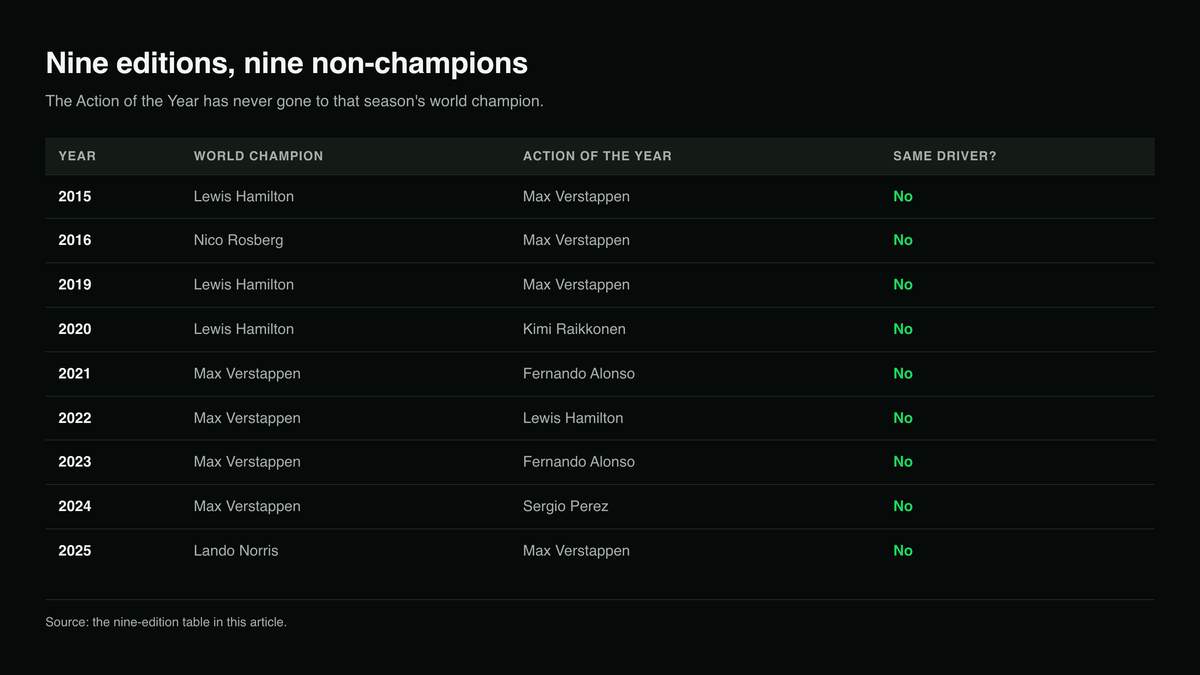
Here is the fact that should frame every price in this market. In the nine Formula 1 editions of this award, it has never gone to the driver who won that season’s world championship. Not once.
| Year | World champion | Action of the Year | Same driver? |
|---|---|---|---|
| 2015 | Lewis Hamilton | Max Verstappen | No |
| 2016 | Nico Rosberg | Max Verstappen | No |
| 2019 | Lewis Hamilton | Max Verstappen | No |
| 2020 | Lewis Hamilton | Kimi Räikkönen | No |
| 2021 | Max Verstappen | Fernando Alonso | No |
| 2022 | Max Verstappen | Lewis Hamilton | No |
| 2023 | Max Verstappen | Fernando Alonso | No |
| 2024 | Max Verstappen | Sergio Pérez | No |
| 2025 | Lando Norris | Max Verstappen | No |
The reason is structural rather than spiteful. A champion wins by being in front, and the moves that win this vote are made from behind — a last-lap pass on Pérez, a sprint double-overtake, a defence against a faster car. The driver having the season does not often need the move that makes the highlight reel.
That cuts both ways on tonight’s board. It argues for Antonelli at 13.5¢ being roughly right despite a championship won at twenty, three races early, as the youngest champion in the sport’s history and Italy’s first since Alberto Ascari in 1953 — a season I covered in full on the 2026 title page. None of that is an overtake. And it argues that Verstappen at 70.2¢ is being priced on the right thing: he is the man who spent the year chasing, and four of these nine trophies are already his.
Where I part company with the book is the size of the number. Four from nine is a 44% hit rate across the award’s F1 history, against a quote of 70.2¢. The gap is defensible — he has a genuine 2026 candidate move and the largest fanbase in the sport voting on it — but it is 26 points of defending, and nobody buying at 70¢ is being paid to do it.
How the price got here: Mexico City, not Interlagos
The market has been open since March, and its favourite has changed hands more than once. Daily closes from the Polymarket CLOB price history tell the story better than any narrative I could put on it.
| Date | Verstappen | Antonelli | Hamilton | What happened |
|---|---|---|---|---|
| 11 Mar | 48.0¢ | 44.5¢ | 43.5¢ | Market opens, round 2 done |
| 1 Jul | 4.5¢ | 49.5¢ | 2.1¢ | Antonelli the clear favourite |
| 1 Oct | 28.5¢ | 28.5¢ | 5.9¢ | Dead level going into Malaysia |
| 2 Nov | 56.0¢ | 23.0¢ | 4.0¢ | Day after Mexico City |
| 3 Nov | 70.8¢ | 20.0¢ | 2.9¢ | Verstappen +14.8 in a day |
| 8 Nov | 73.8¢ | 13.0¢ | 7.2¢ | São Paulo, both start from the back |
| 9 Nov | 70.0¢ | 13.0¢ | 9.8¢ | Verstappen −3.8, Hamilton doubles |
| 14 Nov | 70.2¢ | 13.5¢ | 9.1¢ | Tonight, three races left |
The decisive day was 3 November, two days after the Mexico City Grand Prix, and Verstappen gained 14.8 points on it. He won that race from Hamilton by under a second, having taken the lead during the pit-stop phase while Leclerc served a five-second penalty, then survived a standing restart after Bottas put his Cadillac into the Turn 2 barriers, then held Hamilton off through a late Safety Car period. Verstappen called it an opportunistic move. The market called it a candidate.
Interlagos is the interesting counter-example. Verstappen and Hamilton both started from the back of the grid at São Paulo, Verstappen produced the recovery drive of the weekend, and his price went down — 73.8¢ to 70.0¢. Hamilton’s doubled instead, 4.9¢ to 9.8¢, and has held near there since. A recovery drive is a sequence of passes rather than one, and this award does not have a category for a good afternoon.
The other half of the chart is Antonelli. He was this market’s favourite at 49.5¢ on 1 July and he is 13.5¢ now, a 36-point fall over the exact stretch in which he won a world championship. That is not the market losing faith in him. It is the market working out what the award is for.
The three-name Action of the Year ballot nobody is pricing
Everything above prices a 22-runner field. The FIA does not run one. In 2025 it opened voting on 26 November, ran one championship a day on its social channels, and put three drivers on the Formula 1 ballot: Verstappen, Norris and Bearman. Verstappen won it for the Imola pass on Piastri. As of tonight the FIA has published no 2026 shortlist and opened no 2026 vote.
So every price in this book is really two probabilities multiplied together, and only one of them is about driving:
| Driver | Quote | If shortlisting odds are… | …the implied vote share is |
|---|---|---|---|
| Max Verstappen | 70.2¢ | 90% | 78% |
| Max Verstappen | 70.2¢ | 100% | 70% |
| Kimi Antonelli | 13.5¢ | 60% | 23% |
| Lewis Hamilton | 9.1¢ | 50% | 18% |
| Charles Leclerc | 2.5¢ | 25% | 10% |
| Any sub-1¢ driver | ≤1¢ | ≤5% | ≤20% |
Read Verstappen’s line and the quote stops looking rich. If he is a near-lock for the ballot, 70.2¢ is a bet that he takes roughly 70% of a three-way fan vote — which is precisely what he did last year against Norris and Bearman. The 44% historical hit rate I used above includes the years he was not nominated at all; conditional on being on the ballot, his record is far better than four from nine.
The same arithmetic guts the bottom of the book. Nineteen of the 22 priced drivers will not be on the ballot, and the shortlist is likely to be published before the final two races are even run. If the FIA repeats last year’s calendar, candidates get locked in around 26 November — after Las Vegas on 21 November but before Qatar on the 29th and Abu Dhabi on 6 December. A spectacular move in the last two rounds of the season might not be eligible for the award at all. That is the asymmetry I would be watching, and it is not in either price.
Five checks before you touch this book
- Price the ballot first, the vote second. Every quote is P(shortlisted) × P(wins the vote). A driver with a great move and no nomination is worth zero.
- Check the quote, not the midpoint. Leclerc’s 2.5¢ is 0.4¢ bid against 4.5¢ offered. There is no tradable price inside a 4.1-point spread.
- Ignore the volume column. Four-fifths of this book’s turnover is No-side flow on 1¢ lines. It tells you where the yield traders are, not where the information is.
- Read the tie rule on your venue. Kalshi pays a Tie line; Polymarket pays the alphabet. On a jointly awarded prize those settle differently.
- Diarise 12 December, not 1 January. The ceremony settles the question weeks before either book closes, so the only liquidity that matters is the liquidity before it.
The live odds board and the drivers’ championship page refresh on their own, so you can re-run these checks against current numbers instead of trusting a table from 14 November; the guide to F1 on Polymarket covers how these books are quoted and settled in general. GridOdds earns a commission if you sign up through the Polymarket button on this page, disclosed in the footer of every page on the site.
Sources and method
Market data: the Polymarket Action of the Year event (33 markets, 22 of them priced) read from the Gamma API at 21:10 UTC on 14 November 2026, and the matching Kalshi KXF1ACTION-2026 series read from the Kalshi public markets API at the same time. Polymarket prices are the API midpoint with best bid and ask quoted alongside; Kalshi prices are last traded, in whole cents. Book totals are the sum of every priced line. Trade-level No/Yes splits come from the Polymarket data API queried per condition ID, which is how $43,718 of reported volume on one line resolves into $5 of buying.
Price history: daily closes from the Polymarket CLOB price-history endpoint, full market life, 218 daily prints for Verstappen and 221 for Antonelli. Award history and winners: the FIA Prize Giving Ceremony record, cross-checked against the FIA’s own announcement that the 2026 FIA Awards run on Saturday 12 December at the West Bund International Convention Center in Shanghai. Race detail from Formula 1’s Mexico City report.
Three limitations worth stating. The 2026 shortlist does not exist yet, so the ballot probabilities in the table above are mine, offered as arithmetic to copy rather than forecasts to trust — change the left column and the right one moves. The voting timetable is last year’s; the FIA has not confirmed 2026 dates. And the historical base rate counts nine F1 editions, which is a small sample to hang a 26-point disagreement on. Odds are implied probabilities, not predictions, and every price here will have moved by the time you read it.
Related reading
- F1 on Polymarket — how to read and trade the championship markets
- Polymarket vs sportsbook F1 odds — comparing cents and fractional prices without fooling yourself
- F1 head-to-head odds 2026 — 23 driver matchups quoted at 50–50 on one trade
- F1 2026 final standings odds — the finishing-position books and a 705% total
- Max Verstappen retirement odds 2026 — the market says 1.4%
- Las Vegas Grand Prix odds 2026 — the next race, on 21 November