
Key takeaways
- Polymarket quotes all 23 Las Vegas head-to-head matchups at exactly 50–50 — every line a 1¢ bid against a 99¢ ask with $1.92 behind it, read at 16:19 UTC on 11 November 2026. The Qatar and Abu Dhabi books have taken $0 between them.
- Only two of those 23 lines deserve 50–50. Leclerc against Hamilton and Leclerc against Russell are both 10–10 this season. Thirteen lines are 60/40 or wider on the same record, and Verstappen against Hadjar is 14–3.
- The book’s only trade bought a near-certainty at 99¢: $95.96 on Bearman over Esteban Ocon, who has not started since round 18. The same trade sits in the last three race books.
- Season-long matchups settle on countback, not points (FIA Article A2.1.4(c)). 36.6% of my simulated endings to Sainz against Alonso finish level, and every one resolves to Alonso on a single eighth place.
- The matchup book emptied as the title race died: $112,729 across rounds 1–14, $4,779 across the nine rounds since.
If you have ever taken F1 head-to-head odds on a teammate matchup, you probably never read how the bet settles — and on a prediction market it settles on a clause of the FIA regulations, not a bookmaker’s rulebook. That matters: 36.6% of my simulated endings to the one season-long matchup Polymarket prices finish level on points, where a single eighth place scored in Malaysia decides the bet. So this page prices every head-to-head line the 2026 season has left — 23 for Las Vegas, 23 for Qatar, 22 for Abu Dhabi and one for the championship — against the records these drivers have actually set, using all 440 classified finishes of the season and 200,000 bootstrap trials per matchup.
The gap turns out to be structural. Every line in the Las Vegas book is quoted at 50–50, while 13 of the 23 matchups behind those quotes are 60/40 or wider on this season’s own evidence. Each line also carries $1.92 of liquidity behind a 98-point spread, so the disagreement you can measure is not one you can trade at size. Here is the whole book, the records that should be pricing it, and the rule that decides the season-long version.
What F1 head-to-head odds actually price
A head-to-head bet strips the field to two drivers and asks which finishes in front. It is the cheapest way to hold an opinion about F1 without needing a winner, which is why every betting guide calls it the beginner’s market. What those guides skip is that three products share the name and settle on three different things.
| Type | What settles it | Quoted for 2026 | Live example |
|---|---|---|---|
| Race matchup | That race’s FIA classification; a retirement still counts, and the driver who completed more laps is ahead | Polymarket, 23 lines a race; most sportsbooks | Verstappen or Hadjar at Las Vegas |
| Qualifying matchup | Saturday’s classification alone | Sportsbooks only | — |
| Season-long matchup | Final standings including FIA tiebreakers — points, then countback | Polymarket, exactly one line | Sainz ahead of Alonso in 2026 |
The settlement column is where money goes missing. A race matchup on Polymarket does not void when a driver retires: the Las Vegas rules say the driver completing more laps is treated as ahead, and a matching lap count pays 50–50 whatever order they stopped in. Sportsbook terms differ on exactly this, several voiding the bet unless both drivers start, so the same opinion can be a dead heat in one place and a loser in another. Know which of the three you hold before you price it.
The Las Vegas book, line by line
Las Vegas runs on Saturday night local time, 22 November at 04:00 UTC, and its matchup book has been open since 24 October with 23 lines: ten teammate pairings plus thirteen cross-team combinations among the top six.
Every one is quoted at 50.0¢ — not approximately, the YES price on both sides of all 23 markets is 0.5 behind a 1¢ bid and a 99¢ ask. The record-implied column is each pairing’s 2026 race-finish record, smoothed by adding one notional win and one loss so 14–3 does not read as a claim of 82% certainty.
| Matchup (as the book lists it) | Quote | Bid / ask | 2026 record | Record-implied |
|---|---|---|---|---|
| Colapinto or Gasly | 50.0¢ | 1¢ / 99¢ | 9–11 | 45% |
| Alonso or Stroll | 50.0¢ | 1¢ / 99¢ | 14–6 | 68% |
| Albon or Sainz* | 50.0¢ | 1¢ / 99¢ | 9–11 | 45% |
| Bortoleto or Hülkenberg | 50.0¢ | 1¢ / 99¢ | 9–11 | 45% |
| Pérez or Bottas | 50.0¢ | 1¢ / 99¢ | 16–4 | 77% |
| Leclerc or Hamilton | 50.0¢ | 1¢ / 99¢ | 10–10 | 50% |
| Ocon or Bearman | 50.0¢ | 1¢ / 99¢ | 8–10 | 45% |
| Norris or Piastri | 50.0¢ | 1¢ / 99¢ | 12–8 | 59% |
| Russell or Antonelli | 50.0¢ | 1¢ / 99¢ | 6–14 | 32% |
| Verstappen or Hadjar | 50.0¢ | 1¢ / 99¢ | 14–3 | 79% |
| Leclerc or Norris | 50.0¢ | 1¢ / 99¢ | 12–8 | 59% |
| Leclerc or Verstappen | 50.0¢ | 1¢ / 99¢ | 8–12 | 41% |
| Leclerc or Piastri | 50.0¢ | 1¢ / 99¢ | 13–7 | 64% |
| Leclerc or Russell | 50.0¢ | 1¢ / 99¢ | 10–10 | 50% |
| Norris or Verstappen | 50.0¢ | 1¢ / 99¢ | 9–11 | 45% |
| Norris or Hamilton | 50.0¢ | 1¢ / 99¢ | 8–12 | 41% |
| Norris or Russell | 50.0¢ | 1¢ / 99¢ | 11–9 | 55% |
| Verstappen or Hamilton | 50.0¢ | 1¢ / 99¢ | 12–8 | 59% |
| Verstappen or Piastri | 50.0¢ | 1¢ / 99¢ | 15–5 | 73% |
| Verstappen or Russell | 50.0¢ | 1¢ / 99¢ | 9–11 | 45% |
| Hamilton or Piastri | 50.0¢ | 1¢ / 99¢ | 13–7 | 64% |
| Hamilton or Russell | 50.0¢ | 1¢ / 99¢ | 9–11 | 45% |
| Piastri or Russell | 50.0¢ | 1¢ / 99¢ | 8–12 | 41% |
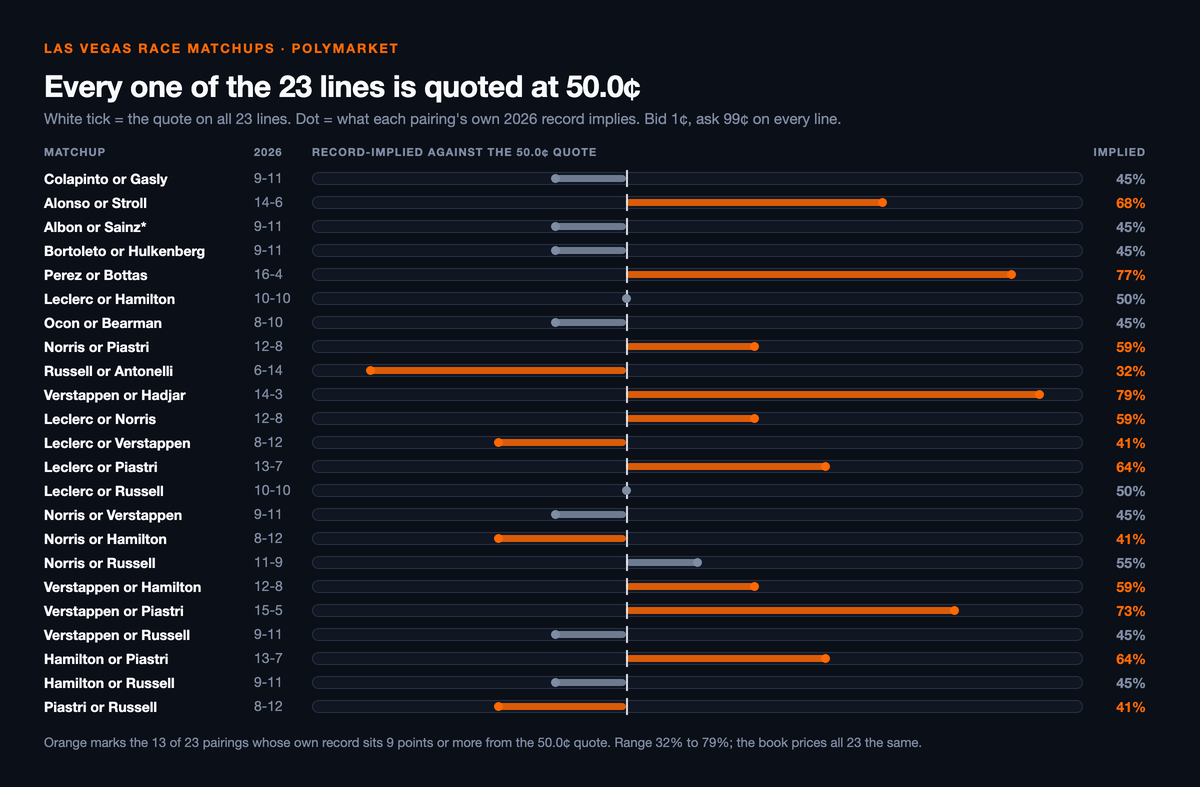
* The book labels that one ’Albon or Jr.’ — its name parser took Carlos Sainz Jr.’s surname and kept the suffix. It is the clearest sign these lines were generated rather than priced.
Two lines, and only two, are honest at 50–50: Leclerc against Hamilton is 10–10 and Leclerc against Russell is 10–10. For 13 of the rest the record is 60/40 or wider. A market pricing Verstappen against Hadjar the same as Leclerc against Hamilton is not expressing a view — it is showing you the number it was initialised with. A 50–50 quote on an empty book is not a probability; it is the midpoint between a 1¢ bid and a 99¢ ask.
The book has taken exactly $95.96 in its life, all of it in one order at 14:34 UTC on 10 November: a buy of Bearman over Ocon at 99¢. That is not a punt on Oliver Bearman’s pace. Ocon has not started since round 18 at Austin — Haas ran Ryo Hirakawa in Mexico City and Rafael Camara in Brazil — and a driver who does not start completes fewer laps than one who does. Someone is buying a near-certainty and collecting the last cent, and the identical trade sits in the Mexico City book ($95.99 on 31 October) and the Brazil book (three orders, 3–4 November).
What that says about the other 22 lines matters more than the trade. The only participant with a view found the line that required no view at all. These quotes are not wrong because the market disagrees with the records — they are wrong because nobody has looked. The same pattern runs through the podium book, where 13 of 23 lines quoted one side only.
The teammate records the book ignores
Teammate matchups are the comparison bookmakers price most often, because the two drivers share a car and most of the noise cancels. Here is where all eleven pairings stand after 20 of 23 rounds, counted only over races both drivers started.
| Team | Pairing | Points | Race record | Share | Championship gap |
|---|---|---|---|---|---|
| Mercedes | Antonelli v Russell | 390–262 | 14–6 | 70% | Settled |
| Red Bull | Verstappen v Hadjar | 279–122 | 14–3 | 82% | Settled |
| Ferrari | Hamilton v Leclerc | 261–249 | 10–10 | 50% | 12 pts |
| McLaren | Norris v Piastri | 246–152 | 12–8 | 60% | Settled |
| RB | Lawson v Lindblad | 89–38 | 13–4 | 76% | 51 pts |
| Alpine | Gasly v Colapinto | 42–27 | 11–9 | 55% | 15 pts |
| Haas | Bearman v Ocon | 23–7 | 10–8 | 56% | 16 pts |
| Audi | Hülkenberg v Bortoleto | 14–14 | 11–9 | 55% | Level |
| Williams | Sainz v Albon | 7–5 | 11–9 | 55% | 2 pts |
| Aston Martin | Alonso v Stroll | 7–0 | 14–6 | 70% | 7 pts |
| Cadillac | Pérez v Bottas | 0–0 | 16–4 | 80% | Level |
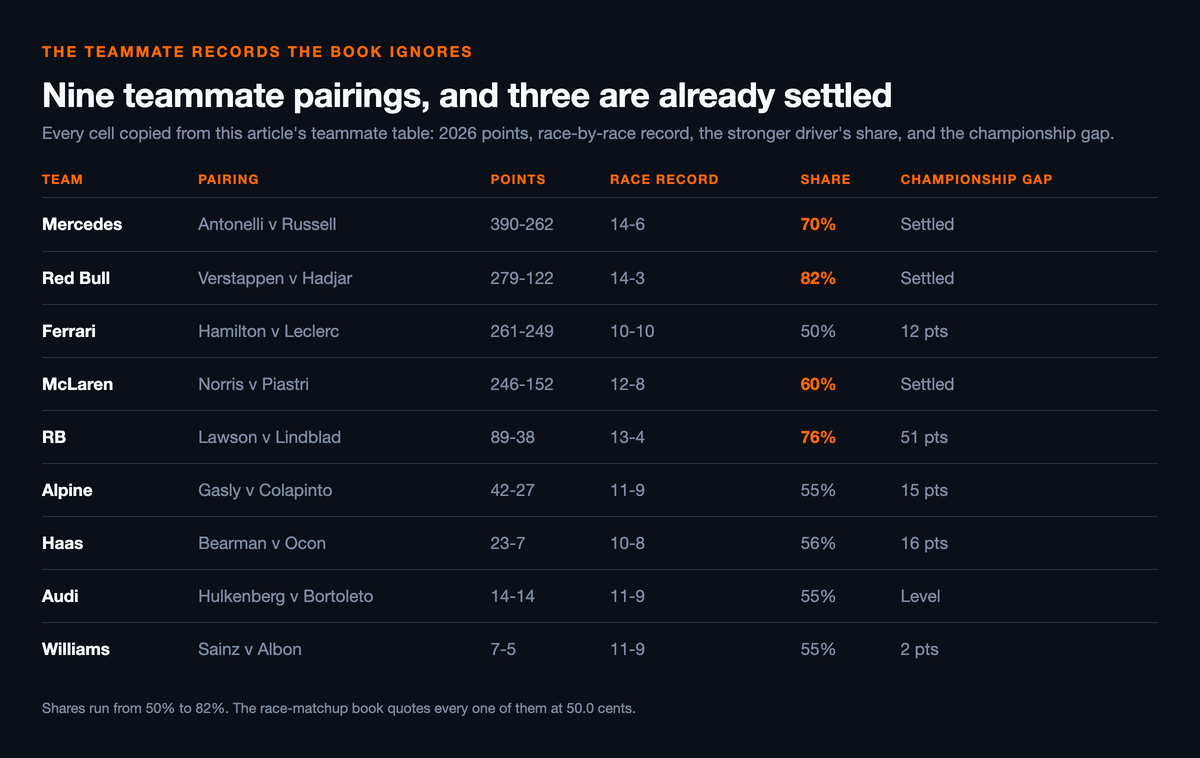
Three matchups are already over: Antonelli leads Russell by 128, Verstappen leads Hadjar by 157 and Norris leads Piastri by 94, while the most any driver can still score is 75 points — 25 a race, with no sprint and no fastest-lap point left in the 2026 rules. A price on those is not an opportunity, it is a dead market.
The useful rows are where the record and the table disagree. Hülkenberg has out-finished Bortoleto 11–9 and they are dead level on 14 points. Sainz has out-finished Albon 11–9 and leads him by two. Pérez has beaten Bottas 16–4 in a Cadillac that has scored nothing at all — a real matchup with no championship consequence whatever.
Ferrari shows why the two are different bets. The race record is 10–10 and Hamilton still leads by 12 points, because a matchup counts finishes while the championship weights them: Hamilton has three thirds to Leclerc’s two, Leclerc has seven fourths to Hamilton’s four, and on Sundays alone Hamilton is 234–215 ahead — the six sprints gave Leclerc seven points of that back, which is why the gap reads 12 rather than 19. Bet the version you actually have an opinion about.
The book emptied with the title race
These books have not always been empty. Polymarket ran one at almost every round of 2026, and across the first fourteen they took $112,729 — $23,897 at Japan, $14,856 at Monaco, $14,095 at the Spanish Grand Prix. Then the championship stopped being a question: Antonelli clinched at Mexico City on 1 November, and Mercedes had the constructors’ title long before, leading Ferrari by 142 with 129 available.
| Round | Race | Book volume | Lines | Lines traded |
|---|---|---|---|---|
| 15 | Azerbaijan | $2,498.04 | 23 | 23 |
| 16 | Bahrain (in Malaysia) | $1,417.76 | 23 | 23 |
| 17 | Singapore | $199.84 | 23 | 9 |
| 18 | United States | $289.00 | 23 | 7 |
| 19 | Mexico City | $182.88 | 23 | 5 |
| 20 | Brazil | $95.99 | 23 | 1 |
| 21 | Las Vegas | $95.96 | 23 | 1 |
| 22 | Qatar | $0.00 | 23 | 0 |
| 23 | Abu Dhabi | $0.00 | 22 | 0 |
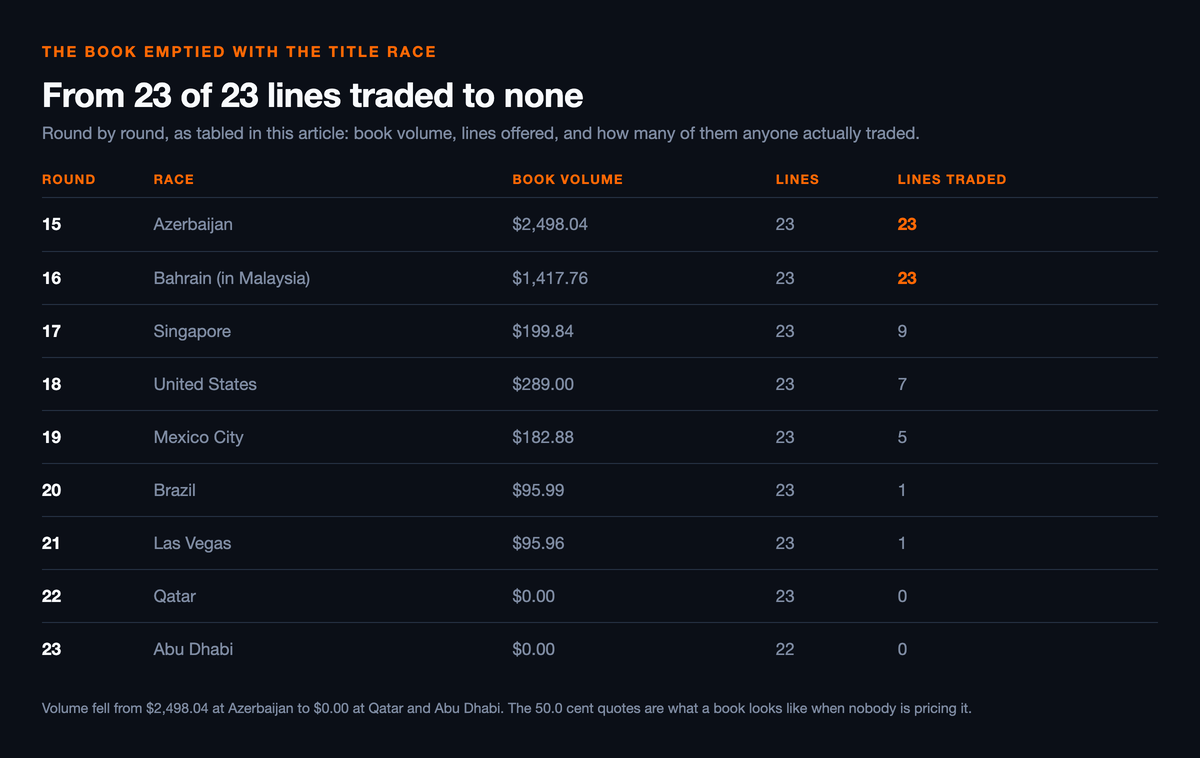
The money did not leave F1: the constructors’ champion market still shows $29.3 million traded. It left the books whose outcome stopped mattering to a title race, and the matchup book went first because it was never the reason anyone showed up. That is the honest frame for everything above — this is not a market that is wrong, it is a market abandoned mid-season, and that also caps what the mispricing can be worth.
Season-long matchups settle on countback
A season-long matchup asks who finishes higher in the final standings, which sounds like a question about points until two drivers end on the same number. Then it becomes a question about Article A2.1.4(c) of the 2026 FIA general regulatory provisions, worth quoting because no page ranking for this query does: the higher place goes to ’the holder of the greatest number of first places in a race’, then second places, then thirds, ’and so on until a winner emerges’.
Two things follow. It is a countback over every finishing position, not just the podium, so an eighth place can separate two drivers who never saw the top ten. And the 2026 rules add a step the 2025 book lacked: if races cannot separate them, the same test runs on the season’s qualifying results, where the old wording handed the decision to the FIA. Three of this season’s matchups are close enough for it to bite.
| Matchup | Points | First deciding count | Holds the tiebreak |
|---|---|---|---|
| Hülkenberg v Bortoleto | 14–14 | Eighth places: 2 v 3 | Bortoleto |
| Ocon v Alonso v Sainz | 7–7–7 | Eighths 1–1–0; Ocon and Alonso level to tenth, then elevenths 2–0 | Ocon, then Alonso |
| Russell v Hamilton | 262–261 | Wins: 3 v 1 | Russell |
Audi is the purest case: level on 14, Hülkenberg 11–9 ahead on the road, and Bortoleto holding the championship place on three eighth places to two. If neither scores again — 21.4% of my trials — Bortoleto wins a bet the head-to-head record says he loses. Note which way chaos cuts here: a race stopped before 25% distance pays a maximum of six points under Article A2.2.1, so a wet, red-flagged Las Vegas makes a level finish more likely, and a level finish favours whoever already holds the countback.
Russell against Hamilton is the same rule with real pedigree attached: one point apart in the fight for third, Russell three wins to Hamilton’s one, and my simulation at 51.0%. Polymarket does not quote it; renormalising their two lines in the third-place market implies 60.2% for Russell, a wider margin than the evidence supports.
Sainz against Alonso: the one priced matchup
One season-long head-to-head carries a real price, and it is the hardest of the three: will Carlos Sainz finish ahead of Fernando Alonso in the final standings. Both are on seven points. The market has taken $5,850 since late August and holds $162 of liquidity.
I priced it two ways, because one model is an opinion and two are a range. The own-form run resamples each driver’s twenty actual 2026 race scores; the field-rate run draws both from the same pool of 280 results scored by every non-top-four car this season, which is the fairer test if you think a wet night could put anyone in the points.
| Estimate | Sainz ahead | Level on points | Notes |
|---|---|---|---|
| Polymarket mid | 23.5¢ | — | bid 8¢, ask 39¢ — a 31-point spread |
| Own-form model | 35.4% | 36.6% | each driver’s own 2026 scores |
| Field-rate model | 38.4% | 23.0% | both drawn from the midfield pool |
| Ties resolve to | Alonso — one eighth place in Malaysia against Sainz’s best of ninth | ||
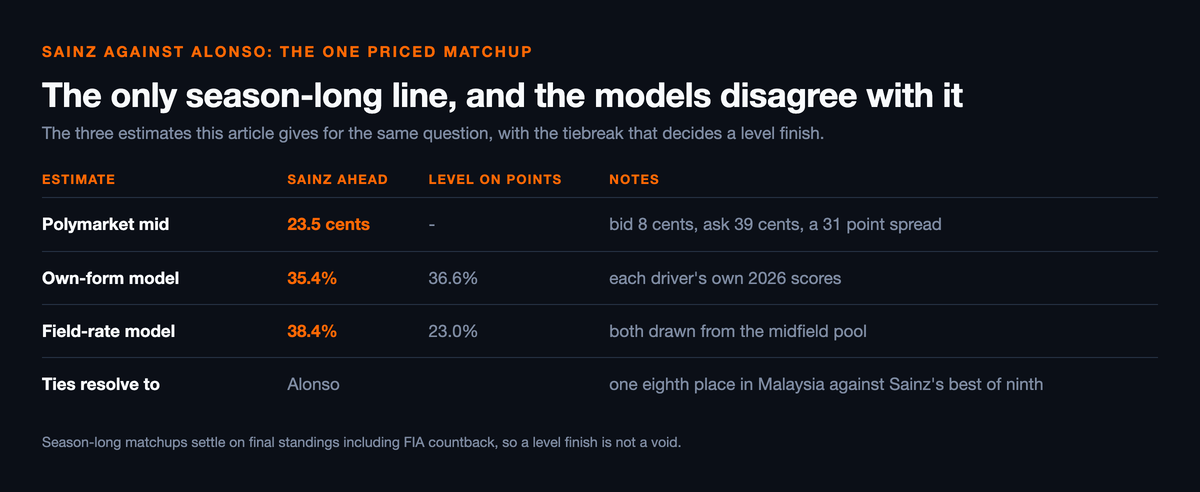
Both models land 12 to 15 points above the quoted midpoint, and both agree on why: this is barely a bet about points. 31.4% of own-form seasons end with neither driver scoring again and 36.6% end dead level, at which point the countback hands the place to Alonso. Sainz does not need to beat Alonso on the road — he needs to score, and Williams has put him in the points four times in twenty races.
So is 23.5¢ a buy? Look at the quote, not the midpoint. You can bid 8¢ and nobody must sell; the only offer is 39¢, above both estimates. The disagreement I can measure sits entirely inside the spread, which is the standard outcome in a thin book and why the expected-value page starts from the price you can transact at.
How I price a head-to-head in five checks
- Read the settlement clause before the price. Race or season-long? Does a retirement void, lose, or pay half? On Polymarket a DNF loses if the other driver completed more laps, and a season-long line settles on the FIA’s final classification including tiebreakers.
- Count the record over shared starts only. Verstappen against Hadjar is 14–3 in the seventeen races both started, not in twenty. Add one notional win and one loss before converting to a percentage: 79%, not 82%.
- Check the matchup is still alive. Three of eleven teammate pairings cannot change with 75 points left.
- Find the tiebreak holder when the gap is under ten points. Countback runs first places, then seconds, then thirds, all the way down, and it decides every level battle on this page. Nobody prices it.
- Price the spread before the edge. A 1¢ bid against a 99¢ ask with $1.92 behind it is not a market you can beat, only one you can be filled in by accident.
The live odds board and the drivers’ championship page refresh on their own, so you can re-run checks two to four against current numbers rather than trusting this table next week; the points calculator handles the arithmetic for any finishing combination. This site earns a commission if you sign up through its Polymarket button, disclosed in the footer on every page.
Sources and method
Market data: the nine 2026 head-to-head books from Azerbaijan to Abu Dhabi, the Sainz-Alonso season matchup and the drivers’ second- and third-place markets, pulled from the Polymarket Gamma API at 16:19 UTC on 11 November 2026 and read line by line. Trade detail comes from the Polymarket data API filtered by condition ID, which is how a $95.96 book volume resolves into one order at 99¢. Quotes are best bid and best ask; the quote column is the API’s midpoint.
Results: all 440 classified finishes of the season from the Jolpica F1 API, cross-checked against the official Formula 1 drivers’ classification. Rules: Articles A2.1.4(c) and A2.2.1 of the 2026 general regulatory provisions, Issue 02 — the 2026 scale carries no fastest-lap point, which is why 25 is a race maximum and 75 covers the three rounds left.
The model: each driver’s twenty 2026 race scores resampled three times, 200,000 trials, fixed seed, ties assigned to today’s countback leader. Three limitations. The draws are independent, so the model understates how often teammates swap places in one race. Resampling cannot invent a result better than a driver’s own 2026 best, which is why the field-rate variant exists. And a strong finish in the last three races would rewrite a countback this model freezes. Odds are implied probabilities, not predictions, and every price here will have moved by the time you read it.
Related reading
- F1 2026 final standings odds — the four finishing-position books, and a 705% total
- F1 runner-up odds 2026 — the second-place market Verstappen leads from third on the road
- F1 podium odds 2026 — why a fair top-three book sums to 300%
- Polymarket vs sportsbook F1 odds — comparing cents and fractional prices without fooling yourself
- F1 points calculator 2026 — what every finishing combination is still worth
- Las Vegas Grand Prix odds 2026 — the next race, and the book that carries the money