
The 2026 drivers’ title is gone. Polymarket has Kimi Antonelli at 97.6c on a market that has traded $204.4 million, and the standings agree: 340 points, 102 clear, six races left. Every page still writing about the championship is writing about a formality. F1 runner-up odds for 2026 are the live question now, and the book that prices them opened underneath it four days ago.
On 13 October at 19:31Z Polymarket created a market on who finishes second in the 2026 drivers’ championship, followed ninety seconds later by a third-place book and, the next afternoon, by fourth and fifth. I read all four from the Gamma API at 21:06Z on 17 October 2026, alongside the standings from the Jolpica F1 feed after round 17 in Singapore. Every number below comes from those two reads.
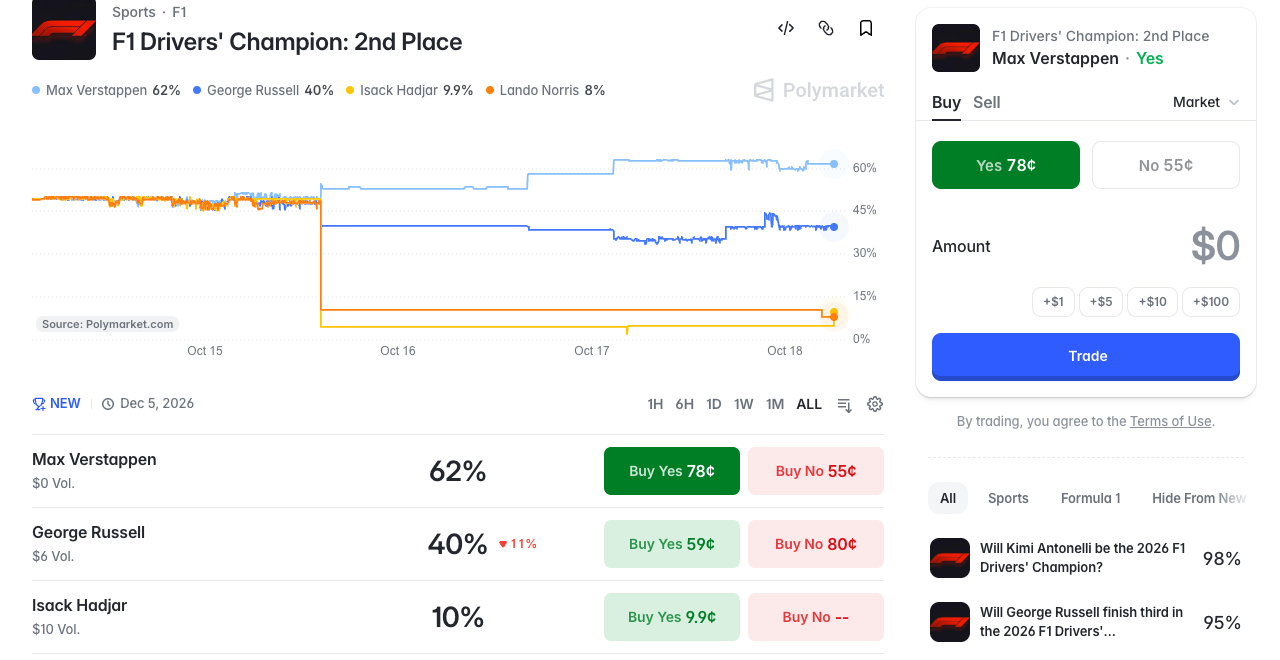
The finding is odd enough to be worth the page. The second-place market makes Max Verstappen the 61.5c favourite — from fourth in the standings, 17 points behind George Russell. Russell, who actually holds the position, trades at 40c. Lewis Hamilton, who is nine points off it, trades at 5c, the same price as a driver 141 points adrift. Three of the four new books have never been touched at all.
Key takeaways
- Polymarket opened four placing markets on 13–14 October — 2nd, 3rd, 4th and 5th in the drivers’ championship. Combined volume across all four is $411.35.
- Only the second-place book has a real price in it. Strip the six empty placeholder slots and it sums to 132.0%; the third, fourth and fifth books sum to 344.7%, 382.3% and 376.0% — untouched seed values.
- Verstappen is the 61.5c favourite for P2 from fourth place. He has outscored Russell 101 to 70 over the last six races, and at those rates finishes on 322 to Russell’s 308 — while the season-long rates say the opposite, Russell 322 and Verstappen 299. The market is a bet on which sample window you trust.
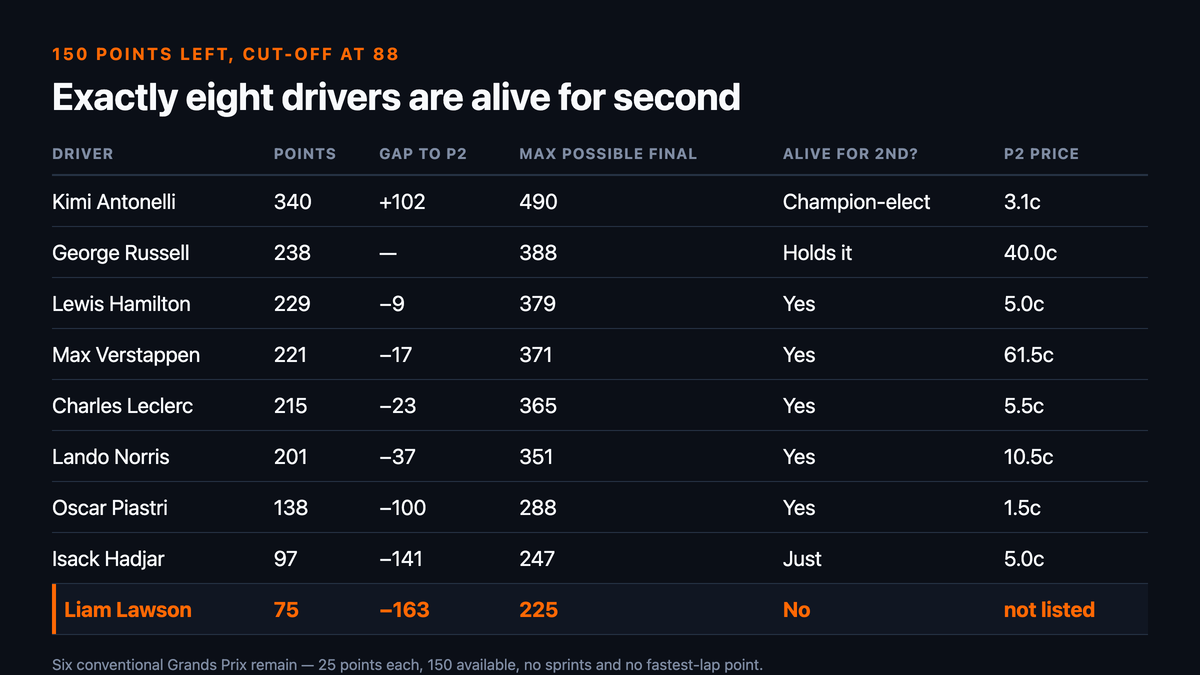
- Exactly eight drivers are mathematically alive for second. The 150 points still available put the cut-off at 88, and Polymarket seeded precisely those eight names.
- The constructors’ runner-up fight has no market at all — McLaren lead Red Bull by seven points with 258 team points left, and it cannot be traded.
The Runner-Up Book Opened on 13 October
Polymarket’s drivers’ championship market has been open since 8 December 2025 and has taken $204.4 million, one of the largest sports books the platform runs. It is also settled in all but name: Antonelli’s yes side trades 97.5c–97.7c, a two-tick spread on $61,388 of resting liquidity. There is no trade left in it.
So the platform did the obvious thing and opened the places behind it. Here is every one of the four new books, with the timestamp it was created and what has actually gone through it.
| Market | Created (UTC) | Real drivers | Raw book sums to | Traded | Resting liquidity |
|---|---|---|---|---|---|
| Drivers’ Champion | 2025-12-08 22:58 | 22 | 99.8% | $204,418,071 | $1,916,534 |
| 2nd Place | 2026-10-13 19:31 | 8 | 432.0% | $57.35 | $16,912 |
| 3rd Place | 2026-10-13 19:32 | 8 | 644.7% | $39.16 | $178 |
| 4th Place | 2026-10-14 15:29 | 8 | 682.3% | $255.04 | $48 |
| 5th Place | 2026-10-14 15:30 | 8 | 676.0% | $59.80 | $88 |
Two numbers in that table do the work. The champion book sums to 99.8%, which is what a probability distribution looks like when millions of dollars have argued it into shape. The four placing books sum to between 432% and 682%, which is what a template looks like before anyone has touched it.
The other tell is the liquidity column. The second-place book has $16,912 of resting orders against $57.35 traded — makers have quoted it and almost nobody has crossed the spread. Third, fourth and fifth have double-digit liquidity: nobody is quoting those at all. One of these four markets is a forecast in progress. Three are furniture.
Verstappen Is Favourite for Second From Fourth
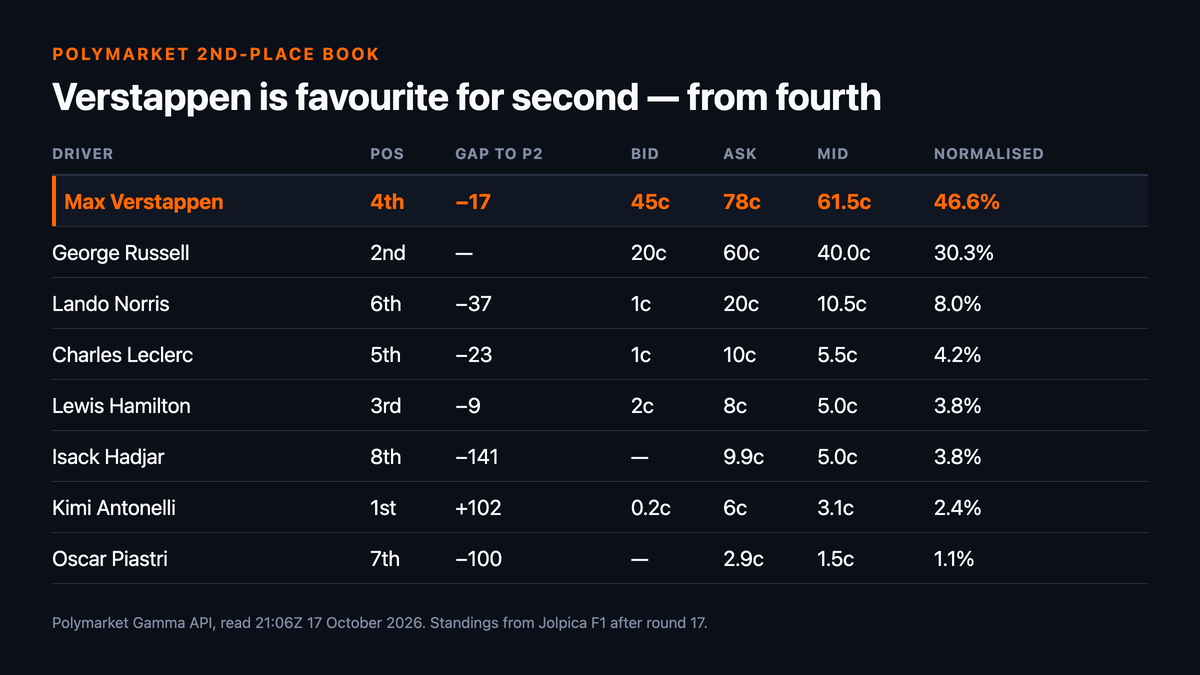
The second-place book is the one worth reading, so read it properly — bid and ask, not the midpoint the front end shows you. Here is the full quote for every real driver in it, next to where that driver actually sits in the standings.
| Driver | Championship pos | Points gap to P2 | Bid | Ask | Mid | Normalised | Resting liquidity |
|---|---|---|---|---|---|---|---|
| Max Verstappen | 4th | −17 | 45c | 78c | 61.5c | 46.6% | $748 |
| George Russell | 2nd | — | 20c | 60c | 40.0c | 30.3% | $653 |
| Lando Norris | 6th | −37 | 1c | 20c | 10.5c | 8.0% | $2,467 |
| Charles Leclerc | 5th | −23 | 1c | 10c | 5.5c | 4.2% | $2,515 |
| Lewis Hamilton | 3rd | −9 | 2c | 8c | 5.0c | 3.8% | $2,347 |
| Isack Hadjar | 8th | −141 | — | 9.9c | 5.0c | 3.8% | $3,618 |
| Kimi Antonelli | 1st | +102 | 0.2c | 6c | 3.1c | 2.4% | $916 |
| Oscar Piastri | 7th | −100 | — | 2.9c | 1.5c | 1.1% | $3,713 |
The standings column and the price column disagree almost everywhere, and the biggest disagreement is the headline. Verstappen is fourth, 17 points behind Russell, and the market makes him close to a coin-flip favourite to finish ahead of him. Normalise the real outcomes and he is 46.6% against Russell’s 30.3% — a 16-point edge for the man in the worse position.
That is not a mistake, and the next two sections are why. But note what kind of number it is. Verstappen’s quote is 45c–78c, a 33-cent spread, on $748 of depth; Russell’s is 20c–60c. These are opinions with enormous error bars, not prices you could move size through. The direction is informative; the precision is not.
Why a 432% Book Is Really a 132% Book
A book summing to 432% looks broken, and the first instinct is to write the whole market off. That instinct is wrong here, and the reason is mechanical rather than interesting.
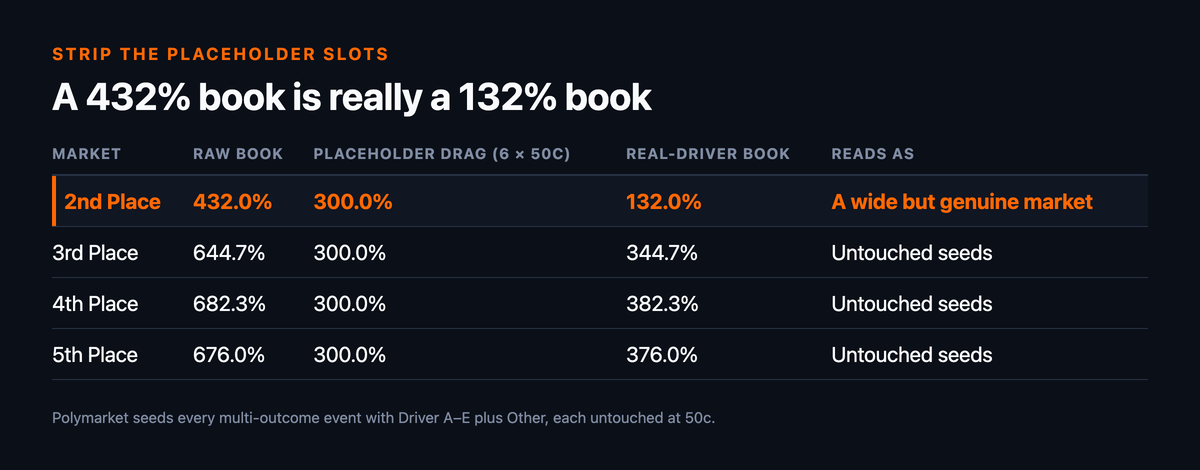
Polymarket seeds every multi-outcome event with spare slots — Driver A through Driver E, plus Other — so that a name can be added mid-season without rebuilding the market. In the placing books those six slots sit at 50c each, untouched, because nobody has quoted them. Six times fifty cents is exactly 300 percentage points of pure overround that has nothing to do with any driver.
| Market | Raw book | Placeholder drag (6 × 50c) | Real-driver book | Reads as |
|---|---|---|---|---|
| 2nd Place | 432.0% | 300.0% | 132.0% | A wide but genuine market |
| 3rd Place | 644.7% | 300.0% | 344.7% | Untouched seeds |
| 4th Place | 682.3% | 300.0% | 382.3% | Untouched seeds |
| 5th Place | 676.0% | 300.0% | 376.0% | Untouched seeds |
Subtract the furniture and the second-place book sums to 132.0%. That is still a 32-point overround — wide by sportsbook standards, roughly what you would expect from a four-day-old market with $57 through it — but it is recognisably a distribution. Somebody has sat down and formed a view.
The other three are not. In the third-place book, six of the eight real drivers are quoted between 43c and 52c — including Antonelli at 43.2c to finish third while trading at 97.6c to win the title outright. In the fourth-place book, six of eight sit within two cents of 48c. Those are seed values, not prices. Check the book sum before you read a price on a new Polymarket market, and strip the placeholder slots before you judge it.
The Points Say Russell. The Form Says Verstappen.
Here is the case for a 61.5c Verstappen, and it is better than the standings make it look. Verstappen took pole in Singapore, won the sprint while Russell crashed out of the lead, then won the Grand Prix; a week earlier he took Red Bull’s first win of the year in Malaysia while Russell retired with a power-unit failure.
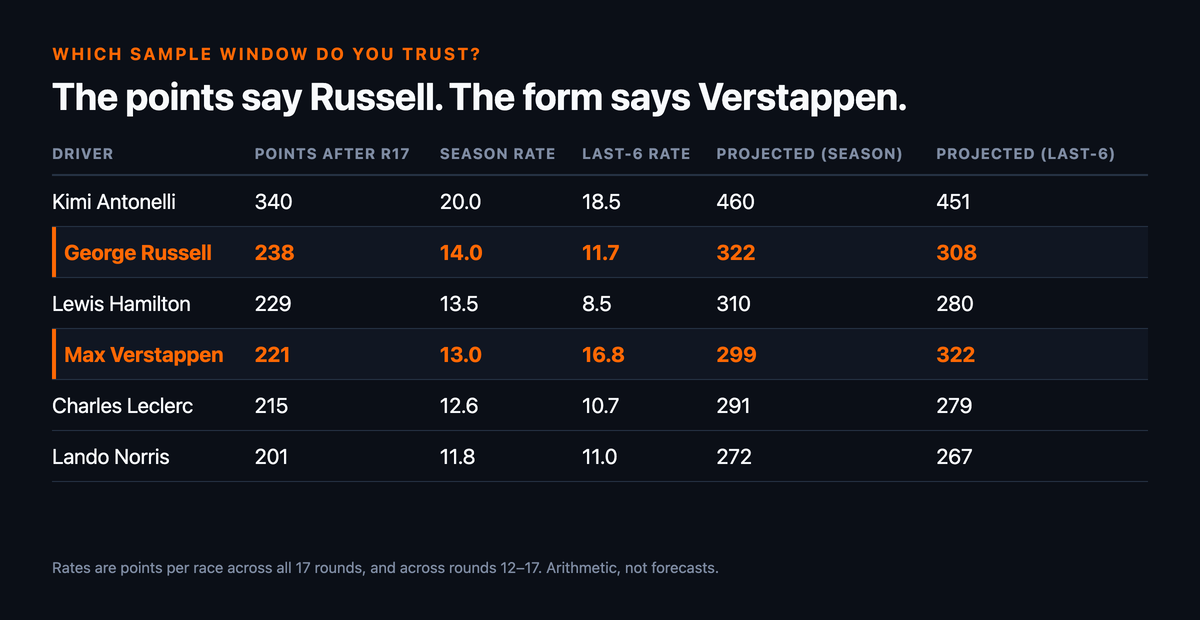
Put numbers on it. Across the last six rounds — Zandvoort, Monza, Madrid, Baku, Sepang and Marina Bay — Verstappen has scored 101 points to Russell’s 70. Only Antonelli, on 111, has scored more. Project both rates forward over the six remaining races and the order flips.
| Driver | Points after R17 | Season rate (per race) | Last-6 rate | Projected final (season rate) | Projected final (last-6 rate) |
|---|---|---|---|---|---|
| Kimi Antonelli | 340 | 20.0 | 18.5 | 460 | 451 |
| George Russell | 238 | 14.0 | 11.7 | 322 | 308 |
| Lewis Hamilton | 229 | 13.5 | 8.5 | 310 | 280 |
| Max Verstappen | 221 | 13.0 | 16.8 | 299 | 322 |
| Charles Leclerc | 215 | 12.6 | 10.7 | 291 | 279 |
| Lando Norris | 201 | 11.8 | 11.0 | 272 | 267 |
Read the last two columns against each other, because that is the entire bet. On season-long form Russell finishes second on 322 and Verstappen fourth on 299. On six-race form Verstappen finishes second on 322 and Russell third on 308. The same two drivers, the same six races to come, a 23-point gap that swings 37 points depending on which window you fit to.
A straight-line projection is the crudest tool there is and neither column will be right. But the market has chosen a side: 46.6% against 30.3% is roughly where you land if you weight the recent window heavily, then discount it because six races is a small sample containing one Russell crash and one Russell engine failure. Our F1 points calculator lets you run the remaining rounds yourself.
What would settle it quickly is Austin. If Verstappen beats Russell again at the next race, the last-six window stops being a window and starts being the season.
What Russell’s Engine Problem Actually Costs Him
There is a specific, non-speculative reason the market discounts the man in second place, and it is written on his power unit.
Russell’s engine failed late in Malaysia on 4 October. Mercedes replaced it in Singapore, which took him past his season allocation, and he started the Grand Prix from the back of the grid. He recovered to ninth and two points — from a weekend where he had been quick enough to lead the sprint. The BBC reported on 8 October that Russell expects to take a further grid penalty before the season ends, on top of the Singapore one. Where it falls has not been confirmed, and reports differ on the detail, so treat the timing as open.
Why one more penalty matters more than it sounds
- Russell’s margin over Verstappen is 17 points. A back-of-the-grid start at a circuit where overtaking is hard is worth something close to a whole race of that margin.
- Singapore already cost him. He led the sprint and scored two points on Sunday. On his season rate that weekend was worth roughly 14.
- The remaining calendar is unforgiving. Three of the six are street or semi-street circuits, where a grid drop is hardest to recover from, and nobody knows which one it lands on.
None of this is in the standings, which is exactly the point of reading a market alongside them. The table says Russell leads by 17. The book says the 17 is worth less than it looks.
Hamilton Is Second-Nearest and Eighth-Favourite
The sharpest oddity in the book is not Verstappen. It is Lewis Hamilton, who sits third in the championship, nine points off second, and trades at 5c — a normalised 3.8%, behind Norris and Leclerc, both of whom are further back than he is.
Part of that is form, and the form is bad: 51 points in the last six races, the worst of the six title-adjacent drivers. Project his last-six rate forward and Hamilton finishes on 280, behind both Russell and Verstappen. The market is not being eccentric.
What it is being is careless, and here is the proof. Hamilton’s 5.0c mid is the same price as Isack Hadjar’s 5.0c. Hadjar is eighth, on 97 points, 141 behind second place. He has never finished on a podium this season. The two quotes are not the same kind of object — Hamilton has a two-sided 2c–8c market on $2,347 of depth, while Hadjar has an ask at 9.9c, no bid at all, and a seeded midpoint — but the front page shows you two drivers at five cents, and only one of them is a real five cents.
That is the practical lesson of this whole book. A midpoint with no bid underneath it is not a price. Four of the eight quotes in the second-place market have a bid of 1c or less or no bid at all; those four are not telling you anything. The four that are — Verstappen, Russell, Hamilton and Leclerc — are where the actual opinion lives.
Who Is Still Mathematically Alive for Second
Six races remain, and this is the number that governs everything above: all six are conventional Grands Prix. The 2026 season’s five sprints were rounds 2, 4, 5, 9 and 12 — China, Miami, Canada, Britain and the Netherlands — and they are all gone. Across all seventeen rounds so far, exactly 101 points have been awarded to exactly ten scorers every single time, so there is no fastest-lap bonus in play either.
Twenty-five points per race, six races: 150 points available, and not one more. Anyone who cannot reach Russell’s 238 is out of the running for second, which puts the cut-off at 88 points.
| Driver | Points | Gap to P2 | Max possible final | Alive for 2nd? | P2 price |
|---|---|---|---|---|---|
| Kimi Antonelli | 340 | +102 | 490 | Champion-elect | 3.1c |
| George Russell | 238 | — | 388 | Holds it | 40.0c |
| Lewis Hamilton | 229 | −9 | 379 | Yes | 5.0c |
| Max Verstappen | 221 | −17 | 371 | Yes | 61.5c |
| Charles Leclerc | 215 | −23 | 365 | Yes | 5.5c |
| Lando Norris | 201 | −37 | 351 | Yes | 10.5c |
| Oscar Piastri | 138 | −100 | 288 | Yes | 1.5c |
| Isack Hadjar | 97 | −141 | 247 | Just | 5.0c |
| Liam Lawson | 75 | −163 | 225 | No | not listed |
Eight drivers clear 88 points. Liam Lawson, on 75, is the first name that cannot reach second place even by winning all six remaining races while Russell scores nothing. And Polymarket’s second-place book lists exactly those eight drivers and no others.
That tells you what kind of error the rest of the book is. Whoever built this market got the outcome list mathematically right to the point — one driver either side of the cut-off — then left the prices on seed values. The structure is careful; the pricing has not happened yet. This is a market waiting for traders, not one that disagrees with you.
For the title itself the maths runs the other way and is nearly done. Antonelli clinches at Austin if he wins while Russell finishes tenth or lower and Hamilton no better than fifth; failing that, in Mexico City provided he loses no more than one point net to Russell. Our Antonelli clinch tracker and the full title race scenarios carry those round by round.
The Constructors’ Runner-Up Fight Has No Market
The same thing has happened one championship over, except Polymarket has not noticed yet.
Mercedes are 99.05c to win the constructors’ title on $29.2 million of volume, and that book sums to a healthy 100.2%. It is over: they lead Ferrari by 134 points. But look at what is live behind them, with 258 team points still available across six races.
| Pos | Constructor | Points | Gap ahead | Wins | Polymarket title price | Market on this position? |
|---|---|---|---|---|---|---|
| 1 | Mercedes | 578 | — | 11 | 99.05c | Yes — $29.2m |
| 2 | Ferrari | 444 | −134 | 2 | 0.90c | None |
| 3 | McLaren | 339 | −105 | 2 | 0.15c | None |
| 4 | Red Bull | 332 | −7 | 2 | 0.10c | None |
Seven points separate McLaren and Red Bull with 258 on the table. That is the closest live fight anywhere in either championship, it carries real prize money, and there is no way to trade it: the platform opened four placing markets for drivers this week and zero for constructors. Red Bull’s two wins in the last two rounds make it the more interesting of the positions nobody can price.
If you want to follow it, the constructors’ championship page tracks the points and the title market side by side, and the constructors’ odds explainer covers how that market resolves.
How I Would Use These Markets
A new market with a 32% overround and $57 of volume is not an opportunity because it is new. It is mostly a hazard. But there are honest ways to read what opened this week.
What I would actually do before Austin on 25 October
- Treat the second-place book as a sentiment reading, not a price. 46.6% Verstappen against 30.3% Russell tells you the market has sided with six-race form over season-long form. That is useful information even if the 33-cent spread makes it untradeable.
- Ignore the third, fourth and fifth books entirely for now. Six of eight quotes clustered within a few cents of 50c is a template, and crossing a 90-cent spread to trade one is just donating.
- Watch the bid, not the mid. Hamilton at 5c with a 2c bid and Hadjar at 5c with no bid are not the same bet. Four of the eight quotes have no meaningful bid at all.
- Let Austin resolve the sample-window argument, and expect the volume to arrive late. The second-place market already has $16,912 of resting liquidity against $57 traded: makers are there, takers are not, and that usually reverses once the title is formally clinched.
The championship market itself remains the only one of the six discussed here that is genuinely priced. Our live odds board tracks it against the standings as it moves, and the drivers’ championship page carries the full field.
Sources and Method
All Polymarket figures were read from the Gamma API at 21:06Z on 17 October 2026, by event slug, for six events: both championship markets and the four new placing markets. Prices are the outcomePrices yes side; bid and ask are bestBid and bestAsk. The placing markets are public as F1 Drivers’ Champion: 2nd Place and its siblings.
“Raw book” adds the yes price across every outcome. “Real-driver book” excludes the six unnamed placeholder slots — Driver A to Driver E and Other — each sitting at an untouched 50c. Normalised percentages divide each real driver’s mid by the real-driver book sum.
Standings, results, the sprint calendar and the remaining schedule come from the Jolpica F1 API after round 17, and match the official Formula 1 classification. That no fastest-lap point is in play is measured, not assumed: across all seventeen rounds each race awarded exactly 101 points to exactly ten finishers. Projections extrapolate two rates — points per race across all 17 rounds, and across rounds 12 to 17 — and are arithmetic, not forecasts.
Russell’s expected second grid penalty is as the BBC reported it on 8 October 2026; outlets differ on where it falls and nothing is confirmed, so it is flagged as open. Prices move; the timestamp above is what this page was written against.
Related GridOdds analysis
- F1 drivers’ championship odds — the $204m market, read against the standings
- Antonelli title clinch 2026 — the clinch scenarios, round by round
- F1 constructors’ title clinch — when Mercedes can finish the job
- Max Verstappen retirement odds — the other Verstappen market nobody has priced
- Mexico City Grand Prix odds 2026 — the race where the title can be sealed
- F1 on Polymarket — how these markets are built, resolved and settled