Formula 1 took the championship point for the fastest lap away at the end of 2024, and almost nobody told the prediction markets. The books are still there, still listing all 23 drivers, and if you search for F1 fastest lap odds this weekend you will find Esteban Ocon at 44% on Polymarket for the Las Vegas Grand Prix. Ocon has not set a single fastest lap in 18 races this season.
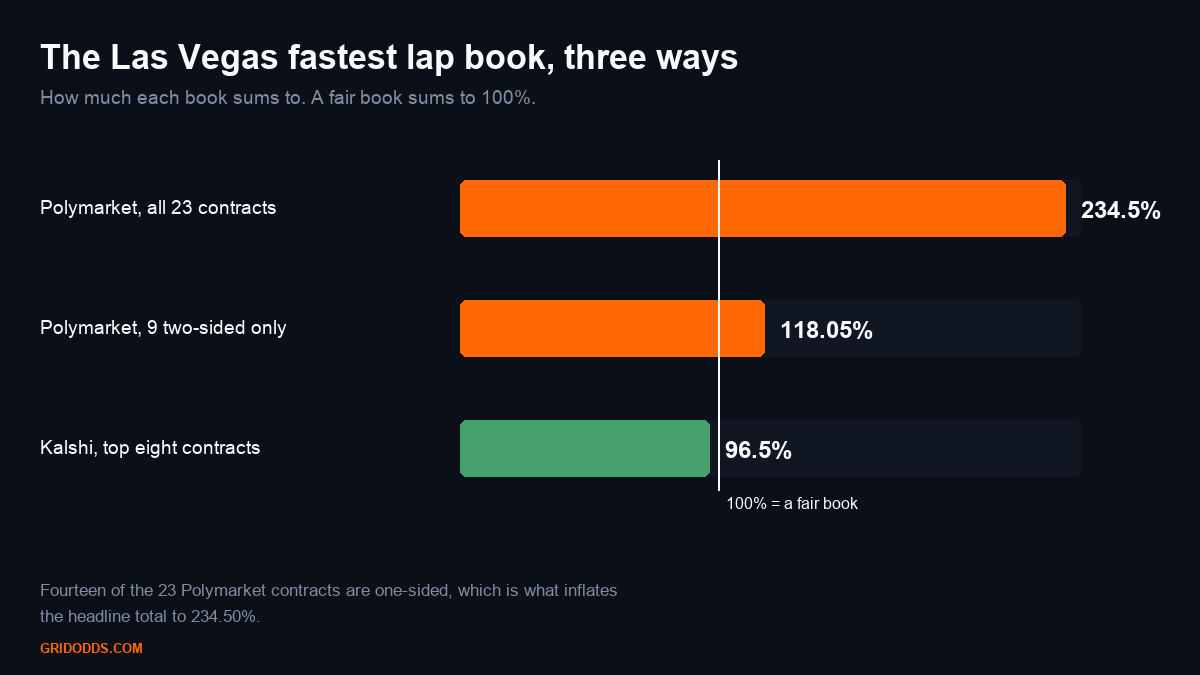
Polymarket's Las Vegas fastest lap book sums to 234.50% across 23 named drivers, on total volume of $810. Its two highest-priced contracts have never traded at all. Meanwhile the race-winner book for the same race, on the same page, sums to 105.45% on $107,765 — so this is not a Polymarket problem, it is a one-market problem, and knowing which kind you are looking at is the whole skill.
I pulled every contract in both venues' Las Vegas fastest lap books from the Polymarket Gamma API and the Kalshi public API, then counted who has actually set all 20 fastest laps of the 2026 season from the Jolpica race feed. Every price below was read on 21 November 2026, about seven hours before the lights go out. The short version: the quoted favourites are an arithmetic artifact, the base rates point at a different driver, and for once the liquid book is the other one.
Key takeaways
- The fastest lap has been worth zero championship points since 2025. The FIA scrapped the bonus in October 2024. Every sportsbook guide still explaining it as a points bonus is five seasons out of date.
- Polymarket's quoted favourites are half of an unanswered ask. Ocon shows 44% because his book is bid nothing, ask 88¢, and the midpoint of nothing and 88¢ is 44¢. Tsunoda's 43.5% is 87¢ the same way. Neither contract has traded once.
- Only four of Polymarket's 23 driver contracts have ever traded, and $594 of the book's $810 total volume sits on Franco Colapinto at 1.7¢.
- Kimi Antonelli has set 8 of the 20 fastest laps this season and been top-three fastest in 17 of 20. Both venues price him second, behind Verstappen on 2.
- Kalshi has the real book here: $15,770 traded against Polymarket's $810, and its eight traded contracts sum to 96.5%. Its headline total of 154% is one untraded reserve driver quoted at 95¢.
- The point is gone, the market is not
- What the Las Vegas fastest lap odds say tonight
- Why two drivers with no fastest laps lead the book
- Who has actually set the 2026 fastest laps
- Kalshi has the liquid book on this one
- Las Vegas settles this in the last four laps
- How to read any fastest lap book in two minutes
- Sources and method
The point is gone, the market is not
The bonus point for the fastest lap arrived in 2019 and came with a catch: you only scored it if you also finished in the top ten. It died at the end of 2024, when the FIA's World Motor Sport Council removed it for the 2025 season. The trigger was Daniel Ricciardo taking the fastest lap at Singapore in 2024 from outside the points, which scored him nothing and denied Lando Norris a point in a title fight.
So the thing you are betting on in 2026 has no championship consequence whatsoever. That matters more than it sounds, because it removes the one force that used to make the market predictable.
| Season | Fastest lap worth | Condition | What it did to incentives |
|---|---|---|---|
| 2019–2024 | 1 point | Must finish in the top 10 | Teams in the points pitted late for a flyer |
| 2025–2026 | 0 points | None | Nobody changes strategy to chase it |
Under the old rule, a team sitting seventh with a free pit stop in hand had a reason to fit softs and go. Now the fastest lap is a by-product of whatever the race was already going to do: a driver on fresh rubber in clean air, late, with nothing to lose. It has become a cleaner read on car pace and a worse read on intent — which is exactly why the base rates below are so lopsided.
The betting markets never adjusted their framing. Every sportsbook explainer I read while researching this still describes the fastest lap as a bonus-point market, and the prediction markets still list it as a headline prop. The market survived the rule that created it.
What the Las Vegas fastest lap odds say tonight
The Las Vegas Grand Prix is round 21, and it starts at 04:00 UTC on 22 November — Saturday night at 20:00 on the Strip. Polymarket's driver fastest lap market carries 29 contracts: 23 named drivers, an "Other", and five placeholder slots labelled Driver A through Driver E that sit at zero.
Here is the whole thing, sorted by the price Polymarket quotes. The mid column is what the site shows you. The bid and ask columns are what is actually behind it.
| Driver | Quoted | Best bid | Best ask | Volume | Last trade |
|---|---|---|---|---|---|
| Esteban Ocon | 44.0% | none | 88¢ | $0 | never |
| Yuki Tsunoda | 43.5% | none | 87¢ | $0 | never |
| Max Verstappen | 37.5% | 22¢ | 53¢ | $42.58 | 38¢ |
| George Russell | 31.0% | 14¢ | 48¢ | $0 | never |
| Kimi Antonelli | 24.5% | 22¢ | 27¢ | $7.55 | 26¢ |
| Lando Norris | 8.5% | 4¢ | 13¢ | $0 | never |
| Isack Hadjar | 5.1% | 2.7¢ | 7.4¢ | $0 | never |
| Arvid Lindblad | 4.9% | none | 9.7¢ | $0 | never |
| Liam Lawson | 4.9% | none | 9.7¢ | $0 | never |
| Charles Leclerc | 4.5% | 3.6¢ | 5.4¢ | $165.96 | 6¢ |
| Nico Hulkenberg | 4.5% | none | 8.9¢ | $0 | never |
| Oliver Bearman | 4.3% | none | 8.6¢ | $0 | never |
| Oscar Piastri | 3.2% | 1¢ | 5.3¢ | $0 | never |
| Lewis Hamilton | 2.7% | 1¢ | 4.3¢ | $0 | never |
| Valtteri Bottas | 2.5% | none | 5¢ | $0 | never |
| Franco Colapinto | 1.2% | 0.4¢ | 2¢ | $593.99 | 1.7¢ |
| Gasly, Alonso | 1.5% each | none | 3¢ | $0 | never |
| Albon, Bortoleto, Perez, Sainz, Stroll | 1.0% each | none | 2¢ | $0 | never |
| Book total | 234.50% | 9 of 23 two-sided | $810.07 | 4 traded | |
Two numbers in that bottom row do the damage. 234.50% means the book is pricing well over two certainties into a race that will produce exactly one fastest lap. And four is how many of the 23 driver contracts have ever changed hands: Verstappen, Antonelli, Leclerc and Colapinto. Everything else is a quote nobody has answered.
The volume distribution is stranger still. Of the $810 traded, $593.99 — 73% of the entire book — is on Colapinto at 1.7¢, a driver with no fastest lap and a best fastest-lap rank of seventh all season. Someone bought a lottery ticket and that lottery ticket is now the most-traded contract in the market.
Why two drivers with no fastest laps lead the book
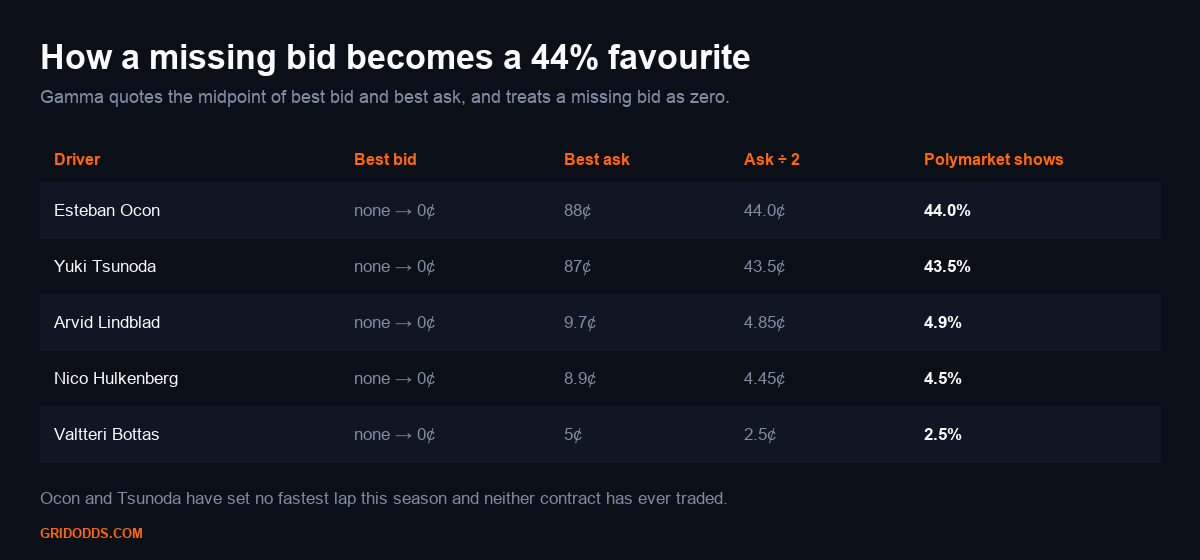
This is not a mystery, and once you see the arithmetic you cannot unsee it. Gamma reports each contract's price as the midpoint of the best bid and the best ask. When there is no bid at all, it treats the bid as zero. So the quoted probability becomes exactly half the ask.
| Driver | Best bid | Best ask | Ask ÷ 2 | Polymarket shows |
|---|---|---|---|---|
| Esteban Ocon | none → 0¢ | 88¢ | 44.0¢ | 44.0% |
| Yuki Tsunoda | none → 0¢ | 87¢ | 43.5¢ | 43.5% |
| Arvid Lindblad | none → 0¢ | 9.7¢ | 4.85¢ | 4.9% |
| Nico Hulkenberg | none → 0¢ | 8.9¢ | 4.45¢ | 4.5% |
| Valtteri Bottas | none → 0¢ | 5¢ | 2.5¢ | 2.5% |
It holds for all 14 one-sided contracts without a single exception. Ocon is the market's "favourite" for one reason: a liquidity provider parked an 88¢ sell order on him and no human has ever bid against it. He is not the favourite, he is the widest unanswered ask in the book.
Filter to the nine contracts that have a bid on both sides and the book drops from 234.50% to 118.05%. That is still fat, but it is recognisably a market. The 116 points of nonsense in between are entirely manufactured by dividing asks by two. I walk through the same overround arithmetic on a cleaner market in our F1 podium odds breakdown, where a fair three-slot book sums to 300% by design.
Third-party aggregators republish these midpoints as probabilities without the filter, and it goes wrong in public. One prediction-market data site called Fernando Alonso the 41.5% favourite for the Miami fastest lap this May. Alonso has not set a fastest lap all season. That market resolved to Lando Norris.
Who has actually set the 2026 fastest laps
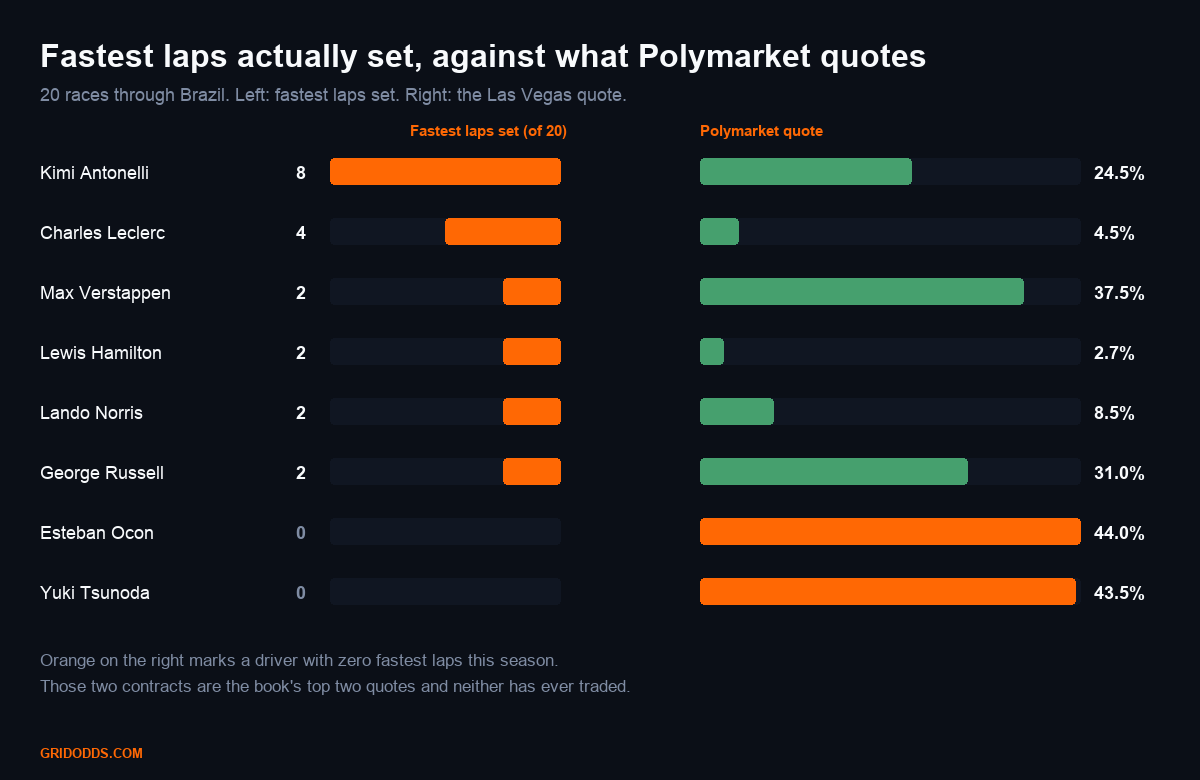
Twenty races have run in 2026, through Brazil on 8 November. Six drivers have set all twenty fastest laps between them. That is the number worth internalising before you look at any fastest lap odds again: in a 23-car field, six drivers account for 100% of the outcomes.
| Driver | Team | Fastest laps | Share of 20 | Top-3 fastest in race | Polymarket quote |
|---|---|---|---|---|---|
| Kimi Antonelli | Mercedes | 8 | 40% | 17 of 20 | 24.5% |
| Charles Leclerc | Ferrari | 4 | 20% | 6 of 20 | 4.5% |
| Max Verstappen | Red Bull | 2 | 10% | 9 of 20 | 37.5% |
| Lewis Hamilton | Ferrari | 2 | 10% | 7 of 20 | 2.7% |
| Lando Norris | McLaren | 2 | 10% | 5 of 20 | 8.5% |
| George Russell | Mercedes | 2 | 10% | 4 of 20 | 31.0% |
| Esteban Ocon | Haas | 0 | 0% | 1 of 18 | 44.0% |
| Yuki Tsunoda | Racing Bulls | 0 | 0% | 0 of 3 | 43.5% |
Antonelli's record is the standout and it is not close. Eight fastest laps, and top-three fastest in 17 of 20 races — he has been within a tenth of the quickest lap of the afternoon almost every weekend of his title year. Leclerc is the second story: four fastest laps, two of them in the last four races, priced at 4.5%.
Verstappen at 37.5% on two fastest laps all season looks rich on the raw tally, and the bulls have a reasonable answer: he is 50.5% to win this race, he won here in 2023 and 2025, and he set the Las Vegas fastest lap himself last year. The market is pricing the car at this circuit, not the season's history.
The rough decomposition is worth doing. Across 2026, the race winner also set the fastest lap in 8 of 20 races, or 40%. Verstappen at 50.5% to win times 40% gives about 20% from the winning path, plus whatever he adds from setting it without winning — which he did once this year, from sixth in Australia. Call it high twenties. Kalshi's 31¢ sits just above that; Polymarket's 37.5¢ sits well above it, and it is a midpoint of a 31-cent-wide spread, so it is not a price anyone is offering.
Ocon and Tsunoda, for completeness: Ocon has been third-fastest once in 18 starts, and Tsunoda has three starts all year with a best fastest-lap rank of twelfth. Together the market makes them 87.5%.
Kalshi has the liquid book on this one
We usually find Polymarket is the deeper venue for F1 — that is the premise of our Polymarket versus sportsbook comparison. On the fastest lap, it is the other way round, by a factor of nineteen.
| Driver | Kalshi bid–ask | Kalshi last | Kalshi volume | Polymarket quote | Polymarket volume |
|---|---|---|---|---|---|
| Max Verstappen | 29–31¢ | 31¢ | $4,032.77 | 37.5% | $42.58 |
| Kimi Antonelli | 23–24¢ | 24¢ | $3,226.41 | 24.5% | $7.55 |
| George Russell | 16–20¢ | 19¢ | $2,762.71 | 31.0% | $0 |
| Lando Norris | 6–9¢ | 11¢ | $2,310.07 | 8.5% | $0 |
| Charles Leclerc | 4–5¢ | 5¢ | $1,011.34 | 4.5% | $165.96 |
| Isack Hadjar | 3–7¢ | 7¢ | $840.92 | 5.1% | $0 |
| Lewis Hamilton | 3–4¢ | 4¢ | $787.52 | 2.7% | $0 |
| Oscar Piastri | 4–5¢ | 5¢ | $280.81 | 3.2% | $0 |
| Those eight | sum 96.5% | — | $15,252 | sum 117.0% | $216 |
Kalshi's eight traded contracts sum to 96.5%. That is a functioning book — slightly under a hundred because the long tail carries the rest, with one-cent spreads at the top. Open interest backs it up: 2,969 contracts on Verstappen, 2,825 on Antonelli.
And Kalshi has the identical defect, just better hidden. Its full 23-contract book sums to 154.00%, and 47.5 of those points are one contract: Ryo Hirakawa, a Haas entry with one race start in 2026, quoted bid 0¢, ask 95¢, zero volume, zero open interest. Strip that single untraded line and the book sums to 106.5%. Same arithmetic, same cause, one driver instead of fourteen.
Where the two venues have both traded, they agree closely: Antonelli 24¢ against 26¢, Leclerc 5¢ against 6¢, Colapinto 1¢ against 1.7¢. The only real disagreement is Verstappen, 31¢ against a 38¢ last trade on $42 of volume. When a $42 trade disagrees with a $4,000 book, the $42 trade is not the signal.
Las Vegas settles this in the last four laps
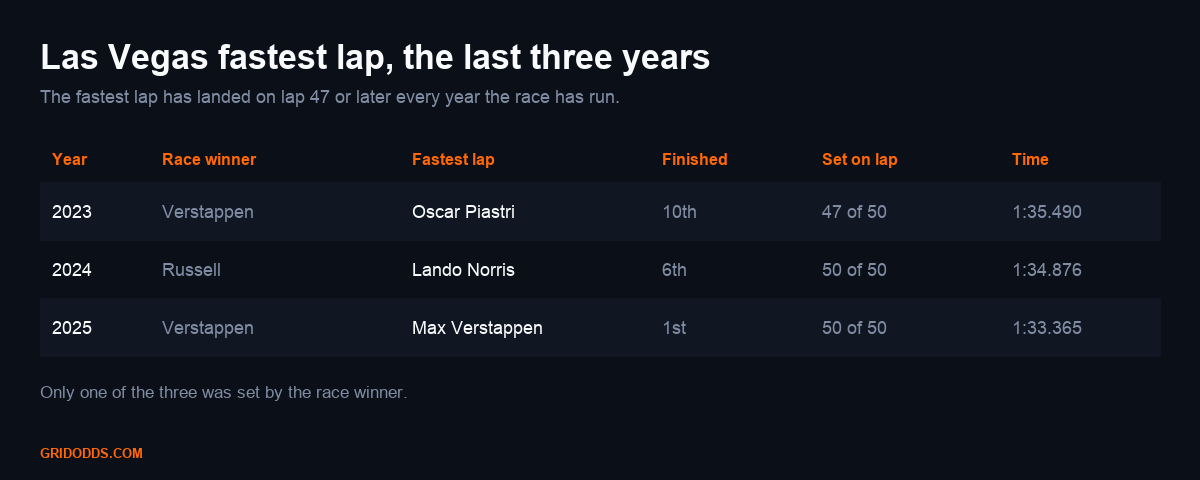
The Las Vegas Strip Street Circuit runs 50 laps, and its fastest lap has been set in the closing stages all three times it has hosted a race. There is no mystery about when this market resolves.
| Year | Race winner | Fastest lap | Finished | Set on lap | Time |
|---|---|---|---|---|---|
| 2023 | Verstappen | Oscar Piastri | 10th | 47 of 50 | 1:35.490 |
| 2024 | Russell | Lando Norris | 6th | 50 of 50 | 1:34.876 |
| 2025 | Verstappen | Max Verstappen | 1st | 50 of 50 | 1:33.365 |
Two of those three came from outside the podium, from drivers with a free stop and nothing to defend. That pattern holds across the season as a whole, and it is the single best argument against simply backing whoever leads the race-winner book.
| 2026 measurement | Result | What it implies |
|---|---|---|
| Fastest lap set in final 20% of distance | 12 of 20 races (60%) | The market is live until the closing laps |
| Fastest lap set on the final lap itself | 4 of 20 races | A late flyer can flip it after the last stop |
| Race winner also set the fastest lap | 8 of 20 races (40%) | Backing the winner is a coin flip at best |
| Fastest lap set from outside the podium | 7 of 20 races (35%) | Midfield free stops genuinely win this |
The most extreme case this year was Antonelli at the British Grand Prix: fastest lap of the race, finished fifteenth. Under the pre-2025 rule that lap would have scored nobody a point, which is precisely the Ricciardo scenario that got the bonus abolished. Now it simply resolves a market.
If you want the companion read on how in-race chaos reprices these props mid-event, our F1 safety car odds explainer covers what a neutralisation does to a late-stop plan — and a safety car is the one thing that can delete this market's deciding laps entirely.
How to read any fastest lap book in two minutes
This generalises to every per-race prop on either venue, and it takes four checks. I run them in this order every time.
One: sum the book. Add every quoted percentage. One fastest lap gets set, so a sane book lands near 100%. At 234% you are not looking at probabilities, you are looking at midpoints.
Two: delete everything with no bid. If the bid column is empty, the quote is half the ask and carries no information. On Polymarket's Las Vegas book that deletes 14 of 23 contracts, including both "favourites".
Three: check volume per contract, not per market. A market can show $810 of volume and have four live contracts. Open interest is the better tell where you have it — Kalshi publishes it, and 2,969 contracts on Verstappen means real money is positioned, not just passing through.
Four: compare to the base rate before you compare to the other book. Six drivers have set every fastest lap this season. Any price that implies a seventh is wrong before you check anyone else's number. If you want to formalise the gap between your estimate and the quote, our F1 expected value walkthrough has the arithmetic.
Applied here, the four checks say: ignore Ocon and Tsunoda entirely, treat Kalshi's 31¢ Verstappen and 24¢ Antonelli as the actual market, and note that the season's most prolific fastest-lap setter is priced second while a driver with four fastest laps in 2026 sits at a nickel. That is where I would be looking tonight, and I would be doing it on the venue with the $15,770 book.
Sources and method
Market prices are from the Polymarket Gamma API (event f1-las-vegas-grand-prix-driver-fastest-lap-2026-11-21, 29 contracts) and the Kalshi public events API (series KXF1FASTLAP, event LASV26, 23 contracts), both read on 21 November 2026. Polymarket quotes are Gamma's outcomePrices midpoints; bid and ask are bestBid and bestAsk from the same response. Kalshi figures are yes_bid_dollars, yes_ask_dollars, last_price_dollars and volume_fp.
Fastest lap records, finishing positions, lap numbers and lap times for all 20 completed 2026 rounds and for Las Vegas 2023–2025 come from the Jolpica F1 results feed, the Ergast successor, using the FastestLap.rank field to identify each race's fastest lap. Round 21 timing is from the same feed's race schedule.
One caveat on the comparison table: Polymarket's quoted percentages and Kalshi's last-traded prices are not the same kind of number, and I have labelled them separately rather than averaging them. A midpoint on a 31-cent spread and a last trade on a one-cent spread do not belong in the same column. Where a contract has never traded, I have written "never" rather than implying a price.
Nothing here is betting advice, and prices quoted seven hours before a race will not be the prices you see.
Related analysis
- Las Vegas Grand Prix Odds 2026: A 1,138% Untraded Book — the same weekend's race-winner and constructor markets.
- F1 Podium Odds 2026: Why a Fair Book Sums to 300% — how overrounds work when the book is supposed to exceed 100%.
- F1 Head-to-Head Odds 2026: 23 Lines Stuck at 50-50 — the same no-bid artifact in a two-outcome market.
- F1 Qualifying Odds Explained: Why Saturday Moves the Market — the session prop that does still have championship consequences.
- F1 on Polymarket: How to Read and Trade the Championship Markets — the venue primer, including where its books are genuinely deep.
- F1 2026 Final Standings Odds: Five Drivers, 40 Points — what is still open in the drivers' table behind the new champion.